
most people think about CBDCs as digital cash. faster payments, programmable transfers, financial inclusion for the unbanked. that framing isn’t wrong. it’s just incomplete.
the @SignOfficial New Money System documentation describes something more specific and more consequential than digital cash. it describes a programmable money infrastructure where a central bank controls the consensus nodes, defines privacy tiers, sets rate and volume limits per identity, and can pause or rollback the entire system under emergency controls.
that’s not a payment rail. that’s monetary policy with code.
$SIGN #SignDigitalSovereignInfra
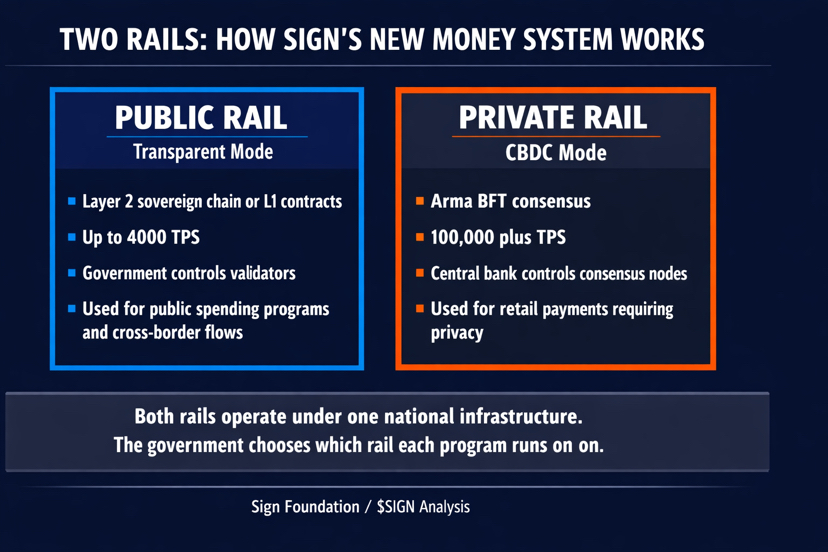
the architecture is a dual-path system. a public blockchain approach for transparency-first programs, government spending that needs public accountability, cross-border interoperability, open verification. and a private blockchain approach for confidentiality-first flows, retail CBDC transactions where strong privacy protections are required.
the private rail runs on Arma BFT consensus. 100,000 plus TPS. immediate finality. namespaced into wCBDC for wholesale institutional flows and rCBDC for retail with high privacy, potentially ZK-based. the central bank controls the consensus nodes directly.
that last part is worth sitting with.
in a traditional banking system, a central bank influences monetary conditions through interest rates, reserve requirements, open market operations. indirect tools. the money itself, once issued, moves through a system the central bank doesn’t fully control.
in the S.I.G.N. model, the central bank runs the nodes that produce the blocks that settle the transactions. the money doesn’t just move through infrastructure they influence. it moves through infrastructure they operate.
the bridge between the private CBDC rail and the public stablecoin rail is where the policy controls become most visible.
a conversion from private CBDC to public stablecoin requires compliance checks, identity verification, AML and sanctions screening, rate and volume controls per identity per institution per day, and emergency pause capability. atomicity is required, no partial completion. every conversion emits a signed evidence artifact with the ruleset version and hash that governed it.
the documentation describes these as security requirements. they are also control mechanisms.
rate and volume controls per identity mean the system knows exactly how much any individual is converting and can enforce limits. emergency pause means conversion can be stopped entirely. the evidence logging means every action is permanently attributable.
for a government running a legitimate public benefit program, these are exactly the right tools. the audit trail is real. the controls prevent abuse. the privacy protections keep sensitive citizen data off public rails.
the same tools in a different governance context are something else entirely.
#SignDigitalSovereignInfra $SIGN

what @SignOfficial built is technically correct for the use case it describes. sovereign infrastructure that gives governments real operational control over their monetary systems without depending on foreign platforms. the Kyrgyzstan deployment proved it works at a national bank level. the Middle East is the next logical market because the Gulf states have exactly the right profile, stable institutions, strong digital economy ambitions, and a genuine need for infrastructure they own.
the documentation is honest about what the system does. it doesn’t hide the policy controls. it documents them in detail and frames them as features for responsible sovereign deployment.
what i keep thinking about is the gap between the system as designed and the system as deployed across a diverse set of sovereign contexts. the controls are documented. the governance that determines how those controls get used is not a protocol question. it’s a political one.
programmable money infrastructure that gives responsible governments precise control over national monetary systems, or a configurable control surface that outlasts the specific governance context it was designed for?