
Every time Binance announces a new coin, the price rises dramatically. By the time you see the announcement and rush in, it's often already at someone else's selling price.
The real Alpha is hidden in the on-chain data before the coin listing announcement.
In today's article, I will combine the official investment records of Binance Labs (now renamed YZi Labs) and observable on-chain signals to help you build a 'new coin listing prediction framework.' It's not metaphysics, it's not insider information; it's a methodology that anyone can replicate.
First, clarify: how does a coin get listed on Binance?
Many people think that listing on Binance is simply 'the project party pays, Binance lists the coin.' The reality in 2025 is much more complex. Binance currently has a clear progressive listing path:
YZi Labs investment → Testing in Binance Alpha → Launchpool/Futures testing → Official Spot listing
Every step is a filter. Projects that can complete the entire process account for less than 2% of the total applications.
🔑 Key understanding: YZi Labs' investment behavior is the "zero-step signal" of the entire chain.
Two, YZi Labs: The choice of a $1 billion fund is the strongest preheating signal.
YZi Labs (formerly Binance Labs) manages about $10 billion in assets and has invested in over 285 projects, personally led by Binance co-founder He Yi, with CZ deeply involved in investment decisions.
Its investment record is itself a "potential listing checklist".
📊 Recent key investment overview:
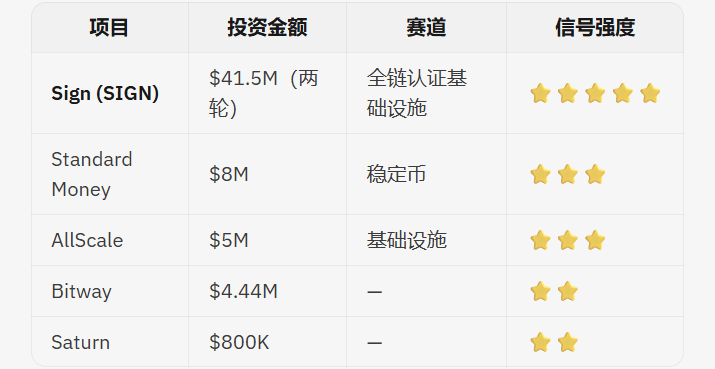
What does it mean for a project to be invested in twice by YZi Labs?
After reviewing 285 investment cases from YZi Labs, there are only a handful of projects that have led two rounds of investment totaling over $40 million within 9 months. This is not ordinary "optimism"; it is a strategic bet.
🔑 Practical advice: Regularly pay attention to the investment trends disclosed by YZi Labs. When a project receives continuous investments, add it to your focus observation list.
Three, the five core signals of on-chain preheating
After YZi Labs invests in a project, observable signals usually appear on-chain before it officially lands on Binance. I will take Sign ($SIGN) as a case and break it down one by one:
📡 Signal 1: Abnormal aggregation of smart money addresses
Performance: Multiple previously inactive new wallets start to buy the same token within a short period, with large purchase amounts, low frequency, and dispersed timing.
Principle: Large funds avoid slippage and exposure by splitting positions across dozens of addresses and building positions in batches. On-chain analysis tools can identify these associated wallets through "address clustering algorithms"—they often share the same Gas price preferences, trading time windows, and sources of funds.
How to look at it: Use on-chain analysis tools to track changes in the number of addresses holding >$10M. If the number of "whale addresses" for a token suddenly increases without any positive news, this is a signal.
📡 Signal 2: Continuous amplification of net outflows from exchanges
Performance: A large number of tokens are withdrawn from exchanges to private wallets, and the net outflow from exchanges continues to be negative.
Principle: Whales withdrawing coins from exchanges means they do not intend to sell in the short term—they are "locking up". This is one of the most classic bullish signals.
Reverse Signal: If you see a large amount of tokens flooding from private wallets into the exchange, it may indicate that selling pressure is about to arrive. In March 2025, YZi Labs deposited 134 million ID tokens (approximately $6.63 million) into Binance, sparking market speculation about their sell-off.
🔑 The net outflow from exchanges is a directional indicator, and net inflow is an alarm. Both need to be monitored.
📡 Signal 3: Abnormal surge in DEX trading volume (without news catalysts)
Performance: A token's trading volume on DEXs like Uniswap and PancakeSwap suddenly increases by 3-5 times, but there are no positive news on Twitter, Discord, or news outlets.
Principle: This "silent volume increase" often indicates that informed funds are laying out in advance. Because once the Binance listing announcement is made, the liquidity on DEX will be instantly drained, so smart money must complete their positions before the announcement.
Practical operation: It is particularly important to focus on the DEX anomalies of BEP-20 tokens (tokens on the BNB chain)—the ecological link between Binance and the BNB chain means that BEP-20 tokens have a higher probability of listing on Binance.
📡 Signal 4: "Paving" listing on small and medium exchanges
Performance: A token will first appear on small and medium exchanges like Gate, Bybit, and KuCoin before officially listing on Binance.
Principle: This is not a coincidence, but a strategy. Project parties establish initial liquidity and price discovery mechanisms through small and medium exchanges while accumulating trading data to provide a "report card" for Binance's listing review.
Pattern: If a project invested by YZi Labs goes live on more than three small and medium exchanges within three months, the probability of it landing on Binance will significantly increase.
📡 Signal 5: Appearance in the Binance Alpha zone
Performance: The token appears in the Binance Alpha section (the early projects area within Binance).
Principle: Binance Alpha is Binance's official "testing ground". Projects are tested here with real user transactions, and the Binance team will monitor their trading volume, community growth, and project milestone completion.
Key Data: The approval rate for Binance Alpha applications is less than 2%. Being able to enter Alpha means that it has already passed Binance's compliance review, technical security audit, and team background check.
🔑 The Alpha zone is the last waiting room before the official listing on Spot. Projects that enter Alpha are worth focusing on.
Four, case breakdown: The preheating signal timeline of $SIGN
Sign is currently one of the heaviest invested projects by YZi Labs, and we use it to validate the aforementioned framework:
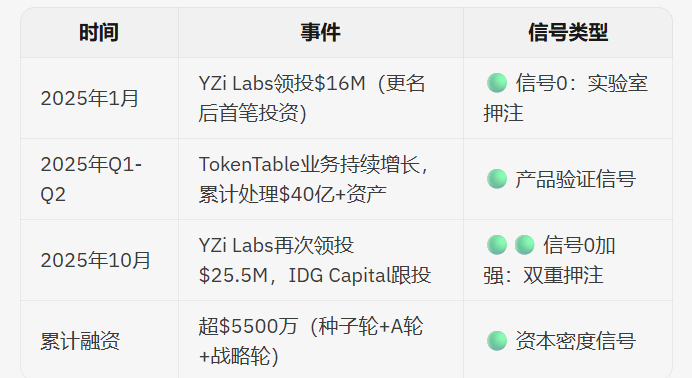
Notable details:
The first investment after YZi Labs changed its name was given to Sign—this is a "good start" level signal, indicating that Sign has a very high priority within YZi Labs.
Leading two rounds of investment within 9 months, totaling $41.5M, this investment density is extremely rare among YZi Labs' 285 projects.
Sign's product matrix (EthSign signing + Sign Protocol certification + TokenTable distribution) has already generated real revenue, not just a narrative project.
Five, practical framework for ordinary people: three-step selection method
Not everyone has time to monitor on-chain data. Here is a simplified selection process for you:
Step 1: Lock in YZi Labs' new investments 🎯
Follow YZi Labs' official announcements and investment databases like Crunchbase/RootData
Key markers: projects with investment amounts >$10M, projects that have been continuously invested in
Step 2: Monitor on-chain anomalies 📊
Use tools like Arkham and Nansen to track smart money addresses
Focus on net outflows from exchanges, abnormal surges in DEXs, and changes in the number of whale addresses
Set alerts: Trigger when the concentration of whale holdings in the target token suddenly rises
Step 3: Observe the progress of the listing path 🛤️
Has it been listed on small and medium exchanges? How many?
Has it appeared in the Binance Alpha zone?
Is community activity, developer activity, and partner announcements accelerating?
When three signals overlap, it is a moment worth focusing on.
Six, risk reminders (this section must be read)
⚠️ On-chain signals do not equal certainty. Not all projects invested by YZi Labs will list on Binance Spot. Historically, there have been cases where invested projects ultimately performed poorly.
⚠️ Whale monitoring itself has become a "self-fulfilling prophecy". When too many people focus on the same whale wallet, herd behavior itself will drive the price, and this push may have nothing to do with the fundamentals.
⚠️ On-chain transfers exceeding 5000 BTC on a single transaction will average a 2.7% price fluctuation within 24 hours. However, most transfers between wallets are just routine asset management and do not carry trading signals.
⚠️ Always combine with fundamentals. On-chain signals are "techniques", while project quality is "principle". A project with no users and zero revenue, even with strong on-chain signals, may still be a trap.
Conclusion
In the matter of listing tokens on Binance, the information gap between ordinary people and smart money is narrowing. On-chain data is public, analysis tools are free, and YZi Labs' investment records are transparent.
You don’t need inside information; what you need is a systematic observation framework and sufficient patience.
Token listing announcements are results, while on-chain signals are processes. Learn to understand the process, and you will see results earlier than 90% of people.
💬 What other on-chain preheating signals have you observed? Let's discuss your findings in the comments.
📌 Save this article, and next time you see a new investment from YZi Labs, check against the framework.