

I think a lot of people still look at crypto through the wrong lens.
They focus on speed, fees, liquidity, or whatever token happens to be trending that week. But the deeper issue has always been trust. Not the emotional kind. The structural kind. Who can verify a claim? Who can prove eligibility? Who can distribute value fairly? Who can check whether a digital action actually happened the way it was supposed to?
That is where SIGN starts to matter.
At first glance, it is easy to reduce the project to a simple label like credential verification or token distribution. But that framing feels too small. The more I look at it, the more SIGN appears to be chasing a larger role: becoming infrastructure for verifiable claims, structured evidence, and distribution logic in digital systems that increasingly need to coordinate across wallets, apps, institutions, and jurisdictions.
That is a serious ambition. And it is also why the project deserves real evaluation instead of lazy praise.
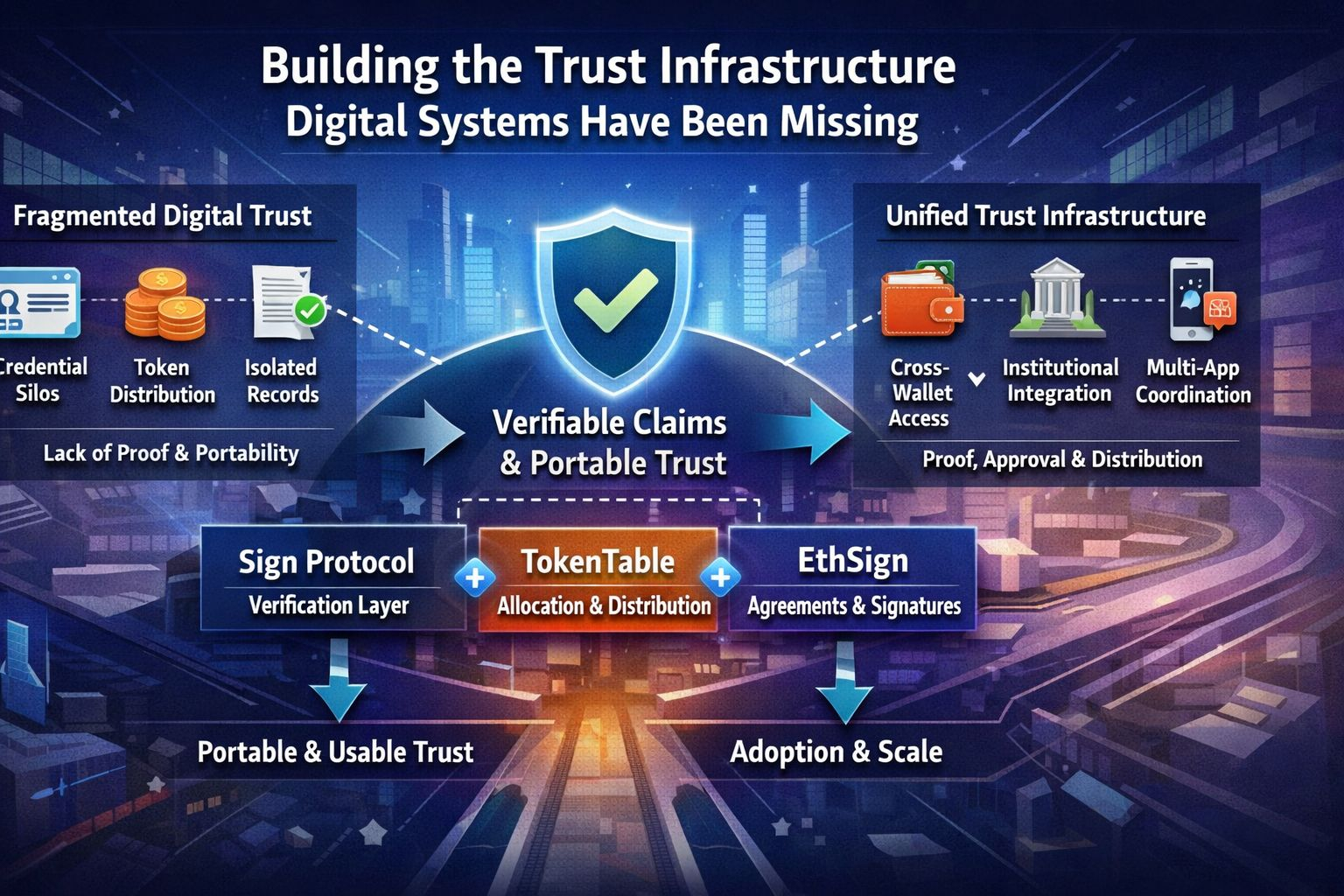
The strongest part of SIGN’s design is that it focuses on a problem most systems still handle poorly. Digital activity creates records everywhere, but records alone are not enough. They often lack context, proof, and portability. A user may have done something valid in one environment, yet the proof of that action is difficult to carry into another. Identity gets fragmented. Eligibility has to be rechecked. Rewards have to be reissued. Trust keeps getting rebuilt from scratch.
SIGN is trying to solve that inefficiency by turning claims into structured, verifiable objects. That sounds technical, but the idea is actually pretty practical. Instead of leaving trust buried inside closed databases or isolated apps, it tries to make trust readable, portable, and usable across systems. That matters because digital coordination breaks down when every platform becomes its own separate source of truth.
What makes the project more interesting is that it is not built around one single use case. That can be a strength if executed well. Sign Protocol acts as the evidence layer. TokenTable connects that trust layer to allocation and distribution. EthSign extends the ecosystem toward agreements and signatures. When you put those pieces together, the broader strategy becomes clearer: SIGN is trying to build a stack where verification is not separate from action. Proof, approval, and distribution can exist inside one connected system.
That is a smarter positioning strategy than launching a narrow app and hoping users show up.
Still, broad ambition creates a higher burden. It is one thing to say you support identity, capital, and digital coordination. It is another to become the default infrastructure those systems depend on. Crypto is full of projects that sound powerful in theory but never become indispensable in practice. So the real question is not whether SIGN has a compelling narrative. It does. The real question is whether it can build enough adoption and dependency that developers, institutions, and platforms genuinely need it.
This is where some of the adoption signals become important.
SIGN has real product surfaces, and that matters more than polished branding. Token distribution infrastructure is not glamorous work, but it is operationally meaningful. If a project has already handled large-scale allocations and distribution workflows, that says something useful. It suggests the system is being trusted in places where mistakes are expensive, public, and difficult to hide. That gives SIGN more credibility than the average infrastructure project that lives mostly in whitepapers and community threads.
But adoption numbers in crypto always need to be read carefully.
Big distribution volume sounds impressive, yet volume alone does not prove durable network effects. Sometimes a product gets used because it is convenient for a moment, not because it has become foundational. The key test is whether usage compounds. Do teams come back? Do developers build around it? Do institutions integrate it deeply enough that replacing it becomes painful? That is the line between a useful service and actual infrastructure.
I think SIGN’s core advantage is that it understands trust as workflow, not just identity.
A lot of competing projects stay stuck in one corner of the problem. Some focus only on credentials. Others focus only on signatures. Others focus only on distributions. SIGN seems to recognize that real digital coordination usually needs all three. A claim has to be defined. A proof has to be issued. An action has to follow from that proof. Value may then need to be distributed according to those verified conditions. That end-to-end logic is where the project feels stronger than many of its peers.
The token side, though, deserves a more skeptical look.
This is where many infrastructure stories become less clean. A protocol can be useful without its token capturing much of that value. That is a harsh truth in crypto, and it applies here too. If SIGN the token is central to usage, access, or economic coordination, then long-term alignment becomes easier to defend. If not, there is always a risk that the ecosystem grows while the token remains more symbolic than essential. That does not mean the token has no role. It means the burden is on the network model to show why activity, adoption, and token relevance will tighten together over time rather than drift apart.
That is especially important in projects with large total supply structures. Even when market cap looks modest, future dilution can still shape sentiment, incentives, and long-term holder expectations. So the investment case and the infrastructure case are not automatically the same thing. A good product does not always produce a strong token outcome. Serious analysis has to keep those two ideas separate.
There is also an execution risk that comes with SIGN’s expanding scope.
The project now touches evidence, signatures, identity-linked workflows, and token distribution. On paper, that creates a powerful ecosystem. In practice, it can also create strategic blur. The market usually rewards clarity. If SIGN tries to do too much at once, it may become harder for outsiders to understand what the core wedge really is. And in infrastructure, clarity matters because developers and institutions usually adopt the product they can explain internally with the least friction.
Even so, I would rather watch a project stretch toward a larger infrastructure role than settle for a shallow narrative.
What keeps SIGN interesting to me is that it is trying to address a real weakness in digital systems: the absence of portable trust. Not just identity. Not just payments. Trust itself. The ability to verify something once and make that verification usable again in meaningful ways. If that layer becomes reliable and widely adopted, it could quietly sit beneath a lot of systems people use without even noticing it.
That is the kind of infrastructure that often matters most.
So my read is fairly simple. SIGN has a stronger foundation than many projects in its lane because it is aimed at an actual coordination problem, not an invented one. Its product structure makes sense. Its broader ecosystem strategy is more thoughtful than it first appears. Its usefulness is easier to imagine than its inevitability. And that last distinction matters.
Because the future of SIGN will not be decided by whether the idea sounds important.
It will be decided by whether digital systems begin to treat verifiable evidence and programmable distribution as something they cannot operate without.
#SignDigitalSovereignInfra @SignOfficial $SIGN
