
I read that whole framing again and had the same reaction at first. It sounds like something overengineered, like we took simple ideas and wrapped them in layers of complexity until nobody fully understands what’s going on anymore.
But then I tried to break it down the way $SIGN seems to be doing, and it actually comes back to two very basic questions. Who are you, really… and who is supposed to receive what?
And somehow those two questions are still not solved cleanly anywhere.
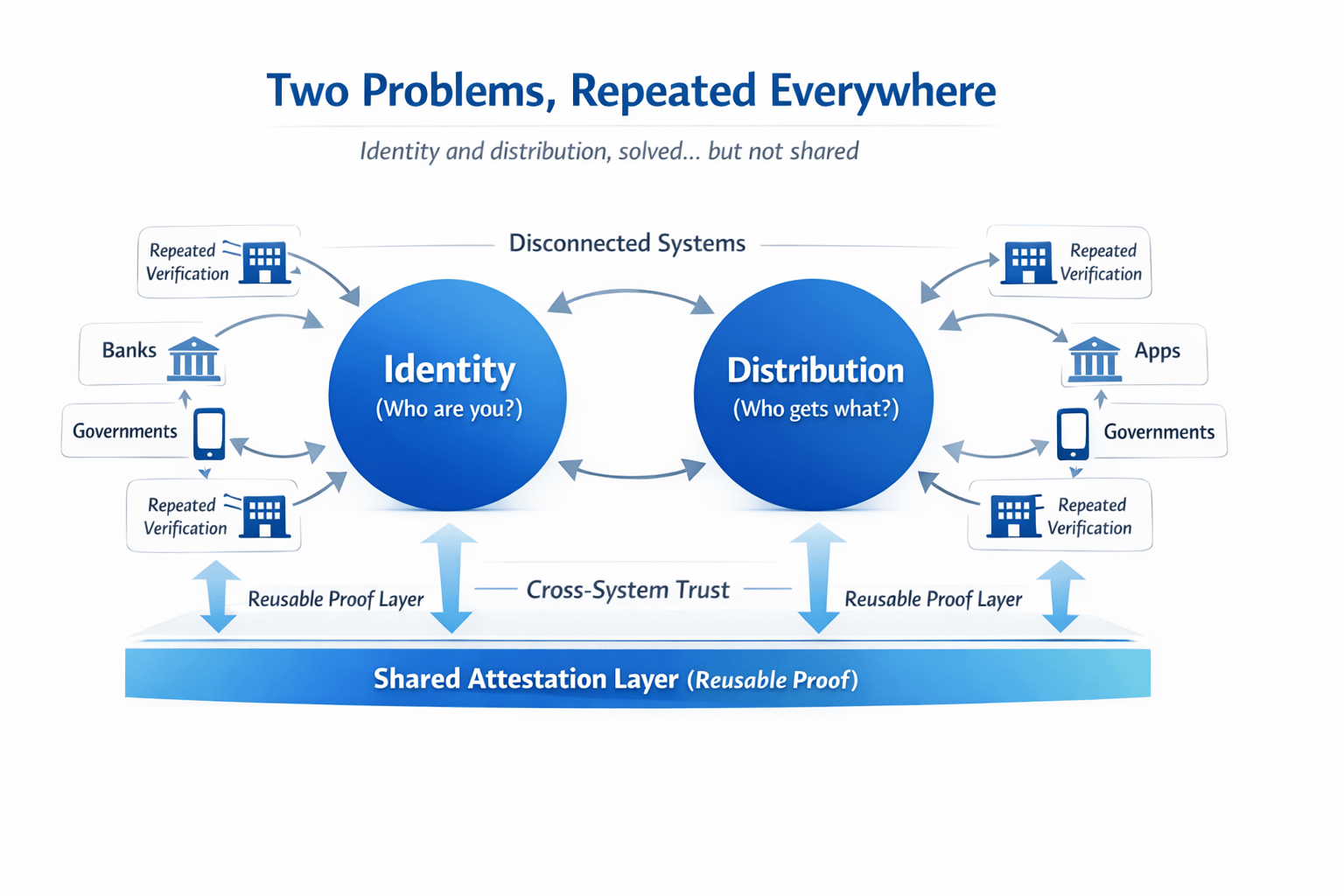
The weird part is we didn’t start from zero. Systems already exist. Identity systems, payment systems, distribution programs. They all work in isolation. But none of them really connect in a way that lets one system trust what another has already verified. So everything gets repeated. You prove who you are again, submit documents again, wait again.
It feels inefficient, but also kind of fragile.
What Sign is trying to do, at least how I understand it, is not to replace those systems directly. It’s to sit underneath them and standardize the “proof” itself. So when something gets verified once, that result becomes reusable. Not as a PDF, not as a database entry locked somewhere, but as something like an attestation that other systems can query and trust.
Same with distribution. Instead of sending tokens or funds and then figuring out later what happened, they structure the whole process upfront. Who gets what, under which conditions, and every step produces evidence as it executes. Not logs you reconstruct later, but something that exists as part of the system.
I think that’s the part that shifts the perspective for me. The problem isn’t that we don’t have systems. It’s that those systems don’t share a common way to express truth.
Still, I don’t think this magically fixes everything. Coordination across different organizations, standards adoption, legacy systems… that’s where things usually get stuck. And it’s not a small hurdle.
But I get why Sign is approaching it this way. Instead of adding more layers on top, they’re trying to define a shared layer underneath.
Whether that simplifies things or just adds another layer… I’m still figuring that out.