
The more I think about regions like the Middle East, the more I feel like people focus too much on capital and not enough on what actually slows things down. There’s no shortage of money there. UAE, Saudi, big funds, big projects… that part is already solved.
But speed? That’s a different story.
Because a lot of the friction isn’t visible. It sits in trust infrastructure.
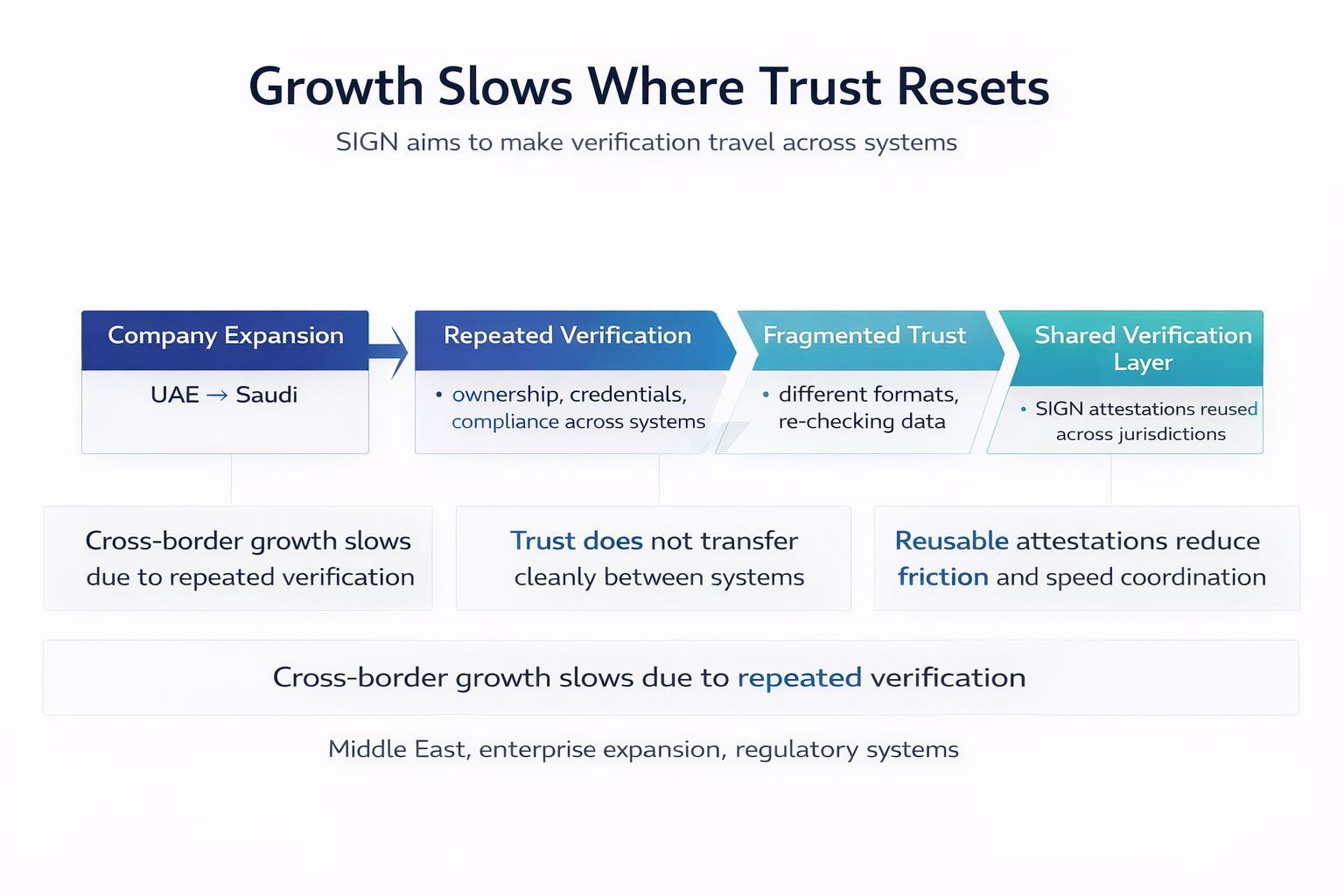
Take something simple. A company in Dubai trying to expand into Saudi Arabia. On paper, it sounds straightforward. In reality, it turns into a chain of verification. Ownership, credentials, compliance… and then the same information gets checked again in another system, another jurisdiction, another format.
Not because it failed. Just because it doesn’t carry over cleanly.
That repetition is where things slow down.
Same thing with cross-border deals. Even when both sides are well-funded and serious, there’s still this layer of document validation, identity checks, legal confirmations. Each step adds time. Adds cost. And sometimes introduces inconsistencies just because systems don’t talk to each other properly.
That’s where $SIGN tarts to make more sense to me.
Not as something flashy, but as a layer that tries to standardize how verification works. The idea is pretty simple: if something is already validated, it shouldn’t need to be rebuilt from scratch every time it moves into a new context.
And if that actually works, the impact is kind of obvious.
Expansion gets faster because companies don’t keep re-proving the same things. Regulatory processes get smoother because data is consistent. Capital moves with less friction because trust doesn’t have to be reconstructed every step of the way.
It’s not about making systems faster in isolation.
It’s about removing the parts that make them slow.
What I find interesting is that this kind of infrastructure doesn’t grow through hype. It grows quietly, by becoming useful. Once it’s embedded into workflows, it becomes hard to replace, not because of marketing, but because everything starts depending on it.
That’s why I don’t really see SIGN as just another token.
It feels more like a layer that sits underneath everything else. And if regions like the Middle East keep pushing for large-scale coordination across borders and institutions, that layer becomes more relevant over time.
Still early, obviously. A lot depends on adoption, standards, and whether different systems actually agree to share trust in this way.
But direction-wise, it doesn’t feel random.
It feels aligned with where things are already trying to go.