

When monitoring projects, I have a habit of first finding reasons to refute my own assumptions. It's not to be dissenting, but rather because I believe only logic that can withstand repeated scrutiny deserves a second glance; if it can't, the sooner I discover it, the sooner I can avoid pitfalls. When monitoring projects, the question I repeatedly ask myself is very simple: The sovereignty narrative has been discussed in the market for so many years, but how many have actually materialized? I've seen many projects labeled "national-level infrastructure," but they either remain at the conceptual stage or progress at a pace so slow it exhausts one's patience.
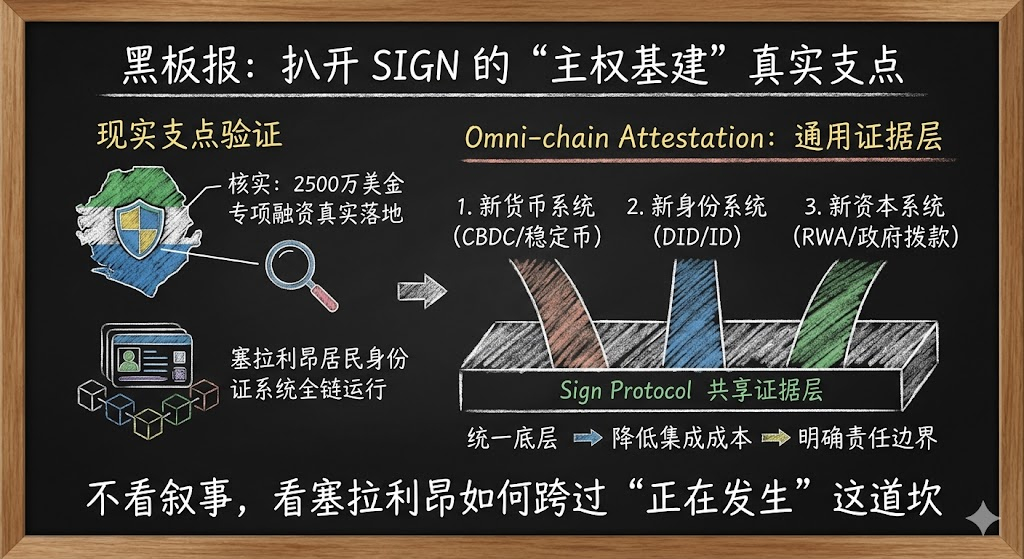
Until last week, I saw some information that changed my perspective on this issue. $SIGN Sierra Leone secured $25 million in dedicated funding to support the construction of its national blockchain infrastructure, and its resident identity card project is already fully operational on this infrastructure. I verified this and confirmed it was a real-world case before I started to seriously re-examine the project. I'm a rather principled person, and I trust publicly verifiable progress more than just storytelling. The Sierra Leone case made me adjust my previous observation framework. Previously, I was quite wary of sovereignty narratives, always worried that the market would overinterpret "contact" and "pilot projects" as "imminent large-scale implementation," only to be swayed by emotions when real progress occurred. But this time is different; the resident identity card system is truly running, which crosses the hurdle from "possible" to "actually happening." Although it's currently only one country, the underlying logic at least has its first verifiable point of reference. #Sign地缘政治基建 This statement has become more concrete for me now. This is not a vague concept, but rather a geopolitical need that a sovereign state has begun to respond to with a concrete system.
To elaborate on the omni-chain attestation of the Sign Protocol, I found its most interesting aspect is that it addresses a sufficiently foundational and universal need: who is who, whether something is true, under what rules it holds, and whether a third party can independently verify it. This logic appears repeatedly in scenarios like national identity verification, cross-border compliance, institutional qualification verification, and asset distribution. The project extends this framework into three tracks: a new currency system, a new identity system, and a new capital system, using the Sign Protocol as a shared evidence layer. This architecture does not build three separate systems but instead thickens and standardizes the common foundation. For institutions, the unified foundation reduces integration and maintenance costs, and clarifies responsibility boundaries, which are all points that will be seriously considered in actual decision-making.
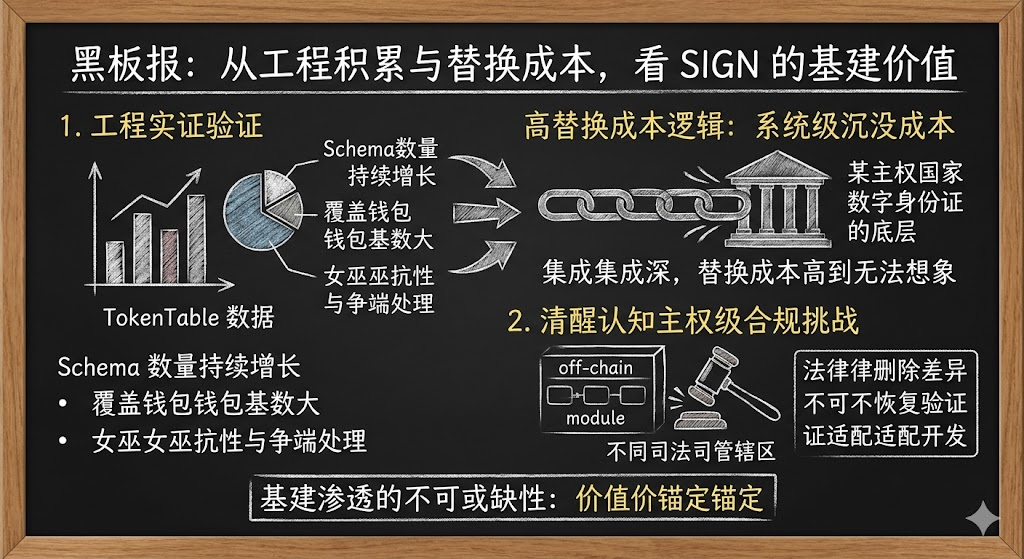
Data from TokenTable indicates that there is indeed something on the engineering level. It has already processed a large amount of asset distribution, covering a significant number of wallets, and the growth in the number of schemas and attestations is also quite noticeable. This is not a demonstration of concepts but an execution capability that has been validated through real business at high intensity. To handle this scale, issues like witch attacks, rule conflicts, cross-chain differences, and dispute resolution must be addressed in a solid manner. This engineering accumulation is a part of the project that is relatively hard to replace easily.
Of course, I am not foolish enough to overlook the uncertainties. There are indeed objective gaps in the supply structure, and the amount unlocked in the future is a risk variable that needs to be monitored. Expanding from a single case to more countries, from a single scenario to multi-track comprehensive applications, the cycles are generally counted by years, and the market pace may be difficult to completely align. The information disclosure of sovereign-level progress inherently has asymmetries; when the next landing will occur and the scale is often hard for observers to know in advance. These are all points I repeatedly remind myself of; maintaining clarity is much more important than simply getting carried away.
Recently observing the macro environment, I can feel that financial infrastructure is being assigned more roles in the context of multipolarity. In some regions, the uncertainty of traditional clearing channels has led to a stronger demand for self-controlled digital infrastructure. This is also why I pay more attention to projects like Sign, which aims to create a compliant, sovereign attribute evidence layer infrastructure. From the perspective of sovereign nations, regions like the Middle East want to maintain independent control while also needing solutions that comply with international regulations during their digital transformation. Sign's approach to aligning with relevant regulations indeed has its applicability in this context. The team's actual work focus seems to lean more towards cooperative verification with government levels rather than purely market promotion. In terms of valuation, I tend to think from the perspective of system-level sunk costs. If a country's digital identity or fund distribution system is deeply integrated with such protocols, the replacement costs would be very high. Its value may anchor more on the indispensability of infrastructure penetration rather than short-term emotional fluctuations. Moreover, in actual scenario testing, I noticed a challenge worth paying attention to: different jurisdictions have varying legal definitions for data 'deletion' or 'right to be forgotten'. Sign's current off-chain architecture may still need further development of verifiable adaptation modules to meet strict requirements like 'irreversible' when addressing such sovereign-level compliance needs. This is not just a simple technical patch but relates to the admission criteria for truly serving sovereign-level clients. If this direction can be realized, its potential in connecting different digital sovereign systems will become clearer.
Overall, after the emergence of the Sierra Leone case, my observation framework for the project has shifted from 'direction recognized, waiting for verification' to 'logic has the first real pivot, but more verifiable progress is needed to strengthen it'. I am currently focused on two points: first, whether there is a second publicly verifiable sovereign-level deployment case; second, whether the actual processing and calling volume within the ecosystem can continuously reflect real growth instead of being propped up by short-term activities. In this environment, projects that provide certain infrastructure are worth ongoing observation. Each real sovereign cooperation that materializes may clarify the practical value of the relevant systems a bit more. The above is my personal research sharing and subjective judgment for reference only and does not constitute any investment advice. The market has risks; independent thinking and cautious decision-making are essential. (This article is a platform task and does not constitute any investment advice.)