On March 24th, when I saw the listing announcement on Coinbase, I was stunned for several seconds.
It’s not that the listing itself is so rare, but just a month ago, this guy had just dropped to a bottom of 0.023 dollars, with a screen full of mockery saying 'another air project gone to zero'. I didn't take it too seriously at the time, after all, among projects claiming 'government cooperation', nine out of ten end up leaving no trace.
As a result, these past two weeks @SignOfficial have taught me a lesson.
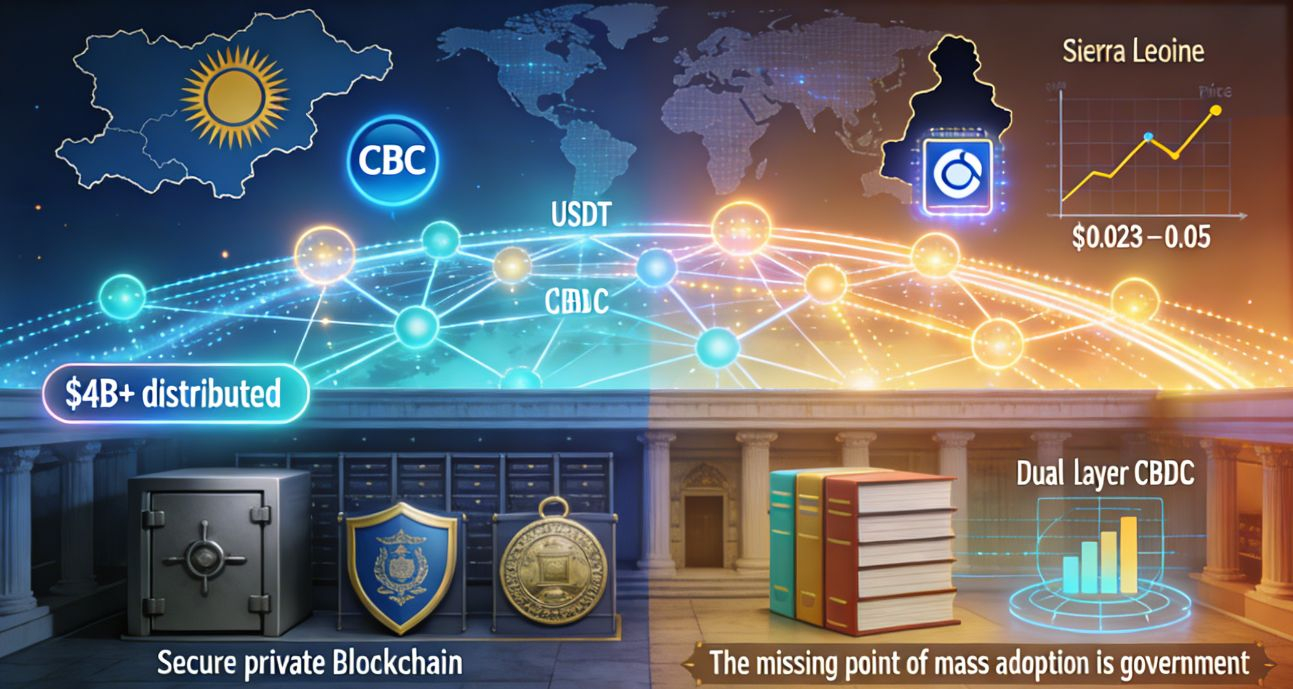
Starting in early March, the price of $SIGN surged from 0.024 to around 0.05, more than doubling. I went back to closely examine what it had done, and the more I looked, the more I felt I might have underestimated it before.
Do you know what founder Yan Xin said? 'The missing point for mass adoption is the government.'
Two years ago, I would have scoffed at this - isn’t web3 all about decentralization and bypassing the government? But looking back now, stablecoins have a market value of hundreds of billions, and the real large-scale adoption has emerged from places collaborating with the government. Kyrgyzstan wants to develop a CBDC, and Sierra Leone wants to establish a digital identity system, all looking for SIGN.
This is interesting.
Most blockchain projects have an attitude towards the government of 'stay out of my way', while SIGN directly turns it around - 'Let me help you build.' This perspective shift is crucial. The dual-layer CBDC architecture it is working on uses a private chain for the central bank to settle, while the upper layer uses a public link for stablecoins and global liquidity. The control the government wants is retained, and efficiency can also be improved.
Moreover, it is indeed not just a pie in the sky. The distribution amount running on the TokenTable has exceeded 4 billion dollars, and the digital identity project in Sierra Leone is also progressing. To be honest, this listing on Coinbase feels more like the market's delayed response to the realization that 'this thing actually has real business operations.'
Of course, I tend to be cautious when it comes to investing. Now that the price has risen, I won’t chase after it, but SIGN has already made it into my top three watchlist. The reason is simple - during this cycle, everyone is looking for 'things that can land', and SIGN is one of the few projects that can simultaneously articulate 'government compliance' and 'blockchain efficiency.'
There’s another detail you can pay attention to. Founder Yan Xin said that Kyrgyzstan hopes for a structure of 'one CBDC plus one stablecoin', to be built through Sign, and after being listed on Binance, to exchange with USDT. The trading volume and liquidity demand involved are the true value support for $SIGN.
The Coinbase listing is just a signal; the real narrative is - when more and more sovereign countries start using this infrastructure to issue currency, identity, and settle accounts, the pricing logic of that token will be on a completely different level than it is now. To summarize in one sentence: this wave of SIGN has made me realize that the narrative of geopolitical infrastructure might really not be just hot air.#Sign地缘政治基建