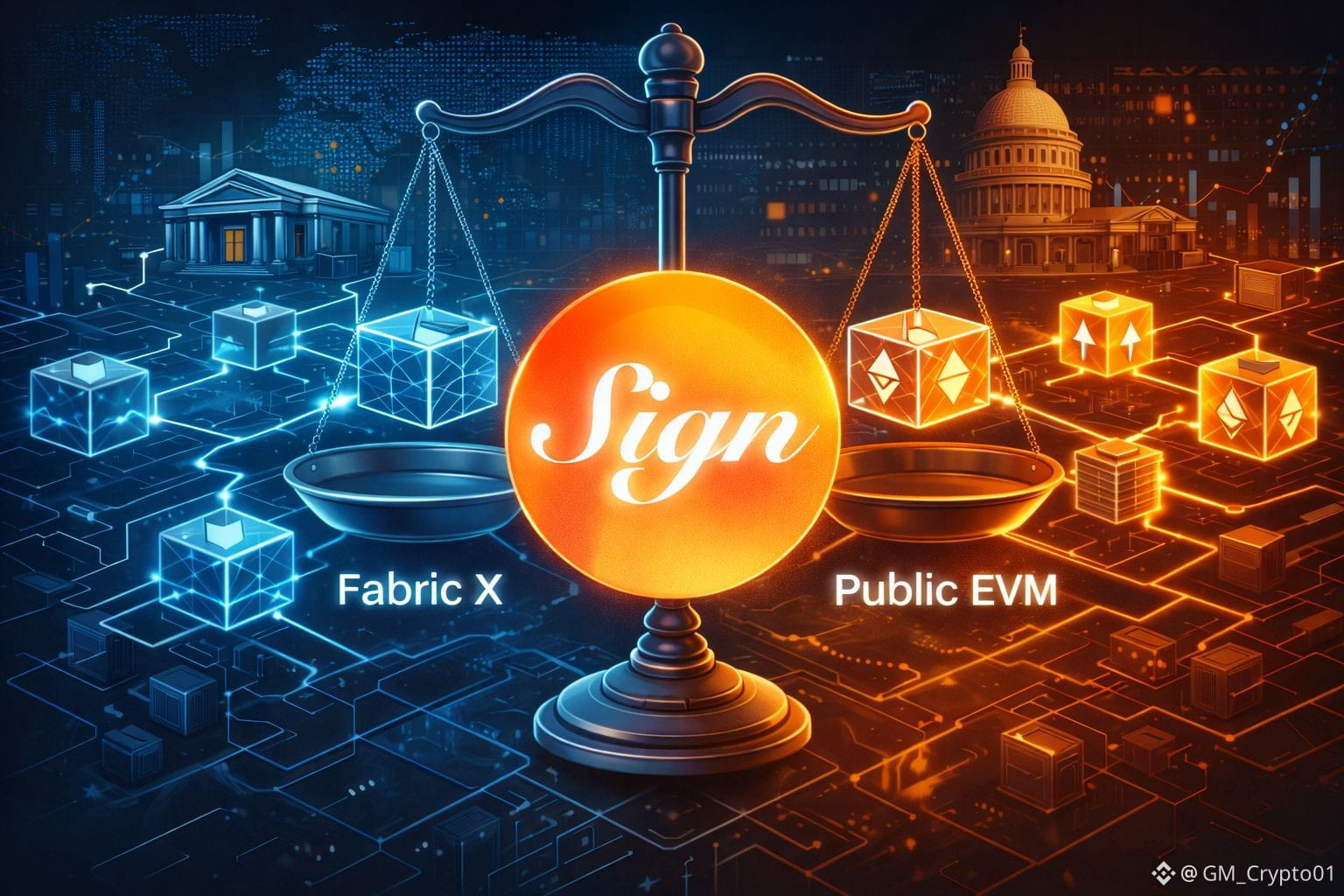
When I first looked at this, I assumed the answer would turn on speed. That is the shallow crypto habit now, compare chains by throughput, fees, and composability, then call the fastest option “better.” What changed my view was noticing that a CBDC is not really choosing a venue for speculation. It is choosing where authority, privacy, and audit rights sit when money becomes public infrastructure.
That shift matters because public EVM chains and Fabric X are solving different anxieties. On the surface, a public chain looks attractive because it is open, legible, and already connected to liquidity. Underneath, that same openness creates exposure, and for retail money exposure is not a small bug. SIGN’s own whitepaper is pretty explicit here: the private-chain path is built around namespace separation, where wholesale, retail, and regulatory activity do not all live in the same visible room.
So I keep landing on a narrower thesis. If the question is whether SIGN can place a CBDC inside the part of the system where predictability matters more than reach, Fabric X looks better suited than a public EVM chain. Not because it is newer, and not even mainly because it is faster, but because it lets the issuer decide who validates, who sees, and when settlement is final. That is a coordination advantage more than a product feature.
The numbers reinforce that. SIGN’s reference specs put the EVM-based sovereign chain at up to 4,000 transactions per second with finality after 1 to 5 block confirmations, while Fabric X is described at 100,000+ TPS with immediate finality on block commitment. At a glance that looks like a performance comparison. Underneath, it is really about operational certainty, which is closer to what a central bank needs when balances, reversibility, and regulatory timing all carry legal weight.
What becomes visible here is that privacy is not being treated as secrecy for its own sake. In SIGN’s Fabric X model, wholesale transfers stay closer to RTGS-style transparency, retail transfers get higher privacy, and regulators keep defined access through a separate namespace. In plain terms, the system is trying to avoid the common mistake of making every participant equally visible just because the ledger is shared. That enables cleaner boundaries, but it also introduces a risk, because trust shifts back toward governed access rules and whoever controls them.
There is a reasonable case for the opposite view. Public EVM systems still win where distribution, interoperability, and market access matter most. SIGN’s own framework more or less admits this by recommending public blockchain stablecoins for public services and social benefits, while reserving Hyperledger Fabric X CBDC for banking operations where privacy and regulation dominate the design.
Meanwhile the market is quietly telling us what capital prefers. Crypto’s total market cap sits around $2.36 trillion and Bitcoin dominance is about 56.01%, which usually means risk appetite is still concentrated in the asset seen as the cleanest collateral rather than in broad alt expansion. US spot Bitcoin ETFs have still accumulated about $56.1 billion in net flows overall, even though recent daily flow has turned uneven. That does not prove anything about CBDCs directly, but it does suggest that money is selecting for trustable structure before it selects for experimentation.
SIGN itself sits in a revealing middle ground. Its market cap is about $52.9 million against roughly $43.3 million in 24 hour volume, with 1.64 billion tokens circulating out of a 10 billion max supply. I read that less as maturity and more as a signal that the market is trading the possibility of infrastructure before the infrastructure is socially settled. And in that kind of market, the calmer design usually matters more than the louder chain.
So yes, for the core CBDC layer, Fabric X looks more suitable than public EVM, but mostly because it accepts constraints as part of money’s design.