
Many people have written extensively, yet they can't even figure out how the agreement actually 'makes money.' Do you think Saudi Arabia and the UAE (t-21) are desperately transitioning from a 'petro-economy' to a 'digital asset economy' by moving t-23 (central bank digital currency) and national-level identity verification onto the blockchain just for love and casually finding a public chain to run some data?
Kids, wake up. The financial lifeline of sovereign countries fears the most 'malfeasance' and 'tampering.'
🌍 The most profitable business in this world is monopolizing 'trust.'
The true value of the SIGN protocol in the Middle East lies not in how fast the TPS (transaction speed) is, but in the fact that it has created a "trust tollbooth" that the entire MENA (Middle East and North Africa) region cannot bypass.
Imagine that when Abu Dhabi institutions need to verify a sum of hundreds of millions of dollars (real-world assets), why should they trust anonymous verification nodes on the internet?
This is where the most terrifying value lies: the performance bond.
To become a node on the SIGN network that verifies credentials for governments or large organizations, you can't just make verbal promises. You must pledge a massive amount of tokens as collateral in the underlying smart contract. If a node dares to falsify credentials or fails to verify, the ruthless contract code will trigger instantly, confiscating or even destroying your deposit.
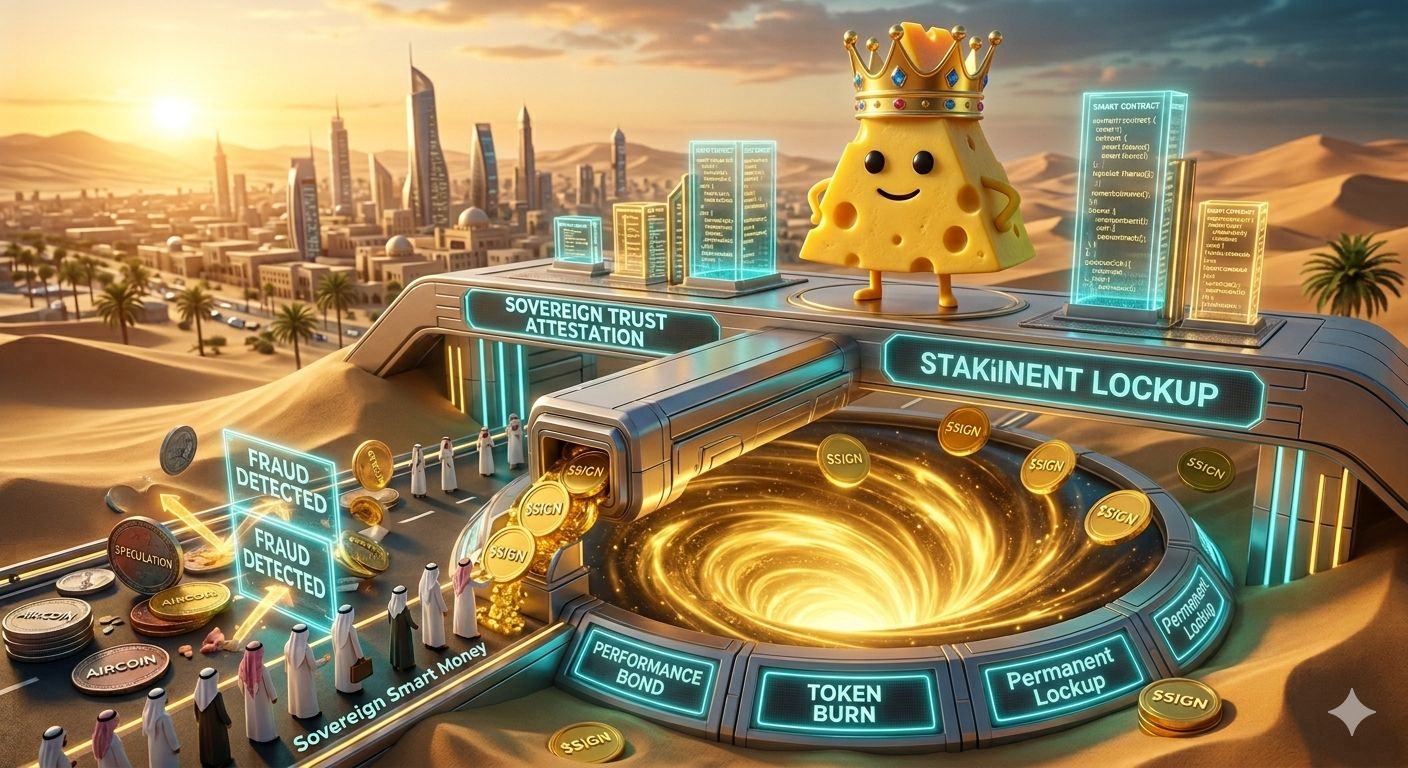
🕳️ Understanding Epic Deflationary Black Holes
What does this mean? It represents$SIGN It's not meant to be used as a speculative tool for retail investors to buy low and sell high!
As more and more government subsidies, cross-border settlements, and digital identity systems in the Middle East are integrated into this standard, global institutions and nodes must frantically buy up assets in the market and inject large amounts of $SIGN into contracts in order to handle these massive national-level businesses.
On one hand, there's the boundless expansion of demand brought about by the digital economic transformation in the Middle East; on the other hand, there's the passive locking up of funds by nodes in order to conduct business. This is a super deflationary black hole that drains market liquidity!
Stop trembling over those few K-lines that will unlock tomorrow. When an agreement becomes the "underlying fuel" and "toll" for the national trust infrastructure of the Middle East, its future growth potential is far beyond what retail investors can imagine.
After you finish this bite of cheese, think it over carefully.
👇 Follow the King of Cheese and see through the true nature of capital operations!
