
I didn’t expect to spend this much time thinking about verification systems. Usually they’re invisible something you deal with once upload a document maybe wait a few days and move on. But the more I looked into this campaign built around Sign Protocol the more I realized it’s trying to solve a problem that doesn’t stay solved.
In most systems trust is a one-time checkpoint. You prove who you are or what you’ve done and that proof just sits there. But in real life things change. Businesses lose compliance. Contributors stop contributing. Permissions expire quietly. And yet systems keep treating old proofs like they’re still alive.
This campaign seems to take a different approach. Instead of relying on a single identity or a one-size-fits-all credential it breaks trust into smaller reusable attestations. Not “who are you?” once but “what is true about you right now?” across different contexts.
That sounds neat in theory. In practice it’s messy.
Take something simple like a grant program. Normally you’d apply submit your background maybe link past work and hope someone reviews it fairly. But behind the scenes there’s always friction. Who verifies your contributions? How recent do they need to be? What stops someone from reusing outdated credentials?
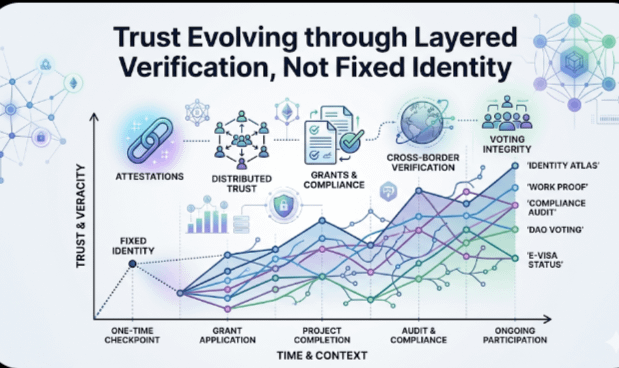
In this model the idea is that your contributions say completing a project passing an audit or being part of a community are attested by different parties. Not one central authority but multiple sources. A DAO might confirm your participation. A protocol might verify your technical work. A third party might attest to compliance or identity.
It distributes trust. But it also distributes responsibility.
And that’s where I start to hesitate.
Because now the question isn’t just “is this person verified?” It becomes “which attestations do we trust and why?” One system might accept a credential that another rejects. A verifier might be reliable today and questionable tomorrow. There’s no single anchor just a network of signals.
The same tension shows up in more serious use cases.
For regulatory records instead of a central registry you have attestations confirming business status approvals and audits. It’s flexible sure but it assumes that the entities issuing those attestations remain credible over time. If they don’t the whole chain weakens.
In voting the promise is even bigger secure private verifiable elections using cryptography. I get the appeal no manual counting no opaque processes. But elections aren’t just technical systems. They’re social ones. Trust isn’t only about math it’s about whether people believe the system is fair. And that’s harder to encode.
Border control and e-visa systems push this even further. The idea of verifying someone’s status without exposing their personal data is powerful. No unnecessary data sharing no centralized databases leaking sensitive information. But coordination between countries is already complicated. Adding cryptographic layers doesn’t remove that complexity it just reorganizes it.
Even automated agents something that sounds futuristic but is already creeping into workflows raise similar questions. If an agent is acting on behalf of a user what proofs does it carry? Who issued them? Who can revoke them if something goes wrong?
What I find interesting is that this campaign doesn’t try to eliminate these questions. It sort of leans into them.
Instead of pretending that trust can be simplified into a single identity it treats it as something layered contextual and constantly changing. You don’t get one badge that unlocks everything. You accumulate proofs and systems decide how to interpret them.
That’s more realistic. But it’s also harder.
Because now coordination becomes the real challenge. Not just verifying facts but agreeing on what those facts mean across different systems communities and jurisdictions. And that’s not something blockchain or cryptography can solve on their own.
Still I can see why this approach is gaining attention.
If it works even partially it could reduce a lot of the friction that exists today. Applying for grants could become less repetitive. Compliance checks could be faster and more transparent. Cross-border processes might feel less invasive. And maybe over time systems would rely less on static identity and more on living verifiable context.
I’m not fully convinced yet. There are too many moving parts and too many assumptions about coordination that haven’t been tested at scale.
But it’s one of the few approaches I’ve seen that actually acknowledges the problem instead of glossing over it.
And that alone makes it worth watching carefully.
@SignOfficial #SignDigitalSovereignInfra
