
If you listen to it, these systems are always described as very 'sophisticated', as if they are solving some macro problem. But when broken down, it essentially revolves around two extremely basic tasks:
Are you really you?
And who is the person receiving the money or access rights?
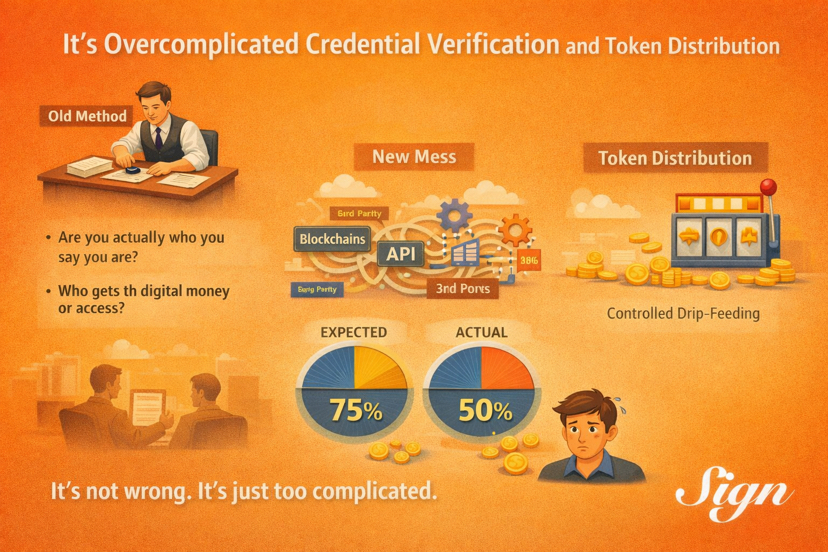
That's it. It's not magic, nor is it some groundbreaking breakthrough. It's just familiar verification processes… transferred to the digital environment and made more complicated than necessary.
In the past, everything was much simpler. One person sat behind a desk, checked documents, stamped, signed, and finished the job. Now, that position is replaced by a multitude of servers, APIs, different standards, and an ecosystem where each party understands it in their own way. The result is that instead of simplifying, we are complicating something that was already clear.
What about 'identity verification'? It sounds sophisticated, but at its core, it's: proving you're not lying. And you have to do this repeatedly, on every platform, every login, every time the system 'forgets' who you are.
In theory, everything is promoted as safe, optimized, standardized. But in practice, it is quite different. Systems connect through patchwork APIs, relying on third parties that no one really trusts completely. And somewhere, there's an engineer staying up late just to find out why a valid user is rejected simply because of a small data field mismatch.
The distribution of tokens is the same. It sounds appealing, as if the value is being allocated freely and fairly. But in reality, it resembles a controlled distribution mechanism. Someone sets the conditions, timing, criteria, and then builds an entire system to automate that.
When everything runs smoothly, no one complains. Token to the wallet, dashboard updates, everyone is satisfied.
But when problems arise, everything becomes apparent: delays, discrepancies, omissions. Users continuously reload the interface, waiting as if pulling the lever of a slot machine, hoping that the next time the number will appear correctly.
The hard truth is: the so-called 'global infrastructure' is not as seamless as it is described. It resembles a patchwork network, incomplete roads, strange toll booths, contradictory signs, built by many different groups, with almost no synchronization.
The problem lies not in whether it is bad or wrong. It's just that it is designed too complex compared to actual needs. And sometimes, it feels like the system is built to serve itself rather than the users.
And in the end, we all still have to use it, whether we understand it or not.