

Ihave been watching the Middle East's crypto and digital asset space closely for the last few years, and if there's one pattern that stands out, it's this the region doesn't lack ambition. From middle east Vision 2030 to the UAE's aggressive push into digital infrastructure, there is a clear sense that these economies are trying to leapfrog traditional development stages and land somewhere ahead of the curve.
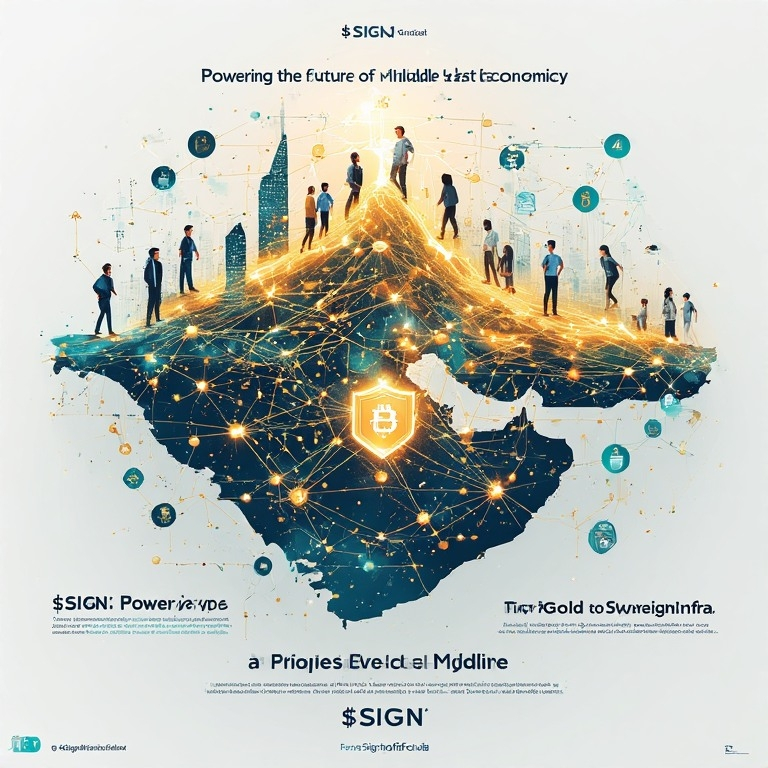
But ambition alone doesn't build sustainable systems. The harder question the one that keeps coming up in conversations with developers regulators and founders in the region is about trust. How do you build digital economies that are open enough to innovate yet secure and private enough to meet regulatory and cultural expectations.
That's where I started paying attention to Sign Protocol ($SIGN). Not because it's flashy but because it seems to be asking a different question than most crypto projects.
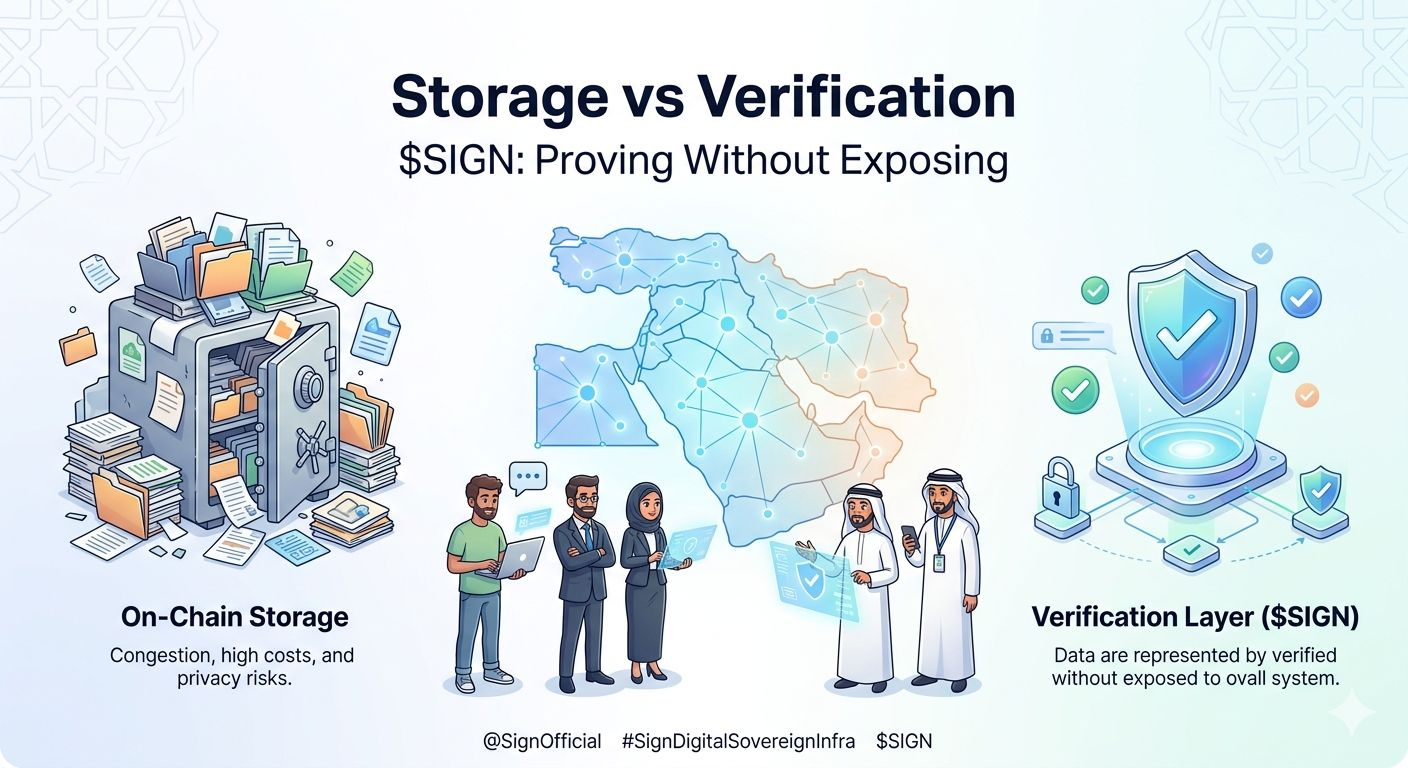
The Storage Trap
Most of the crypto industry, especially in its earlier years, operated on a simple assumption blockchain is a database so put everything in it. That mindset led to a wave of projects trying to store medical records, supply chain data and identity documents on chain. It sounded revolutionary until you tried to scale it.
The reality is that storing raw data on a blockchain is expensive slow and often a privacy nightmare. In a region like the Middle East where financial and government systems are tightly regulated exposing sensitive information on a public ledger isn't just impractical it's a non starter.
Sign Protocol's approach flips this. Instead of treating the blockchain as a place to dump information it treats it as a place to prove information. The distinction is subtle but crucial. You don't store someone's passport on chain. You store a cryptographic proof that their passport was verified by a legitimate authority at a specific time. Anyone can check that proof later without ever seeing the underlying document.
This is one of those ideas that sounds simple but fundamentally changes how you design systems. It separates storage from verification, allowing each to operate in the environment that suits it best.
Why the Middle East Context Matters
When I first started looking at Sign Protocol I wasn't thinking about regional applications. But the more I looked at what's happening in the Gulf the more the alignment became clear.
Countries like the UAE andloca lol are investing heavily in digital identity frameworks. The UAE Pass for example is already used by millions of citizens and residents to access government services. Middle east digital identity initiatives are similarly ambitious. These systems work, but they are largely centralized. They rely on government-run infrastructure, which creates a single point of trust and a single point of risk.
There is a growing interest, both within local administrator party govt circles and among private sector players, in moving toward more decentralized models where individuals have more control over their own data. But you can't just hand control over to individuals without a mechanism to verify that the data they present is authentic. That's the gap Sign Protocol seems designed to fill.

It's not about replacing existing systems overnight. It's about adding a verification layer that allows different systems local party middle east databases, private sector platforms, financial institutions to trust each other's claims without requiring everyone to share all their data with everyone else.
The Gold Parallel
There's a symbolic layer here that I find interesting, though I try not to overstate it.
The Middle East has historically anchored its wealth and trust in tangible assets gold being the most obvious example. Gold works because it is verifiable. You can test its purity, weigh it, and reach a consensus on its value. It doesn't require trusting a counterparty; it requires trusting a verification process.
Digital assets, by contrast, have always struggled with this. How do you verify that a digital asset is real, that it hasn't been double-spent, that it comes from a legitimate source. Most crypto projects answer this by saying look at the blockchain but that requires users to trust the blockchain itself, and more importantly, to understand it.
What Sign Protocol does is abstract that complexity into something simpler attestations. A user doesn't need to understand Merkle trees or consensus mechanisms. They just need to know that a claim has been verified and can be checked. In that sense, it's closer to the gold model than the typical crypto model. The value isn't in the data itself; it's in the verifiability of the claim.
Real World Use Cases Emerging
I've been tracking how projects like this move from theory to practice, and the early signals are mixed but promising.
On the enterprise side, there's clear interest in verifiable credentials for supply chains, particularly in sectors like logistics and energy that are central to the Gulf economies. Being able to prove that a shipment originated from a certified source, passed through regulated checkpoints, and arrived intact without exposing commercial secrets has obvious value.
In finance, the potential is even broader. The Middle East is positioning itself as a hub for digital asset trading and custody. But institutional adoption requires more than just liquidity. It requires auditability. Regulators need to be able to verify that assets are being handled properly. Institutions need to prove their compliance to regulators. Investors need to verify that their assets are where they should be. A verification layer that operates across these different actors could reduce friction significantly.
Then there's the consumer side. Digital identity is the obvious entry point. The ability to prove your age, residency, or professional credentials without uploading documents to every platform you use is a genuine user experience improvement. And in a region with high smartphone penetration and a young, tech savvy population, the adoption curve for such systems could be steep if implemented well.
The Wallet Factor
One detail that stood out to me is the wallet integration. It sounds like a small thing, but it matters.
Most identity and verification systems require users to interact with a dedicated app or portal. Sign Protocol integrates with existing Web3 wallets, which means users can manage their credentials alongside their assets. For someone already using a wallet for DeFi or trading, adding identity attestations becomes a seamless extension rather than a separate workflow.

This also aligns with the broader push toward self-sovereign identity the idea that individuals should own and control their own data. In practice, self sovereign identity has struggled with adoption because it requires users to take on more responsibility than most are comfortable with. But by embedding these capabilities into wallets people already use, it lowers the barrier significantly.
Where the Risks Lie
I try to balance any analysis with a clear eyed view of the risks, and there are several worth flagging.
First, adoption in the Middle East or anywhere is not guaranteed. Sign Protocol can build the infrastructure, but actual usage depends on partnerships with governments, financial institutions, and enterprises. Those partnerships take time, and they often move at the speed of bureaucracy, not at the speed of crypto.
Second, regulatory uncertainty remains a factor. While the Gulf region has been relatively progressive compared to many jurisdictions, the regulatory landscape is still evolving. Projects that operate in the verification and identity space touch on sensitive areas related to data protection, privacy, and financial compliance. Navigating that requires patience and legal sophistication.
Third, and more generally, the crypto market does not always reward long-term fundamentals in the short term. There are countless examples of projects with strong technical foundations that were overlooked during hype cycles and only gained recognition years later. Sign Protocol may fall into that category quietly building while the market chases the next trend.
The Broader Thesis
The more I think about it, the more I suspect that verification infrastructure will become one of the most important categories in crypto over the next five to ten years. Not because it's exciting, but because it's necessary.
We are entering a period where the ability to distinguish real from fake real people from bots, real documents from forgeries, real transactions from fraud is becoming harder. AI generated content, deepfakes, and increasingly sophisticated scams are eroding trust in digital systems. At the same time, privacy regulations like GDPR and their equivalents in other regions are limiting how much data organizations can collect and share.
Crypto's original promise was to enable trust without intermediaries. But for most of its history, it has focused on moving value. That's important, but it's only one piece of the puzzle. Proving information making sure something is real, verifiable, and trustworthy without overexposing it is a different challenge entirely. And it's one that only becomes more complex as more users, more systems, and more rules come into play.
Sign Protocol is building for that reality. Whether it succeeds or not depends on execution, partnerships, and timing. But the underlying thesis that verification will matter more than storage feels increasingly difficult to argue against.
Final Thoughts
I'm not here to make price predictions or claim that Sign Protocol is destined for success. I've been in this space long enough to know that good ideas don't always win, and markets don't always reward the right projects in the right timeframes.
But I am paying attention. In a region undergoing rapid digital transformation, and in an industry that often gets distracted by narrative cycles, there's something to be said for a project focused on a problem that isn't going away. The need for verifiable claims, trusted records, and systems that can prove something without exposing everything behind it that doesn't fade with market sentiment. If anything, it becomes more important as the system grows.
And maybe that's why this one stands out. Not because it's louder than the noise, but because it's focused on something that matters whether the noise is there or not.
This analysis is based on publicly available information and personal research. It is not financial advice. Always conduct your own research before making investment decisions.
@null #SİGN #SignDigitalSovereignInfra $SIGN
