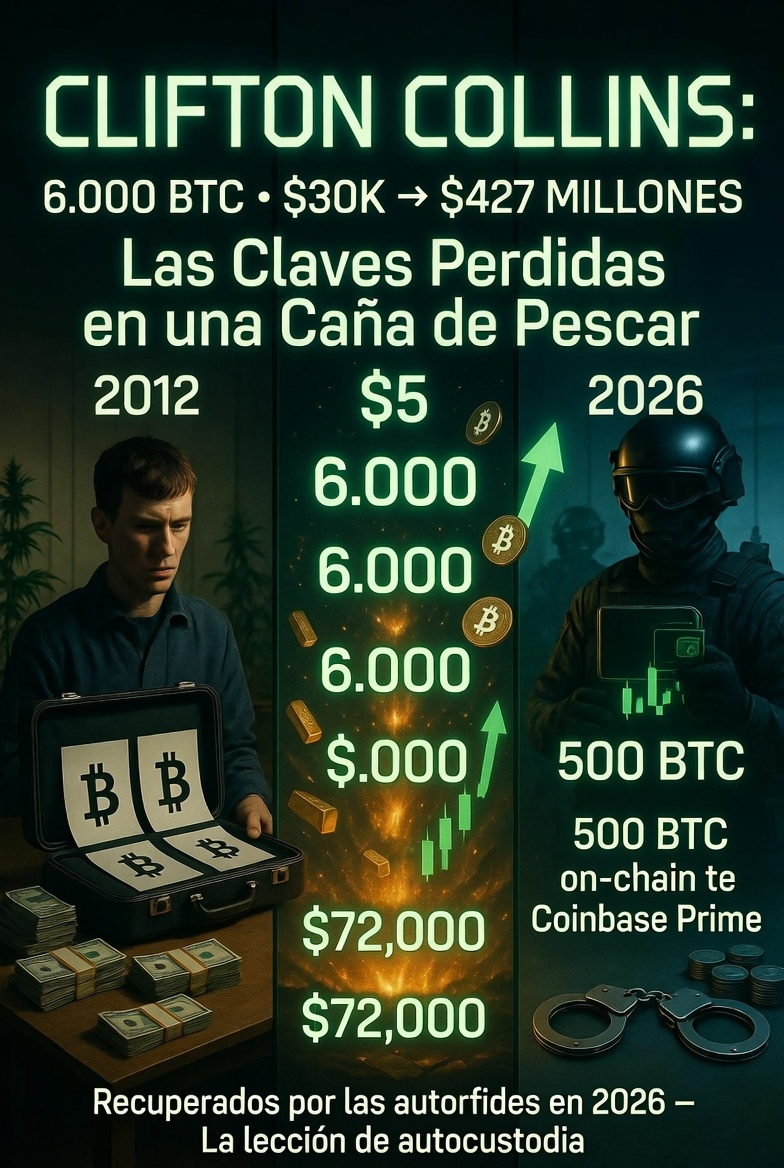
Hello Binancians! As a professional account manager at Binance, with over 11 years of experience as a trader in stock and crypto markets, I am always fascinated by analyzing real cases like this. It is not just a story of “narco” and BTC, but a brutal lesson in risk in self-custody, volatility, and how a digital asset can go from “lost forever” to millions recovered by authorities. I will explain it clearly, chronologically, and with the financial perspective you deserve.
### The Complete Narrative of Clifton Collins and His BTC
Clifton Collins was an Irishman from Dublin, a former security guard and award-winning beekeeper for his honey. Around 2005, he started cultivating cannabis on a large scale in rented houses and selling it. With the profits from that illegal business (no Mexican or Colombian cartels, but local cannabis trafficking), between late 2011 and early 2012, he bought 6,000 BTC when the coin was worth between $5 and $30 approximately. He invested about $30,000 in total.
He divided everything into 12 separate wallets (500 BTC each) to diversify the risk of hacking. He printed the private keys on an A4 sheet and hid them inside a fishing rod case. It was his “ultra-secure vault”… or so he thought.
In 2017, he was arrested for drug trafficking and sentenced to 5 years in prison. While he was incarcerated, his landlord emptied the house and threw away all his belongings, including the famous fishing rod. The 12 wallets remained “lost” for almost 10 years. The crypto community called them “lost keys” and his entire stack reached a value of over $427 million at the current price (around $71,000-$72,000 USD per BTC these days).
### The Turn of March 2026 (just 3 days ago)
On March 24, 2026, one of the 12 wallets “woke up”. Exactly 500 BTC (about $35.4 million) were moved after a decade of inactivity. It wasn't Collins who moved them: it was the Criminal Assets Bureau (CAB) of the Irish police, with technical support from Europol. They managed to decipher the key (they haven't revealed how, but used advanced forensic resources) and sent the funds to Coinbase Prime/Custody. They officially declared it as “proceeds of crime” and have already seized it.
There are 11 wallets with 5,500 BTC (over $390 million at the current price) that remain inaccessible. Authorities believe they could open them all with the same technique.
### My analysis as a professional trader and manager at Binance
- Lesson #1 – Self-Custody vs. Institutional Custody: Collins did what many early adopters recommended in 2011-2012: “Not your keys, not your coins”. But physical keys in a fishing rod case are the worst imaginable cold storage. At Binance, we use bank-level institutional cold wallets, multisig, MPC, and insurance for billions. Our institutional and VIP clients sleep peacefully knowing it doesn't rely on a piece of paper that can be lost or thrown away.
- Lesson #2 – Risk of Confiscation: Although Collins “lost” the keys, the State recovered them. In crypto, if the origin is illicit, authorities (with Europol, FBI, or the DEA) have increasingly more tools. That's why I always recommend my clients complete KYC, clean source of funds, and operate within regulated platforms like Binance.
- Lesson #3 – The Power of Extreme HODL: He bought for less than $30 and today each $BTC is worth over 2,300 times what he paid. It is the perfect example of why in my account management strategies I always include a portion of core BTC for the long term, but with mental stops and diversification.
#CliftonCollins #BTC #bitcoin #AnfeliaInvestment #BitcoinPrices