
The digital asset market is undergoing a fundamental transformation, as a result of which the era of extreme price fluctuations is gradually becoming a thing of the past. This conclusion was reached by Adam Livingston, an analyst and author of the book 'The Age of Bitcoin and the Great Harvest'. Based on mathematical models, he proved that the repetition of a deep crash as in the scenario of 2022 is almost impossible under current conditions.
Market regime shift
Livingston analyzed statistics for the last 11 years (over 3,700 days) and found that the volatility of the first cryptocurrency decreases exponentially.
Key indicators:
Amplitude reduction: if in 2018-2019 the average 90-day volatility was 77.4%, then in 2026 it dropped to 47.4%.
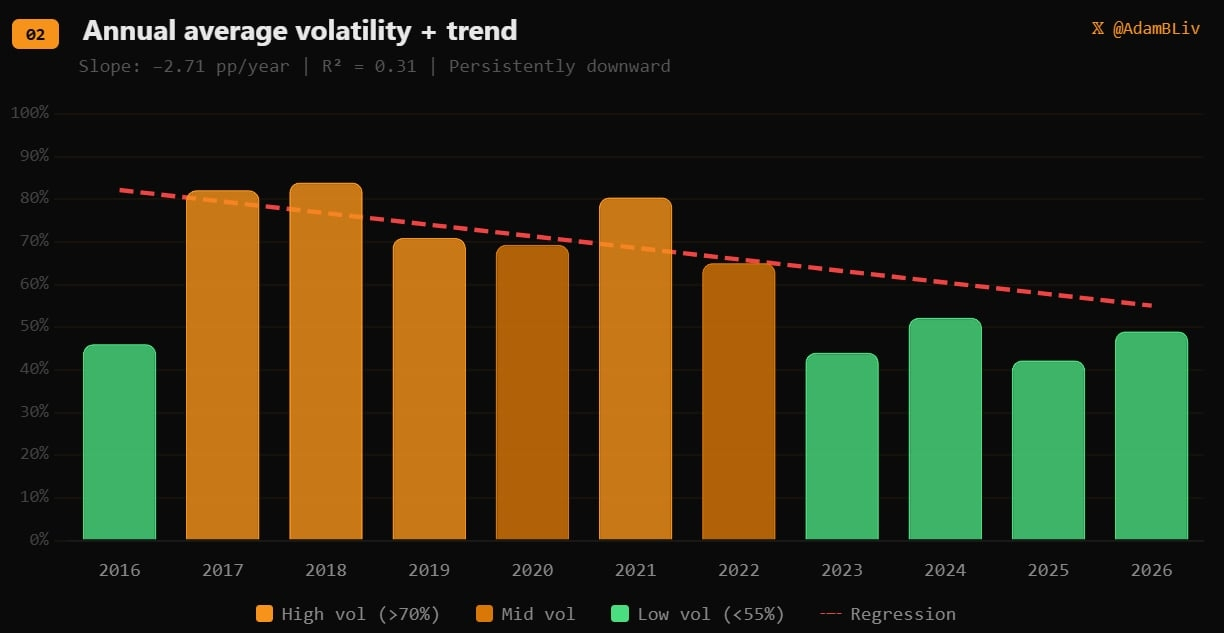
Annual stabilization: linear regression confirms that the asset's volatility decreases on average by 2.71 percentage points annually.
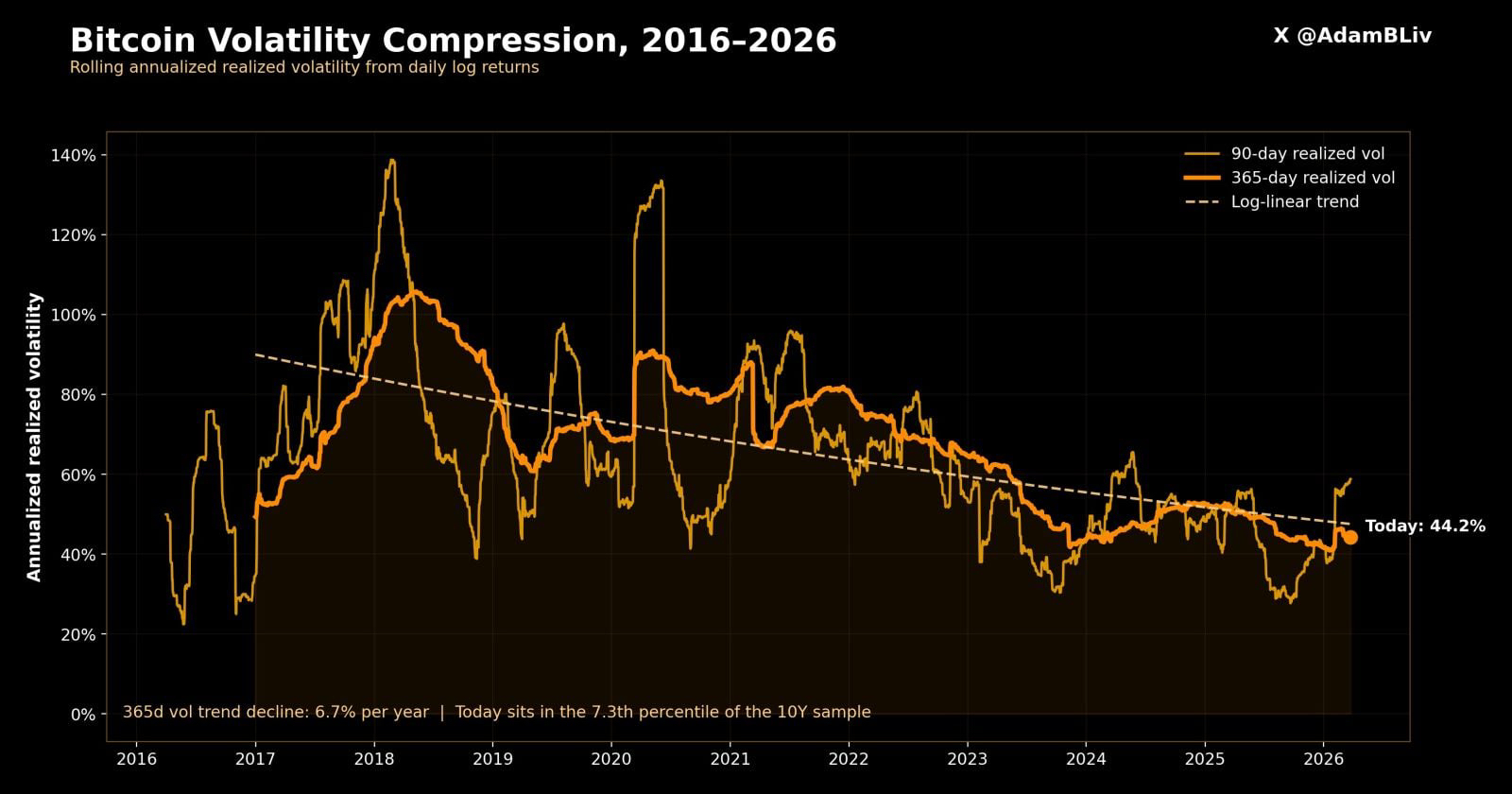
Using the geometric Brownian motion (GBM) model, the analyst calculated that the risk of a Bitcoin crash of 77% (as it was in 2022) has decreased 30 times compared to the five-year cycle.
"Currently, the chance of a similar crash is only 0.19%. Before the 2022 crash, this risk exceeded 13.25%," explains the expert.
The end of the 'candle' era at 10%
The number of days when the price of Bitcoin changed by more than 10% in a day has also sharply decreased. In the period from 2016 to 2022, such jumps were recorded on 3.3% of trading days, while in 2023-2026 this indicator dropped to a symbolic 0.4%.
 Why does the asset 'mature'?
Livingston highlights four main factors that have turned Bitcoin into an inert macroeconomic tool:
Institutional capital: large inflows through spot ETFs and corporate reserves (MicroStrategy, MARA, etc.).
Deep liquidity: increased density of order books, which prevents large players from sharply 'moving' the price.
Derivatives market: record open interest on the regulated CME exchange.
Capitalization: large market weight makes the asset less sensitive to individual manipulations.
"Traders who still expect the price to return to $35,000 are focusing on past volatility, which no longer exists in the modern market," summarized the analyst.