
Lately I’ve been chewing on this idea with SIGN, and I keep coming back to the same feeling: its biggest strength might not be the protocol by itself or the products alone, but how smoothly they connect.
Most of us frame the conversation as an either/or. Either it wins because it’s an open attestation standard that anyone can build on, or it wins by shipping really useful products. Both make sense, but I think they miss the deeper thing that could actually create lasting power.
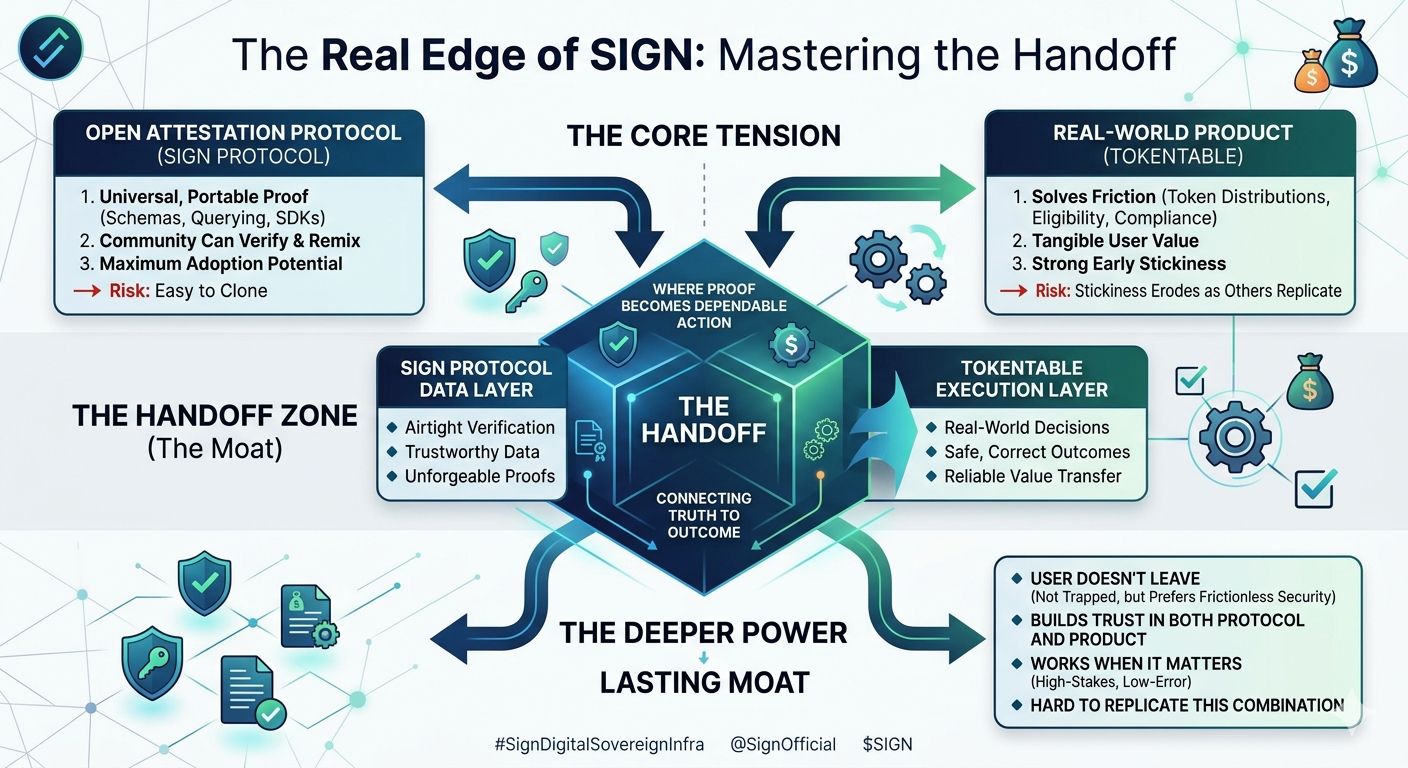
Open protocols are incredible at spreading. They let anyone verify claims, remix ideas, and plug in easily. The catch is that same openness makes it easy for others to copy and extend. Once Sign Protocol becomes the go-to way to issue and check attestations, it starts feeling like shared language rather than something one team fully owns. Super valuable, but not always a forever moat.
Products, on the other hand, can pull you in hard at the beginning. TokenTable is a great example it takes all the painful parts of token distributions (figuring out who’s eligible, handling unlocks, staying compliant, actually getting money to millions of addresses) and makes it feel manageable. When something removes that much real-world friction, especially when money is moving, teams tend to stick around. But that stickiness often softens over time. Once others see the pattern and rebuild it their own way, what felt essential can quietly become just one option among many.
What keeps drawing my attention is the space in between. SIGN seems to be intentionally building right at that connection point. The protocol is where the claims live and stay verifiable by anyone, anywhere. TokenTable is where those verified claims turn into real decisions who gets what, when, and under which rules with the proof and the execution lined up so it actually feels reliable.
A lot of systems stumble exactly here. You can have airtight verification, but turning it into action feels clunky, risky, or locked away. Or you have a slick interface, but the data underneath isn’t trustworthy or portable enough. That gap between “this is proven” and “I’m comfortable acting on it” is where trust either grows or quietly falls apart.
TokenTable stands out to me because it lives in that handoff zone. It’s not just showing attestations it’s turning them into outcomes that matter, especially when you can’t afford mistakes. When real value is on the line, a system that consistently bridges proof to safe, correct action starts to feel different. Deeper. More dependable.
Of course, this only works if the protocol stays truly open. If everything important only works inside one closed interface, then the openness is mostly for show. The stronger play is letting anyone verify claims through Sign Protocol even if they’re not using the other tools, while still making TokenTable the place many teams choose because it simply handles the messy, high-stakes parts better.
Striking that balance feels tricky. You have to be okay giving up some control at the base layer while still competing hard on the execution side. But if they get it right, it creates a quieter kind of moat not “you can’t leave,” but “why would I risk more friction and uncertainty somewhere else?”
I also notice the smaller moves matter here things like better schemas, easier querying, SDKs, and different attestation modes. It feels like they’re making the data layer useful beyond their own products. At the same time, the focus on real deployment lessons suggests they’re learning where theory meets actual pressure.
At the end of the day, when people ask where SIGN’s real edge comes from, I don’t think it’s pure openness or pure product lock-in. It’s forming in that handoff the moment where something provable becomes something you’re willing to depend on.
If SIGN can keep that balance truth stays portable, but acting on it feels safer and smoother inside their world they’re building something that’s genuinely harder to walk away from. Not because users are trapped, but because it just keeps working when it really counts.
And honestly, in systems like this, that’s often what makes people stay.
@SignOfficial #SignDigitalSovereignInfra $SIGN
