
The cryptocurrency revolution began with a bold promise: eliminate the need for trust. Systems like Bitcoin introduced decentralized consensus, allowing strangers to transact without intermediaries. Yet paradoxically, modern crypto still relies heavily on blind trust—trust in smart contracts, wallets, signatures, and even user interfaces that most people barely understand.
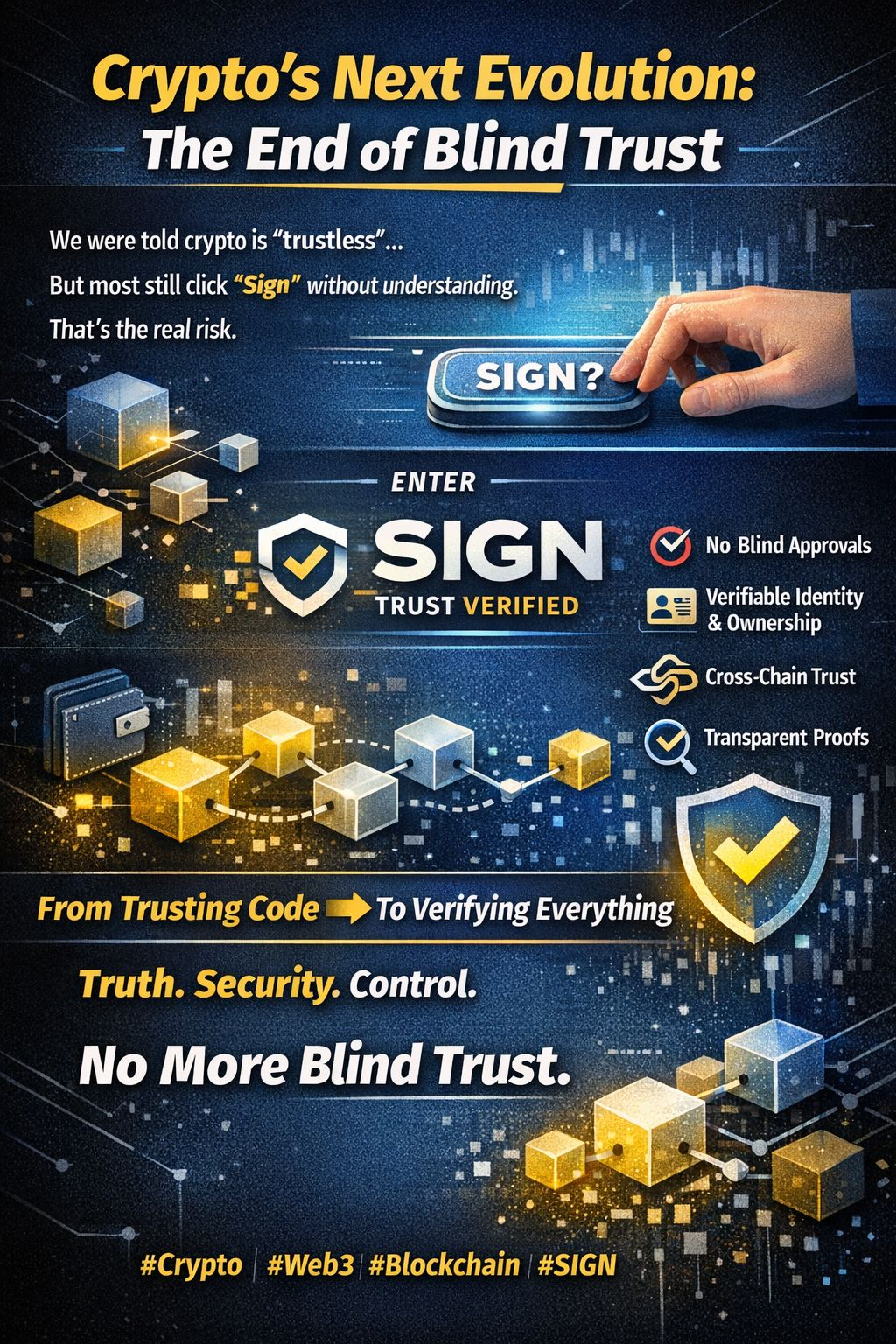
Today, a new evolution is emerging. Projects like SIGN are not just building faster blockchains or cheaper transactions—they are redefining how trust itself works in Web3.
The Problem: “Trustless” Systems Still Require Trust
At the core of blockchain lies cryptography—digital signatures, encryption, and consensus mechanisms. These tools ensure that transactions are valid and immutable. However, for everyday users, interacting with crypto often means clicking “Approve” or “Sign” without fully understanding what they are authorizing.
For example:
Wallet signatures can grant permission to move funds or interact with contracts.
Many users approve transactions without reviewing the data behind them.
Once signed, actions are irreversible.
In fact, crypto signatures are essentially approvals using private keys, and signing something without understanding it can expose users to risks like phishing or fund loss �.
support.uniswap.org
This creates a critical gap: systems are mathematically secure, but human understanding is weak.
Enter SIGN: Building Verifiable Truth
SIGN represents a shift from “trustless” to “verifiable trust.” Instead of assuming systems are correct, SIGN focuses on proving and validating information across decentralized environments.
At its core, SIGN is built around an omni-chain attestation protocol—a system that allows data, credentials, and claims to be verified across multiple blockchains �.
https://help.weex.com
Think of it as:
A digital notary for Web3
A system that verifies identity, ownership, or agreements
A bridge between real-world trust and blockchain logic
Rather than blindly trusting a platform, users and applications can verify:
Who someone is
What they own
What they are allowed to do
All without relying on centralized authorities.
From Cryptography to Usability
To understand SIGN’s importance, it helps to look at the evolution of cryptographic trust.
Traditional systems relied on separate tools:
Digital signatures → prove authenticity
Encryption → protect confidentiality
Modern innovations like signcryption combine both in a single efficient step, ensuring integrity, confidentiality, and authenticity simultaneously �.
Wikipedia
SIGN builds on this foundation but takes it further:
Not just securing data
But making data meaningfully verifiable across systems
This is crucial because the next phase of crypto isn’t just about security—it’s about clarity and interoperability.
Key Innovation: Attestations Over Assumptions
SIGN introduces the concept of attestations—verifiable statements stored on-chain.
These can include:
Identity verification (e.g., government-issued credentials)
Financial reputation (e.g., creditworthiness in DeFi)
Ownership records (e.g., NFTs, assets)
Participation proofs (e.g., DAO voting or events)
Instead of trusting a platform’s claim, users can independently verify the truth.
This changes everything.
Real-World Impact
SIGN’s model unlocks powerful real-world applications:
1. Digital Identity
Governments or institutions can issue verifiable credentials that work across platforms without exposing sensitive data.
2. Fair Token Distribution
Through tools like TokenTable, projects can distribute tokens transparently and efficiently, reducing manipulation and fraud �.
https://help.weex.com
3. Cross-Chain Trust
In a fragmented blockchain ecosystem, SIGN allows data to move and remain trustworthy across networks.
4. Safer User Experience
By making signatures and approvals more interpretable, SIGN can reduce scams and user errors.
The Bigger Shift: From Blind Trust to Proof-Based Systems
Crypto is entering a new phase.
Phase 1: Trust institutions (banks, governments)
Phase 2: Trust code (blockchains, smart contracts)
Phase 3 (Now Emerging): Verify everything
SIGN sits at the center of this transition.
It acknowledges a hard truth:
Decentralization alone is not enough—users must understand and verify what they interact with.
Challenges Ahead
While promising, SIGN and similar protocols face real challenges:
Adoption: Developers and institutions must integrate attestation systems
User education: People must learn to value verification over convenience
Standardization: Cross-chain systems require common frameworks
If these hurdles are overcome, the impact could be massive.
Conclusion: The End of Blind Trust
The next evolution of crypto is not about faster transactions or higher yields—it’s about truth.
SIGN represents a shift toward a world where:
Trust is not assumed
Data is not opaque
Every claim can be verified
In this new paradigm, users are no longer passive participants clicking “Approve.” They become informed actors in a system where truth is provable, portable, and transparent.
That is the real revolution. @SignOfficial #Sign #crypto