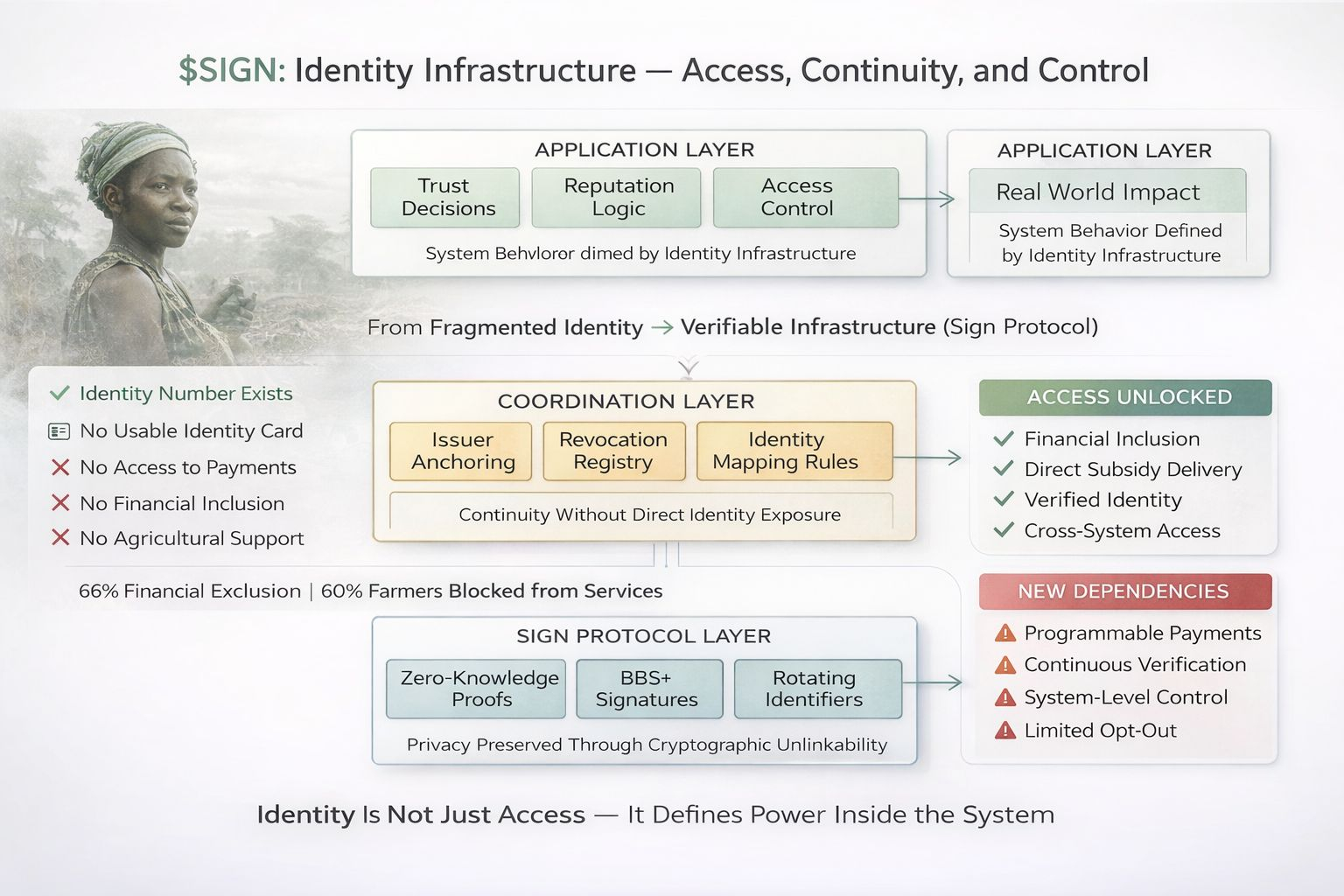
 I kept thinking about Sign Protocol while reflecting on something personal, because this whole idea of identity gaps is not abstract to me. My mother spent years without a birth certificate, not because her country had no system, but because the system was too far, too expensive, and too disconnected from real life. She existed, but not in a way systems could recognize, and that meant no access, no participation, no way to prove anything. And even when she finally got documented, it took years to rebuild a history others had automatically from birth. That experience changes how you see infrastructure, and that is why the Sierra Leone case Sign talks about actually matters, because this is not just data in a whitepaper, it is a real coordination failure happening at scale. The numbers themselves are simple, but powerful. Around 73 percent of people have identity numbers, but only about 5 percent hold usable identity cards, and that gap explains everything. Because identity, in practice, is not just having a number, it is having something that systems can verify and trust. Without that, the rest of the system breaks, and that is exactly why around two thirds of the population remains financially excluded, not because financial services do not exist, but because the identity layer cannot connect people to them. The same pattern shows up in agriculture, where farmers cannot receive subsidies or services that already exist and are funded, not because the programs failed, but because identity failed to deliver access. This is the exact problem Sign Protocol is trying to solve by treating identity as infrastructure, not as a feature, because everything depends on it. Accounts depend on identity, payments depend on accounts, services depend on payments, and if the first layer does not work, everything above it becomes irrelevant. What makes Sign interesting is how it approaches this problem through attestations and verifiable credentials. Instead of rebuilding identity checks again and again, systems can rely on shared proofs that can be verified across contexts. That means a person does not need to prove themselves differently every time they interact with a new service, and in environments like Sierra Leone, that is a huge shift, because the issue there is not lack of data, it is lack of usable and trusted connections between systems. Sign tries to fix that by making identity reusable, verifiable, and portable, and if that works, it can unlock real access for people who are currently excluded from systems designed for them. But this is also where things become more complex, because the same infrastructure that enables access also creates dependency. Once identity becomes the gateway to payments, services, and participation, it also becomes a central point of control, and Sign sits directly at that layer. It enables structured attestations, programmable conditions, and integration with financial and regulatory systems, which makes the system powerful, but also means that once someone is inside it, their interactions can be continuously verified, recorded, and structured. For someone who currently has no access, entering this system is a major improvement, but it is not a neutral shift. It changes the relationship between the individual and the system, and that is where the real question begins. The Sierra Leone case is used as proof that this infrastructure is needed, and it is, but the people used as proof of demand are also the ones who will depend on it the most, and often have the least ability to question how it is used. Sign explains what the system can do very clearly, but the harder part is understanding what limits those capabilities, what protections exist for individuals once their identity and activity are tied into a unified system, because infrastructure at this level does not just enable services, it shapes behavior inside those services. This is not an argument against Sign, or against digital identity. The exclusion problem is real, and solving it matters. Sign is one of the few projects actually trying to fix the base layer instead of building on top of broken systems, but access alone is not enough. If identity becomes programmable, then safeguards need to be just as strong as the capabilities. If systems can verify everything, they also need to protect what should not be exposed, and if identity becomes permanent infrastructure, then user protection needs to be built into that permanence. Sign Protocol, right now, represents a very important shift. It connects identity, payments, and coordination into one system, and if it works the way it is intended, it can unlock participation for millions of people who are currently excluded. But at the same time, it raises a deeper question about how that system behaves once people depend on it, because for those populations, this is not just technology, it is the difference between finally being included and becoming part of a system they cannot easily push back against. And that is why the real question is not just whether Sign works, but whether it works in a way that protects the people it is built for. Because identity infrastructure is not just about being seen, it is about what happens after you are.

Article
Sign Protocol and the Identity Gap Reality, Access Alone Is Not Enough
Disclaimer: Includes third-party opinions. No financial advice. May include sponsored content. See T&Cs.
0
14
173
Explore the latest crypto news
⚡️ Be a part of the latests discussions in crypto
💬 Interact with your favorite creators
👍 Enjoy content that interests you
Email / Phone number