
The first time I tried to verify my credentials on a decentralized platform I was met with scattered emails fragmented signatures and endless manual checks. The promise of Web3 trustless systems, instant verification, and tokenized incentives felt tantalizingly close yet frustratingly out of reach. That experience made me realize something important: the real bottleneck in Web3 isn’t scalability or DeFi protocols it’s trust in identity and credential verification.
Web3 was designed on the principle of decentralization yet our systems for proving who we are or what we hold remain surprisingly centralized. Traditional credentialing whether diplomas licenses, or attestations relies heavily on central authorities. Without a reliable scalable infrastructure for verifying credentials and distributing tokens, the ecosystem risks inefficiency fraud and user friction.
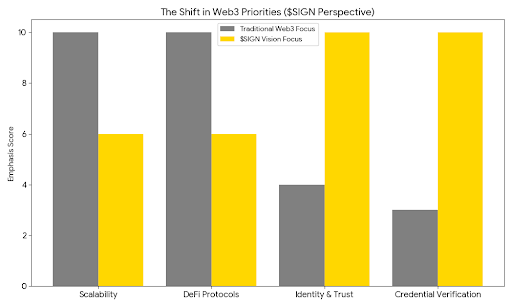
Enter $SIGN a project that doesn’t just tokenize credentials but reimagines how identity and trust operate on a global decentralized level. At its core $SIGN leverages zero knowledge proofs to create verifiable credentials that remain private while being provably authentic. This is not just a technical innovation it’s a philosophical shift. We are moving from transparency as the sole measure of trust to verifiability as a balanced approach that respects both privacy and authenticity.
The architecture of $SIGN is elegant. Credentials are issued by trusted entities and cryptographically signed but the holder retains control. When verification is required for instance, to access a DeFi product or claim an NFT airdrop the user can prove their eligibility without exposing the underlying data. Privacy is built in by designb not as an afterthought. Practically, this means you could prove you are a licensed professional a verified NFT collector, or a DAO member, all without sharing sensitive personal information.
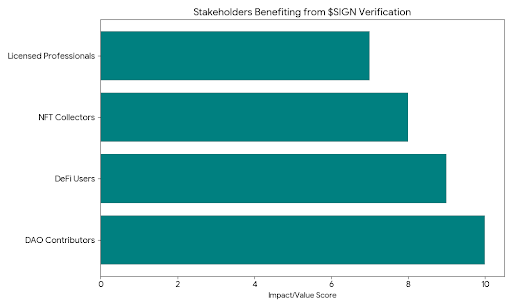
From a human perspective, the impact is profound. Verification bottlenecks can stall community engagement or slow adoption of DeFi tools. With $SIGN, friction is reduced, processes are more fluid, and users are empowered. This enables the design of token distribution models that are fair targeted, and resistant to gaming. Imagine an airdrop reaching only qualified participants worldwide, without exposing personal data or relying on manual KYC processes.
Beyond convenience $SIGN signals a broader evolution in digital trust. Just as HTTPS transformed online transactions by proving authenticity without revealing secrets, zero-knowledge based credential verification can redefine digital interactions. We no longer have to choose between publicly verifiable and completely private we can have both. This duality is essential in financial ecosystems, DAOs, and NFT communities, where trust and privacy often conflict.
Consider a practical example a global DAO wants to reward active contributors with governance tokens. Traditional verification would require central records, audits, or invasive data collection. With $SIGN, each contributor can verifiably prove their contribution, claim their tokens, and maintain privacy. This increases adoption while strengthening the DAO’s integrity reducing the risk of Sybil attacks and fraudulent claims.
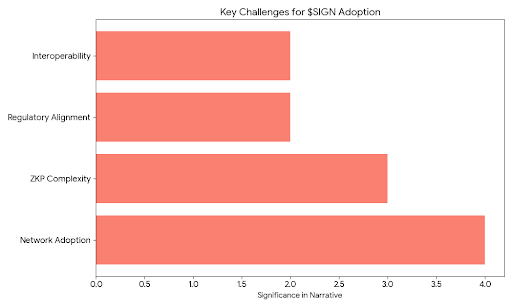
Of course no system is without challenges. Adoption depends on the network of issuers and verifiers; without broad participation the system risks fragmentation. Zero knowledge proofs are elegant but complex, requiring developers and users to understand their implementation to avoid misuse or security pitfalls. Regulatory alignment is another consideration as privacy respecting verification still needs to comply with local laws that vary widely across jurisdictions. Interoperability with other credentialing systems is also key for scaling globally.
Despite these hurdles the potential is compelling. #SIGN exemplifies how Web3 can evolve from a landscape of experimental tokens and smart contracts into a robust infrastructure for trust identity and value distribution. It transforms credential verification from a bureaucratic hurdle into a seamless, privacy preserving enabler of global participation. The vision is audacious: a world where anyone, anywhere, can verify their credentials, access tokenized incentives, and participate in digital economies with confidence.
Ultimately the lesson is clear Web3’s next frontier isn’t just in finance or NFTs it’s in trust infrastructure. The technology that allows us to prove who we are what we own and what we’re entitled to without compromising privacy is the foundation for the next generation of decentralized applications. For creators developers and users alike this infrastructure is what can make Web3 truly global, scalable, and equitable.
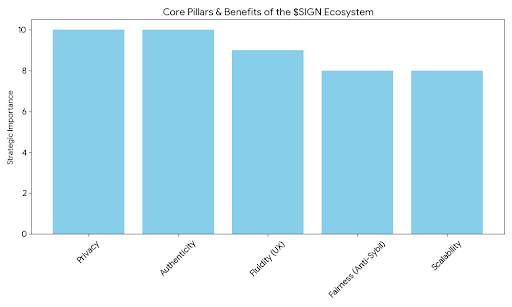
In conclusion #SIGN is more than a token or a protocol it’s a blueprint for how identity, verification and token distribution can coexist in a privacyrespecting, trust-enabled ecosystem. The projects that solve verification friction are the ones that unlock Web3’s real power. Privacy and verifiability are not just complementary they are essential. With infrastructure like $SIGN we finally have a framework capable of redefining how we trust interact and distribute value on a global scale.