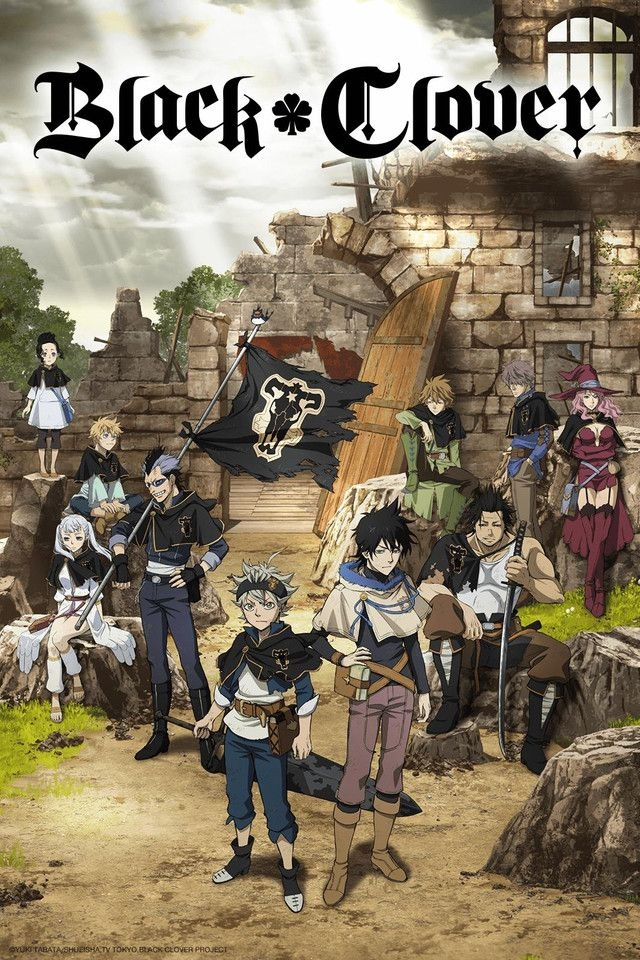
The story of how the anime 'Black Clover' was created is a good example of how the classic shōnen formula was packaged into a modern, very dynamic series aimed at long-term success.
What is 'Black Clover'
Black Clover is an anime based on the manga Black Clover by Yūki Tabata.
The manga started in Weekly Shōnen Jump in 2015, and the anime adaptation was released later when the series had already shown good potential as a long-term shōnen hit.
1) How it all began: the idea of the manga
The creator of 'Black Clover' is Yūki Tabata, a manga artist who had previously worked on other projects, but it was Black Clover that became his biggest breakthrough.
The main idea
Tabata took a very strong and clear shōnen structure:
a world where everyone has magic;
the main character without magic;
a huge dream;
the rivalry of two friends;
growth through battles, friendship, and overcoming challenges.
The main character is Asta, a boy without magical abilities in a world where magic is almost everything.
His rival and simultaneously 'brother by fate' is Yuno.
This was a very successful dramatic base because the conflict is built on several levels:
social — the hero is 'not like everyone else';
personal — to prove one’s worth;
the plot — the path to the title of Wizard King;
emotional — the eternal competition between Asta and Yuno.
2) Why the manga quickly attracted attention
At the start, many noticed that 'Black Clover' relies on classic elements of titles such as:
Naruto
Bleach
Fairy Tail
Hunter × Hunter
Because of this, the series initially had a reputation as a 'very familiar shōnen'. But this actually played to its advantage.
Why the concept worked
'Black Clover' didn't try to be too complex or 'smart for the sake of being smart'. Its strength lay in something else:
very fast pace;
clear motivations of the characters;
vibrant magical battles;
a large cast of characters;
constant progress of power and status.
In other words, this was a project that was well-suited for long serialization and subsequent anime adaptation.
3) How the manga reached the anime
When the manga began to steadily gain popularity, it became clear that it had everything for adaptation:
active audience;
good material for arcs;
bright visual style;
commercial potential for merchandise, games, and franchises.
The stage before a full-fledged series
Before the TV series, 'Black Clover' had special animated promos/OVA formats that tested audience interest and the visual viability of the project.
This is a common practice for promising shōnen series:
first, the industry evaluates how well the story can 'work in motion' — in battle scenes, magic design, character charisma, and pace.
4) Who made the anime
The studio released a full-fledged TV adaptation:
Studio Pierrot
This is a very important point because Pierrot is a studio with vast experience in long shōnen series. That’s why 'Black Clover' was perceived from the beginning not as a 'small seasonal project', but as a potentially long-term television brand.
Why it made sense
Pierrot already knew how to work with:
long arcs;
weekly format;
a large number of characters;
constant battle scenes;
high workload on production.
That is, Black Clover was initially launched as a series for endurance, not as a short elite adaptation of 12–24 episodes.
5) Premiere of the anime and initial difficulties
The anime 'Black Clover' started in 2017.
And that’s where the most interesting part began:
the series immediately received a very strong viewer response, but at the same time a lot of criticism.
The main problem at the start is Asta
In the first episodes, viewers were often annoyed by:
Asta's voice was too loud;
hyperactive delivery;
a very noisy tone of the first episodes.
This became almost a meme among anime viewers.
But why didn’t it kill the series?
Because from there, the series began to reveal its real strengths:
an interesting magic system;
good team battles;
cool knight captains;
strong arcs;
an increasingly serious scale of the world.
That is, the project survived a weak first impression and revealed itself over time.
6) What was the philosophy behind creating the anime
In short, 'Black Clover' was not created as 'author's arthouse anime', but as a mass battle series with high audience retention.
Its DNA was built on three things:
1. Constant movement of the plot
The creators tried not to keep the audience too long in one place:
new enemies;
new powers;
new squads;
new mysteries of the world;
constant increasing stakes.
2. The bet on the 'underdog story'
Asta's story is an archetypal formula:
'You don't have what everyone else has, but you'll still become the best.'
This is one of the strongest types of motivational shōnen story.
3. Team dynamics
Unlike stories where everything relies solely on the main character, 'Black Clover' heavily relies on:
Black Bulls squad;
captains;
kingdoms;
secondary characters.
This allowed the anime to become more 'alive' and long-lasting.
7) Why the anime became popular despite criticism
'Black Clover' had an important industrial advantage:
it didn't try to please 'only the elite anime audience'.
It worked as an honest battle series.
What especially resonated with viewers:
very powerful power progression;
spectacular magical forms;
emotional 'comeback' moments;
a sense of constant growth;
a large number of beloved characters.
That's why many viewers said something like:
At first, it didn't grab me, but then it became really cool.
This is a classic success story for long shōnen series.
8) Why production was not easy
It's important to understand the difference between the quality of the idea and the conditions of production.
'Black Clover' was released in a format of almost constant TV airing, and this means:
tight deadlines;
uneven animation quality in different episodes;
heavy workload on the team;
the necessity to keep the pace almost without stopping.
Because of this, the series had:
episodes with very average visuals;
episodes where everything 'depended on editing and energy';
and, conversely, separate episodes where the studio went all out.
And this is very typical for long shōnen projects.
9) Why 'Black Clover' is important for the modern anime industry
It became an example that not every successful franchise has to be a 'revolution'.
Sometimes the not-so-unusual project wins, but the one that:
consistently delivers emotions;
maintains the pace;
makes the viewer feel 'good and interesting';
can scale up.
In essence, Black Clover proved:
the classic shōnen still works if presented with enough energy.
And this is a very important lesson for the industry.
10) What happened next
After a big TV run, the franchise didn't stop.
Later an animated film was released:
Black Clover: Sword of the Wizard King
This was a sign that the brand remained commercially strong and in demand with the audience.
The story of the creation of 'Black Clover' in one paragraph:
This is a project that started as a very clear, classic shōnen manga by Yūki Tabata, quickly grew into a popular series in Weekly Shōnen Jump, and then received an anime from Studio Pierrot, made with an eye for long-term television success. Despite the criticism at the beginning, the series survived due to its pace, charismatic characters, magical battles, and Asta's strong motivational story.