
The more I look at the market, the more I have a gut feeling: in the next bull market, the truly valuable Alpha is not some liquidity, but rather 'verifiable presence records.' To put it bluntly, whoever can first turn those broken clicks, claims, participations, and contributions on-chain into a set of evidence systems that can be crazily reused across scenarios is not just issuing rewards, but is directly depriving the entire Web3 of its distribution rights.
In the group, a bunch of people started chatting about Sign, and the first reaction was still the same old routine: do tasks, earn badges, roll the whitelist for airdrops. To put it simply, it’s treating it like yet another beautifully packaged operational dashboard. Over the past few days, I've stayed up late digging into its logic, and the more I look, the more I feel these people are too shallow in their understanding. @SignOfficial The truly terrifying part is not that issuing rewards has become smoother, but that it has turned 'behavior' itself into an asset that can be recorded, called, and even reused.
The traces we left on-chain before were mostly exhaust and noise; what about now? SIGN aims to compress this noise into structured 'evidence for court'. You are not merely 'having been there'; you are 'having appeared under specific rules'; you didn't just click a dumb button, but left behind an auditable statement that can travel the world. This is a completely different flavor, directly transforming from an 'activity platform' to 'underlying distribution infrastructure'. This is not just inflated front-end hype built on a few narratives.
That's why I say that those who insist on keeping $SIGN tightly within the 'DID identity track' are completely misguided. What they're focused on is not identity in the traditional sense, but Claim. It's not about 'Who are you?' but about 'What have you done, what conditions do you meet, what should you get?'. The difference between the two is significant! Identity is like a stiff ID photo, while Claim is your vibrant resume, authorization letter, and proof of qualifications. In reality, we don't need to show our underwear to others every time we do something, right? Most of the time, proving 'I meet the qualifications' is enough. Whoever can piece together these fragmented facts at a low cost will master the new grammar of on-chain collaboration. Among institutions, applications, and various chains, what is hardest to transfer is never your Token, but whether 'others recognize this proof of yours'. Once this layer of paper is pierced, the story is much bigger than just issuing a token.


What does truly sexy infrastructure look like?
What makes me feel that SIGN has potential is that it simulates the underlying logic of high-value processes for the future. Today, it is used to issue event qualifications; tomorrow, it can spill over into grant distribution, community governance, and even compliance verification. While everyone is eagerly watching 'what new benefits can be obtained', I am focused on 'whether this set of processes will be repeatedly abused'.
Not long ago, I was running a simple test node for Midnight, and a thought flashed in my mind: true infrastructure is never about making a big splash with announcements; it's about developers being too lazy to switch back to old tools. Who would want to go back to the primitive era of Excel tables and screenshots for proof? Therefore, the core KPI of this project is not hype, but return usage. It's about whether users are a wave or if they are willing to grow on this track in the future. Once the standard is raised, the question shifts from 'Will the token price go up?' to 'Will it be continuously relied upon?' These two questions are not even on the same dimension.
Alright, even after blowing it, we still have to pour a basin of cold water.
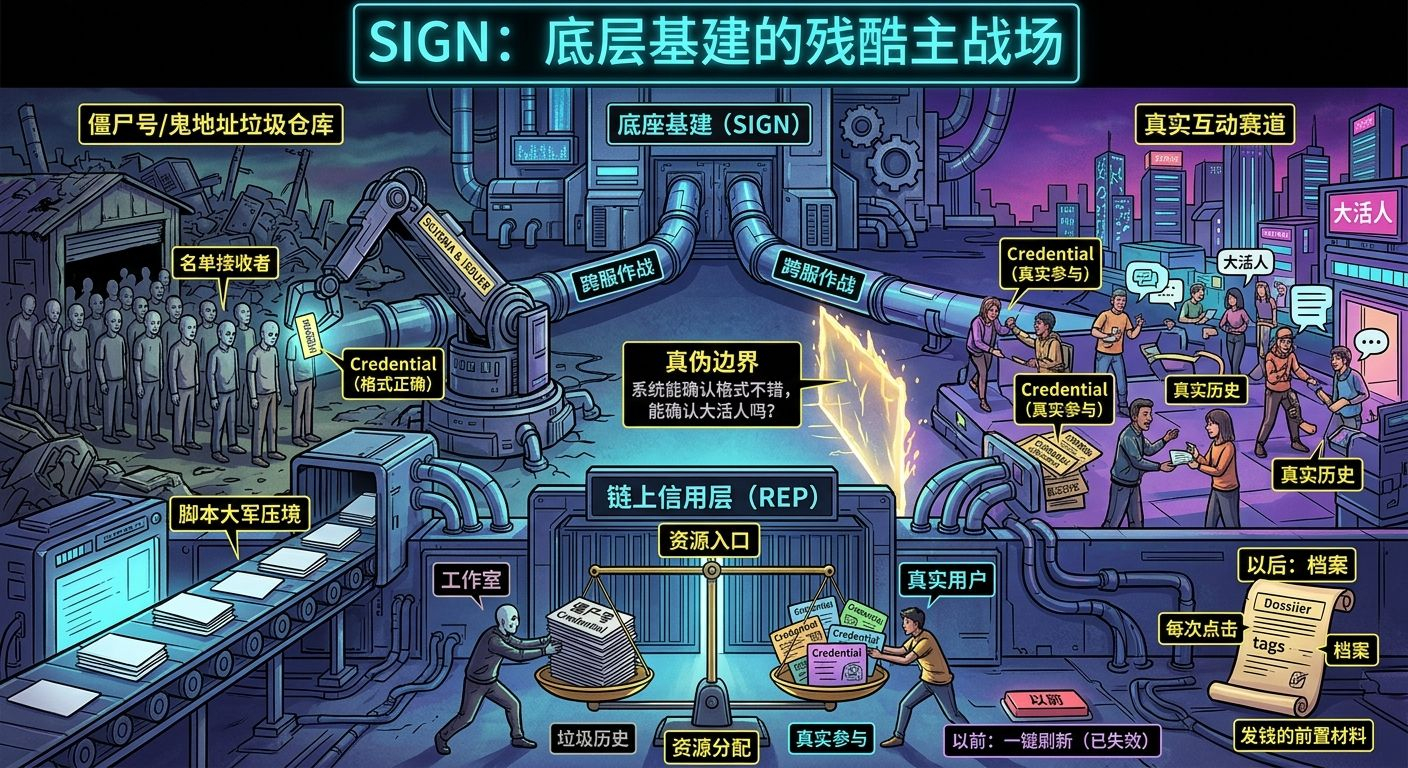
Precisely because SIGN increasingly resembles underlying infrastructure, I am more anxious about its 'truth-falseness boundary'. The system can confirm that the attestation format is correct, but can it confirm that 'the recipient is indeed a real person'? A zombie account or ghost address that has never interacted could quietly accumulate credentials and still appear as a clean and valid 'good child' in the eyes of the system.
A small scale is still manageable, but once the volume increases, what will happen when the studio's army of scripts arrives? At that time, will the system verify 'real interaction', or merely 'being included in the list'? This is a critical dividing line. If we can't cross it, on-chain credibility will directly become a landfill.
Thus, the main battlefield of Sign is neither in the UI nor in how many collaborative activities have been initiated, but in these three matters:
Who sets the rules: Who defines the schema, who acts as the issuer, and who has the final say?
Authenticity verification: How does the system cleanly distinguish between 'being written into the list' and 'actually being there'?
Cross-server operations: Can the revocation, update, and cross-scenario migration of credentials be executed without failing?
Don't find it annoying; this is the crux of whether it can become a 'layer of on-chain credit'. Once attestation becomes a resource entry point, the battle between garbage history and real participation over who is more easily approved is a real struggle for interests. The previous internet allowed you to refresh and start over with one click; what about in the future? Every click you make is a file, a precursor to future monetary distribution. This matter is not romantic at all; it's even a bit cruel.
Let me say a heart-wrenching truth.
In the future, when we engage in activities, it's no longer about 'the more wallets, the better', but rather 'the more your historical records resemble a person, the more valuable they are'. But this matter is particularly prone to escalation. Writing a script or stacking a few bots is too cheap; studios can easily fabricate resumes in bulk. Therefore, I believe the value of SIGN is not simply 'preventing witch hunts'; it elevates anti-witch hunting to another level: from 'counting addresses' to 'analyzing evidence', from 'one-size-fits-all bans' to 'pricing on-chain history based on different qualities'. The direction is absolutely impressive, but the difficulty is hellish because, in the end, the challenge is 'whether there are high-quality, explainable, and trustworthy interaction records'.
From the perspective of a trader, I am quite restrained regarding SIGN now. I won't be brainwashed by grand terms like sovereignty and proof (just look at those mindless hype posts); but I'm not blind either; this is definitely not a rigid classical project. Its value lies in the opportunity to compress a series of discrete and inefficient human trust actions into a standardized evidence flow. The danger lies in this: once distribution and participation can't be clearly separated, the backlash from distortion will be tremendous.
My attitude is clear: on the product side, I am a staunch bull; on the token side, I only look at 'stickiness' and 'reuse rate', a few emotional K-lines won't fool me. If Sign can truly achieve 'repeated use and trustworthy verification' in the future, $SIGN will eventually be revalued by the market. But until then, I will keep a close eye on that bottom line: is it truly recording real revelry, or just elegantly writing a high-level spreadsheet? If it succeeds, it's groundbreaking infrastructure; if it fails, then it's just a big Excel spreadsheet #Sign地缘政治基建 .