

Intel TDX removes the constraints that kept confidential computing from being truly production-ready. Instead of forcing applications into tight enclave limits, TDX makes it possible to run full applications, larger workloads, and real financial services inside protected virtual machines.
That means better developer experience, fewer architectural compromises, and infrastructure that is finally ready for institutional DeFi, RWA, and more serious capital moving on-chain.
DeFi has shown that financial systems can run on open blockchain rails. But full transparency also creates real limits. When every balance, transaction, and position is visible by default, some users and products simply cannot operate as they should.
That is especially true for institutional capital, tokenized real-world assets, and financial applications that require discretion, compliance, or controlled access to sensitive information.
This is where Intel TDX matters.
TDX gives us the foundation to process large-scale workloads and support more serious value moving on-chain
For iExec, TDX is not a standalone privacy upgrade. It is a major infrastructure unlock. It gives confidential computing the flexibility, scale, and trust guarantees needed to support institutional DeFi, tokenized real-world assets, and workflows designed for real capital.
In simple terms, TDX allows sensitive operations to run inside protected virtual machines called Confidential VMs. In these environments, data stays isolated, and execution cannot be inspected or altered by the host or cloud provider. That creates a stronger foundation for confidential computing, because sensitive logic runs in a Trusted Execution Environment (TEE) designed to preserve both confidentiality and integrity.
With TDX, confidential computing becomes production-ready
TDX helps move confidential execution from “trust us” to “verify it.” With attestation, users can check that the right code ran in the right environment before their sensitive data was processed. That is a major step for on-chain finance, because privacy only matters if it is backed by strong guarantees.
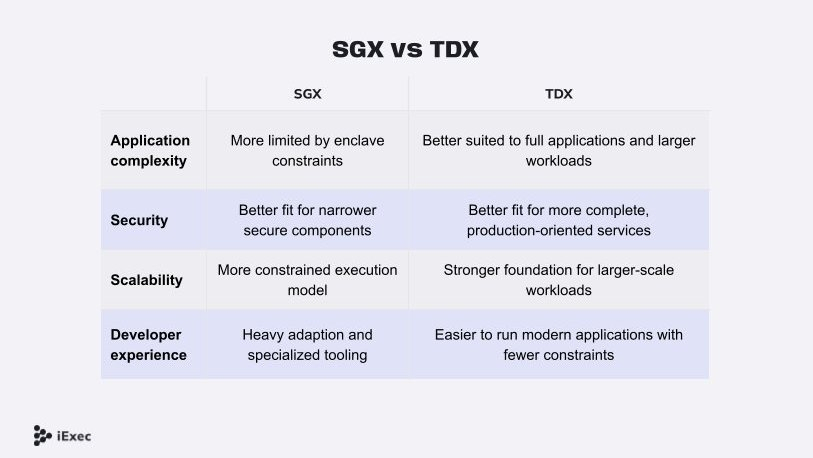
TDX also marks a real maturity step for confidential computing. Earlier approaches were more constrained, harder to integrate, and less suited to production services. TDX gives iExec the flexibility to support full applications, larger workloads, and more complex financial logic inside a protected environment. That is what moves confidential computing from limited experimentation toward infrastructure that is ready for institutional DeFi, tokenized real-world assets, and larger-scale value moving on-chain.
Why This Matters for Confidential DeFi
That matters directly for Confidential DeFi and RWA. Institutional-grade financial applications are not small or simple. They require infrastructure that can handle more demanding workflows, stricter privacy requirements, and stronger execution guarantees. By moving from enclave-constrained execution to confidential VMs, iExec gains a more credible foundation for institutional DeFi, more robust RWA workflows, and the kind of confidential infrastructure needed to support real capital.
What TDX Changes for the Confidential Token
For the Confidential Token, this trust layer is especially important. Private balances, private transfers, and selective disclosure only work if the environment handling that data can itself be trusted. TDX helps ensure that sensitive token operations happen inside a protected and verifiable system, without relying on blind trust in the operator. It also supports more workable compliance models, where authorized access is possible without making everything public by default.
We are now ready for institutional DeFi and RWA
For tokenized real-world assets, it helps support more credible models for investor confidentiality, controlled disclosures, compliance checks, and sensitive offchain data handling. For DeFi, it gives builders a stronger foundation for workflows that depend on both confidentiality and verifiable execution. In both cases, TDX helps make financial logic more workable for serious real-world use.
This is why TDX matters beyond infrastructure alone. Together with Remote Attestation and the broader Chain of Trust, it strengthens the foundation for a new class of on-chain financial products. It gives projects a more credible way to support confidentiality, and it gives users stronger guarantees about how their sensitive data is handled.
Use Cases Enabled by Verifiable Confidential Execution
This opens the door to a range of use cases that benefit from both confidentiality and verifiability:
Private transfers become possible because clear values are only handled inside the enclave.
Confidential compliance can check rules such as KYC status or transaction limits without exposing personal data.
Confidential oracles can process sensitive offchain information before publishing results on-chain.
MEV vulnerable flows can be handled inside the confidential environment before broader disclosure, reducing exposure to front-running.
These are not just security improvements. They are product capabilities that depend on having a trusted execution layer with enough flexibility to support real application logic.
The real shift for Confidential DeFi
This is what makes the transition from SGX to TDX a structural upgrade rather than an incremental improvement. The shift is not merely from one secure environment to another, but from enclave-constrained execution under SGX to a confidential computing model with TDX that can support full applications, larger workloads, and more advanced financial services. That is what makes TDX a meaningful unlock for Confidential DeFi and RWA.
That is the real shift behind Confidential DeFi and RWA: better control, stronger protection, and production-ready trust infrastructure for institutional use cases and real capital moving privately.
Explore the iExec documentation ➡️ https://docs.iex.ec/
$RLC