

I want to talk about something uncomfortable today. But I think it is important and it is directly connected to why $SIGN matters more than most people realize.
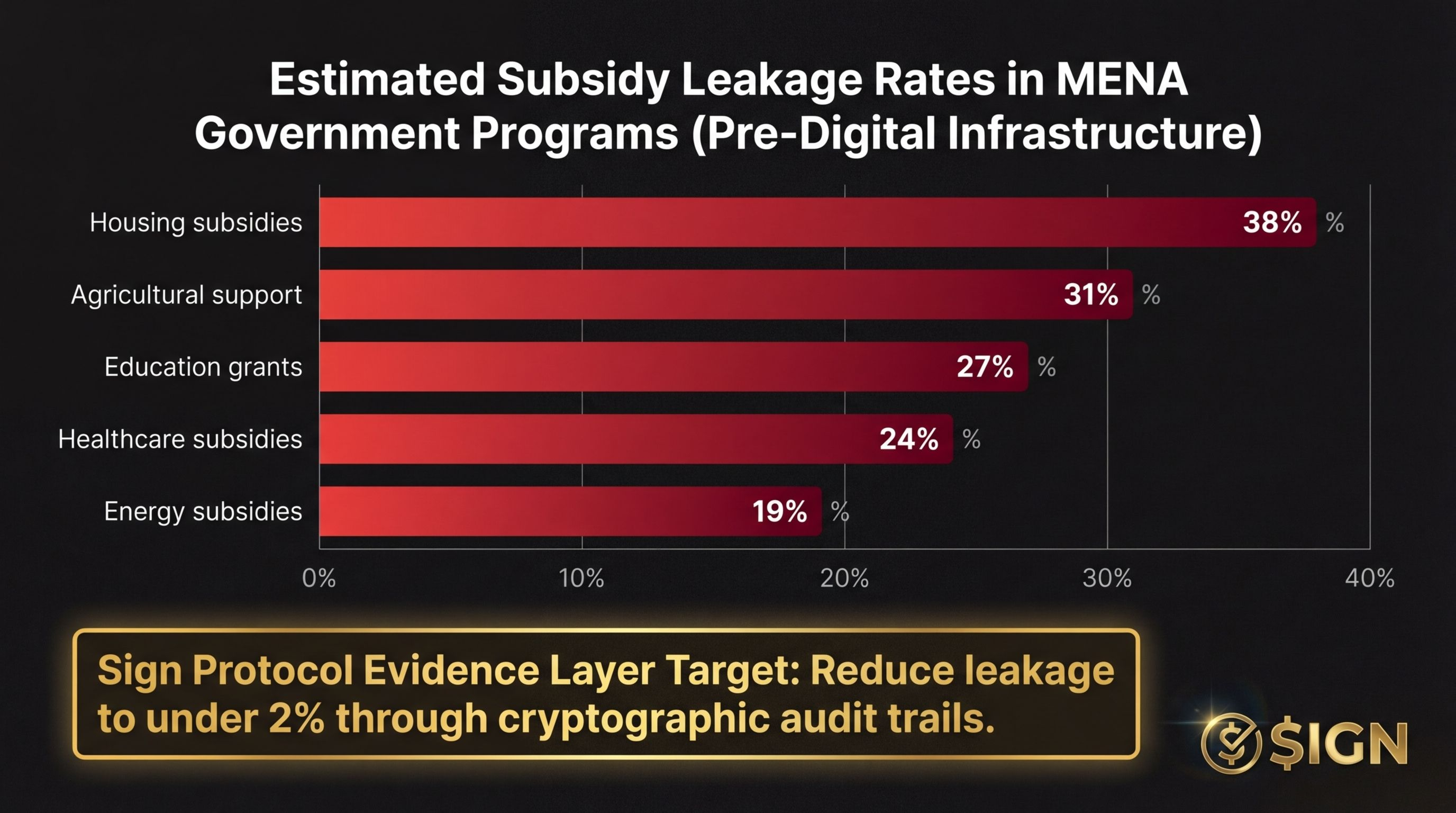
Government subsidy programs across the Middle East and North Africa lose billions every year to corruption, mismanagement and fraud. I am not saying this as a political attack on any specific country. I am saying it as an observable pattern that economists and development organizations have documented extensively.
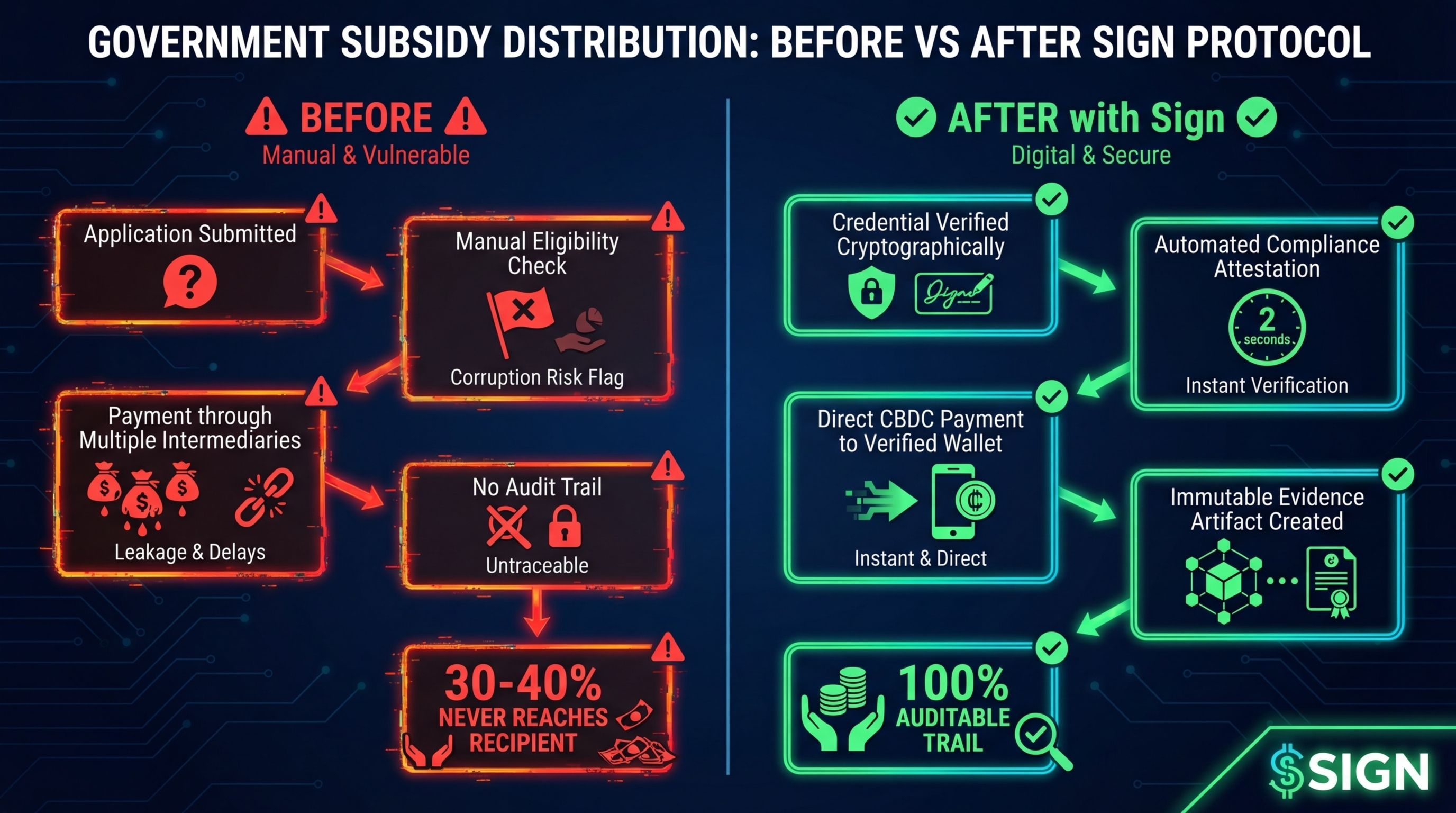
The problem is structural. When you run a program that distributes benefits to millions of people using paper records, manual verification and disconnected government databases corruption is almost mathematically inevitable. Someone has to verify eligibility manually. Someone has to approve disbursements. Someone can falsify records. Someone can create ghost recipients. Without a cryptographically verifiable audit trail, these frauds are extremely hard to detect.
The human cost of this is real. I have read stories about welfare programs where 30 to 40 percent of benefits never reach the intended recipients because of leakage at various points in the distribution chain. That is not just money lost. Those are families who needed food support, medical assistance or housing help and did not get it because someone in the system took their share.
Now let me tell you why what @SignOfficial has built in the Sign Protocol evidence layer is such a powerful response to this problem.
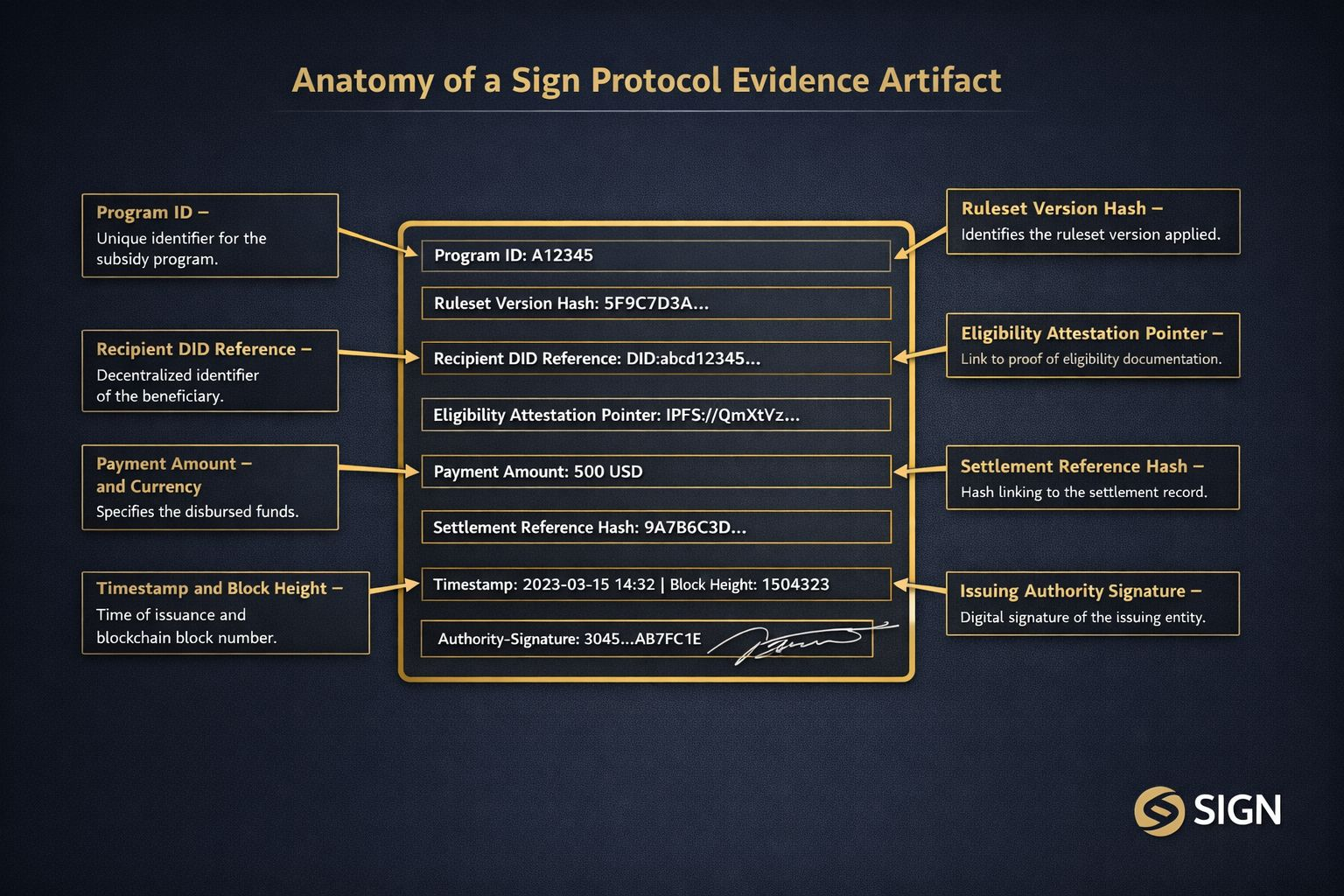
The evidence artifact system is not an afterthought. It is central to how S.I.G.N. works. Every critical action in a government program produces a cryptographic evidence artifact. Who verified what. When. Under what authority. Under which version of the rules. These artifacts are immutable. They cannot be edited after the fact. They cannot be deleted. And they can be queried and audited by authorized inspectors at any time.
Think about what this means for a G2P disbursement program. Government to person. Something like a welfare payment system or a subsidy program.
Right now a typical program in the region might work like this. A person applies. A government official manually checks their eligibility against a database. If approved a payment is scheduled. The payment goes through several hands before reaching the recipient. At each stage there is opportunity for manipulation. And after the fact reconstructing exactly what happened at each
step is a forensic nightmare.
With Sign Protocol's architecture the flow becomes something fundamentally different. Eligibility is verified against a signed credential. The credential check produces a cryptographic attestation. The disbursement batch is generated with a signed manifest that includes a ruleset hash, meaning you can prove exactly which rules were applied. Each payment is settled and its settlement reference is logged as an evidence artifact. A regulator or inspector can audit the entire program retrospectively and cryptographically verify that every step followed the defined rules.
There is literally nowhere to hide a ghost recipient in this system. Because every recipient needs a verifiable credential attesting to their eligibility. You cannot fabricate a credential without a signing key from an authorized issuer. And every issuer is logged in the Trust Registry with their authorized schemas and keys.
I find this deeply exciting not because I think blockchain is magic but because I know that audit trail integrity is one of the most powerful anti corruption tools that exists. When people know that every action they take is producing an immutable verifiable record, behavior changes. The opportunity for manipulation shrinks dramatically.
For the Middle East this is practically significant. Gulf nations are investing in massive social programs as part of their economic transformation plans. Saudi Vision 2030 includes significant social support infrastructure. UAE has major government to citizen program frameworks. These programs need accountability infrastructure that matches their ambition.
Sign is not coming in and saying your government is corrupt and we will fix it. That would be politically impossible. Sign is coming in and saying: here is infrastructure that makes your programs more efficient, more auditable, and more trustworthy. That is a completely different political conversation and it is one that government leaders can actually say yes to.
I genuinely think this is one of the most underappreciated dimensions of what $SIGN is building. The price discussion is secondary to the structural utility. This is infrastructure that solves a real governance problem with real economic consequences.
When I think about the billions of dollars that could be better directed toward actual beneficiaries if this infrastructure existed and worked at scale it genuinely makes me feel like this project is working on something that matters beyond market cycles.
