Of Trust in Web3
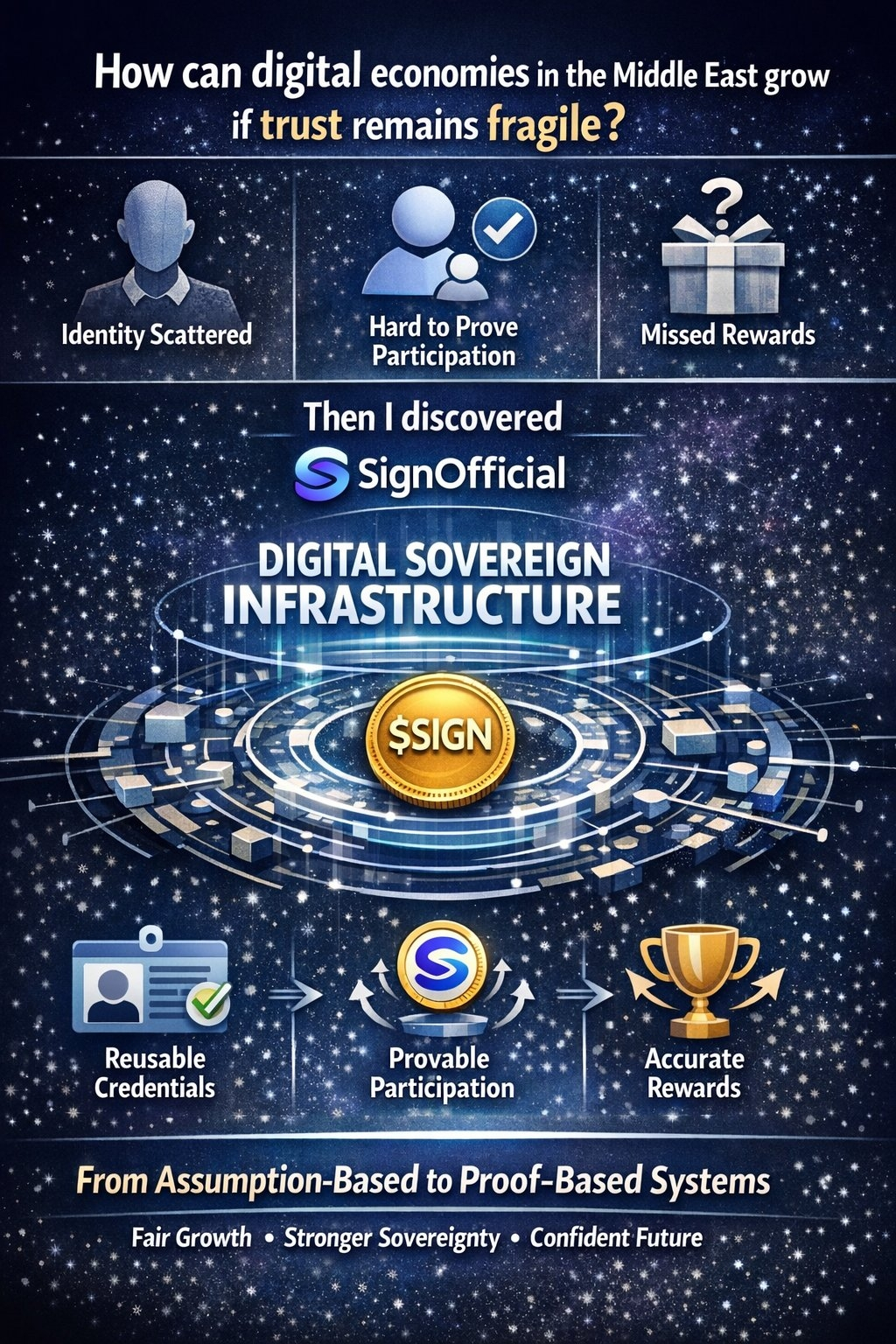
In the early architecture of the internet, identity was an afterthought. Protocols were built to move packets, not to verify people. As a result, the digital world evolved into a patchwork of silos—platform-bound identities, fragmented reputations, and value systems that rarely traveled with the user. What we are now witnessing in the Web3 era is not merely a technological upgrade, but a structural rethinking: identity, participation, and reward are being reassembled into a coherent, interoperable system. Projects like @Sign are positioning themselves at the center of this transition, proposing what can be described as digital sovereign infrastructure—a framework where identity is reusable, participation is provable, and rewards are distributed with algorithmic fairness.
This vision is particularly resonant in regions like the Middle East, where rapid digital transformation meets an increasing appetite for technological sovereignty. Yet the ambition extends far beyond geography. It gestures toward a broader question: can we build a digital economy where trust is not assumed but cryptographically verified, and where participation becomes a measurable, transferable asset?
To understand the implications, one must move beyond the surface-level narrative of “Web3 innovation” and instead examine the underlying primitives being constructed.
The Fragmentation Problem: Identity Without Continuity
At the heart of the current digital ecosystem lies a paradox. Users generate immense value—through data, engagement, and social capital—yet they possess little continuity across platforms. A reputation earned in one ecosystem is largely meaningless in another. Identity, in this sense, is neither portable nor composable; it is locked within the boundaries of each application.
Web3 initially promised to resolve this through wallet-based identity. A public key, in theory, could serve as a universal identifier. But in practice, wallets alone are insufficient. They provide persistence but not context. They answer the question of who is acting, but not how or why.
This is where the notion of reusable identity becomes critical. It is not simply about linking actions to an address, but about constructing a layered identity—one that aggregates credentials, proofs, and behavioral signals across a mesh of chains. In such a system, identity evolves from a static identifier into a dynamic, composable object.
The metaphor here is less a passport and more a living dossier—one that can be selectively disclosed, cryptographically verified, and reused across contexts. It is a federated model of identity, where trust is not centralized but distributed across verifiable attestations.
Participation as Proof: From Engagement to Verifiability
If identity is the foundation, participation is the engine. Yet in most digital systems today, participation is poorly measured. Metrics such as clicks, likes, or even token holdings offer only crude approximations of engagement. They are easily manipulated, difficult to contextualize, and often detached from genuine contribution.
The emerging paradigm seeks to transform participation into a provable artifact. This involves encoding actions—whether governance votes, liquidity provision, or community contributions—into verifiable proofs that can be independently validated. Participation, in this framework, becomes a form of data with integrity.
This shift has profound implications. It allows for the creation of systems where rewards are not based on arbitrary metrics, but on cryptographically attested behavior. It enables the construction of reputation systems that are resistant to sybil attacks and manipulation. And perhaps most importantly, it introduces a new layer of accountability into decentralized networks.
Yet the challenge lies in defining what constitutes meaningful participation. Not all actions are equal, and not all contributions can be easily quantified. There is a risk that overly rigid definitions may reduce complex human behavior into simplistic metrics. The tension between quantification and nuance remains unresolved.
Fair Rewards: The Algorithmic Distribution of Value
The third pillar of this emerging infrastructure is the concept of fair rewards. In traditional systems, value distribution is often opaque and centralized. Platforms capture the majority of economic upside, while users receive fragmented incentives.
Web3 attempts to invert this model by embedding reward mechanisms directly into the protocol layer. Tokens, in theory, align incentives by distributing ownership to participants. But the reality has been more complicated. Tokenomics can be gamed, early adopters often capture disproportionate value, and speculative dynamics frequently overshadow genuine utility.
A more refined approach involves linking rewards directly to provable participation. By leveraging verifiable data, systems can distribute value in a way that is transparent, auditable, and resistant to manipulation. This is not merely about fairness in a moral sense, but about efficiency in an economic sense. When incentives are aligned with actual contribution, networks become more resilient and productive.
However, fairness itself is a contested concept. Algorithms reflect the assumptions of their designers, and any reward system inevitably embeds a set of values. The question is not whether a system is fair, but whose definition of fairness it encodes.
Digital Sovereignty: Beyond Infrastructure
The term “digital sovereignty” is often invoked in geopolitical contexts, referring to a nation’s ability to control its digital infrastructure and data. But in the Web3 paradigm, sovereignty extends to the individual. It is about giving users control over their identity, their data, and their economic participation.
Projects like @Sign are effectively building a blueprint for the internet of value—an infrastructure layer where identity, participation, and rewards are seamlessly integrated. This can be seen as an attempt to move from platform-centric architectures to protocol-centric ecosystems. Instead of relying on centralized intermediaries, users interact directly with a network of interoperable protocols.
In regions like the Middle East, where governments and institutions are actively exploring blockchain technologies, this model offers a compelling proposition. It enables the creation of systems that are both globally interoperable and locally controlled. It provides a pathway for economic participation that is not constrained by traditional financial infrastructure.
Yet sovereignty is not without trade-offs. Greater control often comes with greater responsibility. Users must manage their own keys, navigate complex systems, and bear the risks associated with decentralization. The promise of sovereignty can quickly become a burden if usability and accessibility are not adequately addressed.
The Skeptical Lens: Complexity, Centralization, and Human Behavior
While the vision of digital sovereign infrastructure is compelling, it is important to approach it with a critical perspective. One of the primary challenges is complexity. The systems required to implement reusable identity and provable participation are inherently sophisticated. They involve cryptographic primitives, interoperability layers, and intricate incentive mechanisms.
This complexity can create barriers to adoption. For mainstream users, the value proposition must be clear and tangible. If interacting with these systems feels cumbersome or opaque, adoption will remain limited.
There is also the question of hidden centralization. Even in decentralized systems, certain components—such as identity registries or proof aggregators—may become points of control. The risk is that new forms of centralization emerge under the guise of decentralization.
Finally, there is the unpredictable nature of human behavior. Technology can provide tools, but it cannot fully dictate how those tools are used. Incentive systems may be gamed, reputations may be manipulated, and social dynamics may evolve in unforeseen ways. The history of the internet is a reminder that users often repurpose technologies in ways that designers did not anticipate.
A Mesh of Chains: Interoperability as the Next Frontier
One of the most intriguing aspects of this emerging infrastructure is its inherently cross-chain nature. In a world where multiple blockchains coexist, identity and participation must transcend individual networks. This requires a level of interoperability that goes beyond simple token transfers.
The idea of a mesh of chains captures this vision. Each chain serves as a node within a larger network, contributing to a shared fabric of identity and data. In such a system, a user’s actions on one chain can inform their reputation on another. Participation becomes a multi-dimensional construct, spanning ecosystems and contexts.
Achieving this level of interoperability is a formidable challenge. It requires standardized protocols, robust security mechanisms, and widespread collaboration across the industry. But if successful, it could unlock a new phase of Web3—one where the boundaries between chains become increasingly irrelevant.
The Middle East as a Case Study in Verifiable Growth
The reference to the Middle East is not incidental. The region is undergoing a rapid transformation, with significant investments in digital infrastructure and a growing interest in blockchain technologies. Governments are exploring use cases ranging from digital identity to supply chain transparency.
In this context, the concept of verifiable growth takes on particular significance. Traditional metrics of economic development are often difficult to measure and verify. By contrast, blockchain-based systems can provide real-time, auditable data on participation and value creation.
This opens up new possibilities for policy and governance. Decision-makers can base their strategies on verifiable data rather than assumptions. Citizens can engage with systems that are transparent and accountable. And businesses can operate within an ecosystem where trust is embedded into the infrastructure.
Yet the success of such initiatives will depend on more than technology. It will require regulatory clarity, institutional support, and a willingness to experiment. The interplay between innovation and governance will be crucial in shaping the trajectory of digital sovereignty in the region.
Toward a New Social Contract
At its core, the vision of reusable identity, provable participation, and fair rewards is not just a technical proposition. It is a reimagining of the social contract in the digital age. It asks a fundamental question: how do we organize trust in a world where intermediaries are no longer the default?
In traditional systems, trust is often implicit. We trust institutions, platforms, and authorities to act in our best interests. In Web3, trust is made explicit. It is encoded into protocols, verified through cryptography, and distributed across networks.
This does not eliminate the need for trust; it transforms it. Trust becomes less about belief in institutions and more about confidence in systems. It shifts from a social construct to a mathematical one.
But even in a world of cryptographic guarantees, human trust remains essential. Technology can verify actions, but it cannot fully capture intentions. It can measure participation, but it cannot fully understand meaning. The gap between what can be proven and what can be felt persists.
@SignOfficial $SIGN #SignDigitalSovereignInfra