

I've been watching crypto projects fight tooth and nail to onboard the next million retail users through flashy apps, airdrops, and meme coins. But recently, I stumbled down the rabbit hole of @SignOfficial (S.I.G.N), and it completely shattered my perspective.
While we've been arguing on Binance about which layer-1 chain has the fastest transactions, Sign has been quietly walking into the offices of government ministries and central banks, asking a completely different question: What happens when your country's financial infrastructure fails?
You wake up, grab your phone, and buy a coffee.
You check your digital ID to log into a government portal, pay your taxes, and verify your property deed.
Everything runs smoothly.
What you don't know is that the traditional banking servers went down three hours ago, and every single transaction you just made was processed on a blockchain.
You didn't need a seed phrase.
You didn't pay a gas fee in ETH or SOL.
You just lived your life.
The 'Digital Lifeboat' Theory
Here is the reality check I had to process: Sign isn't trying to build another decentralized casino.
They are building sovereign-grade digital infrastructure for national systems of money, identity, and capital.
They call it a "digital lifeboat."
Think about it from a macroeconomic angle. If a geopolitical crisis or a massive server outage wipes out a country's centralized database, that nation halts.
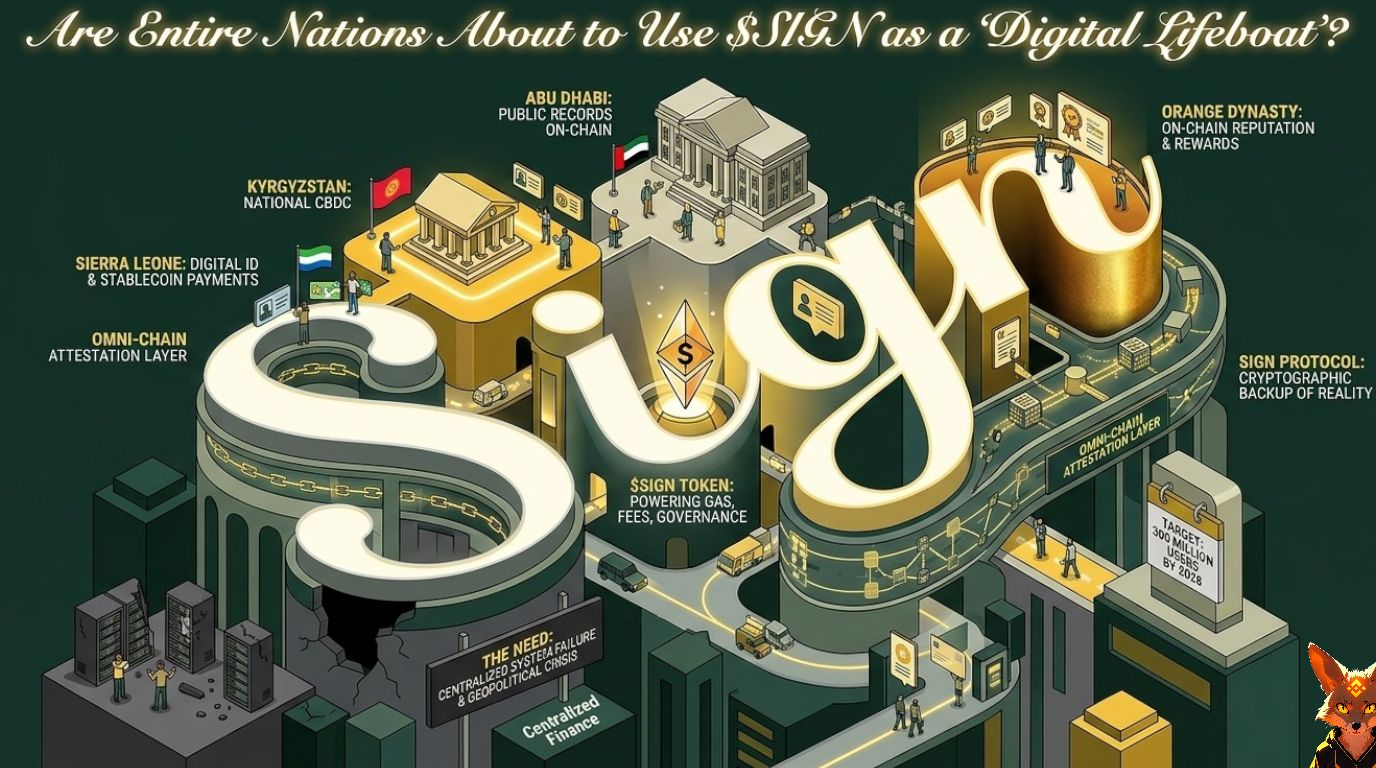
Sign Protocol fixes this by acting as an omni-chain attestation layer.
It creates a cryptographic, tamper-proof backup of reality—a verifiable record of who you are, what you own, and what you owe—that exists across multiple blockchains simultaneously.
Bringing Countries On-Chain (With Receipts)
I know exactly what you're thinking right now because I thought it too: "Sure, it sounds great on paper, but governments hate crypto."
That's the twist.
Governments don't hate blockchain; they hate losing control.
Sign Global gives them the security of decentralized ledgers without sacrificing their operational sovereignty.
And this isn't just a whitepaper dream. Papers have actually been signed:
Kyrgyzstan is literally building its national CBDC (Central Bank Digital Currency) on Sign.
Sierra Leone is rolling out digital ID and stablecoin payments with the Ministry of Communication.
Abu Dhabi is moving critical public records on-chain.
Their target is to onboard 300 million people by 2028.
Not through an app store download, but by integrating into the very national systems these populations already use every single day.
Where Does the $SIGN Token Actually Fit In?
As an investor and a researcher, my next question was obvious: Where is the value capture? If countries are using this behind the scenes, what does the $SIGN token actually do?
$SIGN is the heartbeat of this entire omni-chain ecosystem.
It powers the gas, the fees, and the governance across their massive suite of products—like TokenTable (which has already handled over $ 4 billion in token distributions) and SignPass (the on-chain identity registry).
But what fascinates me most is the cultural layer they've built on top of this institutional framework: The Orange Dynasty App.
It’s a verifiable, on-chain reputation system. Instead of your influence being measured by how many followers you have, it’s measured by your cryptographic footprint.
Your contributions, your campaign participation, and your loyalty are attested on-chain.
It completely redefines what it means to be a "verified" contributor in Web3.
The Invisible Revolution
I'm writing this because I truly believe we are standing at the edge of a massive paradigm shift.
We’ve spent a decade waiting for mass adoption, expecting it to look like everyone downloading a wallet.
What if mass adoption is actually invisible? What if the infrastructure of tomorrow runs on $SIGN, and the average citizen never even knows they are interacting with Web3?
The market is starting to wake up.
With heavy hitters like Sequoia and CZ writing massive checks, and the token showing incredible resilience when the rest of the market bleeds, the institutional pivot is clear.
We are moving from speculative trading to sovereign utility.
I want to know what you guys think about this angle.
Will the true future of crypto be user-facing apps, or invisible sovereign infrastructure like Sign Global?
Drop your thoughts below—I’ll be replying in the comments! 👇
By #SaidBNB