I have read about a lot of crypto projects, and honestly, most of them start blending into each other after a while. The same big promises. The same dramatic language. The same idea that everything is about to change overnight. But Sign never really hit me that way. It felt quieter than that. More practical. More like it was trying to fix something real instead of just selling a story around a token. And I think that is why it stayed in my mind. 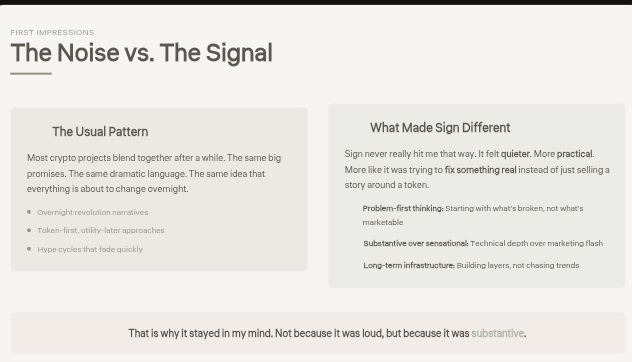
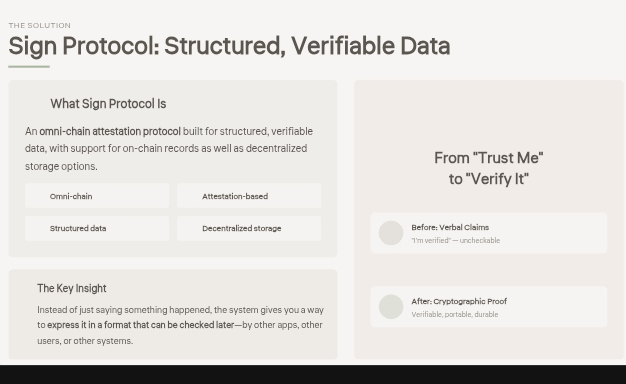
What pulled me in first was the simple fact that the internet still does a terrible job with proof. People say things online all the time. They say they are verified. They say a wallet is eligible. They say a certificate is valid. They say a contract was signed or a record is authentic. But once you stop and ask, “How do I actually check that?” everything starts to feel shaky. Too much of the digital world still depends on screenshots, isolated databases, and trust that breaks the moment it is tested. That is the space where Sign starts to make sense. Its official docs describe Sign Protocol as an omni-chain attestation protocol built for structured, verifiable data, with support for on-chain records as well as decentralized storage options. 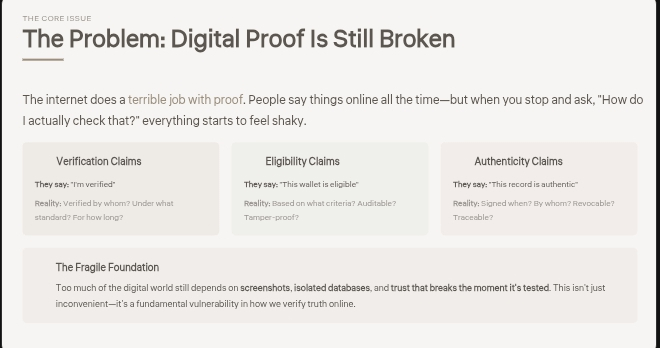
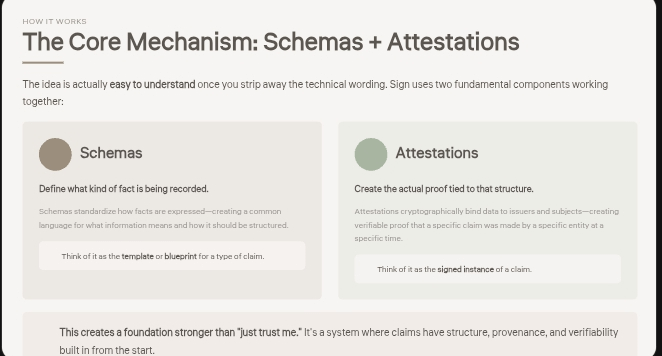
What I like is that the idea is actually easy to understand once you strip away the technical wording. Sign uses schemas to define what kind of fact is being recorded, and attestations to create the actual proof tied to that structure. So instead of just saying something happened, the system gives you a way to express it in a format that can be checked later by other apps, other users, or other systems. Sign’s own documentation says schemas standardize how facts are expressed, while attestations cryptographically bind data to issuers and subjects. That is a much stronger foundation than “just trust me.”
And that is why this project feels more serious to me than a lot of the noise we usually see in crypto. Sign is not really built around empty excitement. It is built around the idea that proof should be usable, portable, and durable. The docs now frame S.I.G.N. as broader infrastructure for systems involving money, identity, and capital, while Sign Protocol acts as the evidence layer underneath. That tells me the project is thinking beyond one narrow on-chain gimmick. It is trying to build something that can sit underneath larger, more formal systems where verification actually matters.
That broader direction is what makes $SIGN feel more interesting than just another ticker floating around the market. On the official Sign site, the token is presented as part of a wider ecosystem that includes Sign Protocol, TokenTable, and EthSign. The company’s materials also position these products around real-world uses rather than just speculative messaging. EthSign, for example, says it has more than 2 million users and 800 thousand contracts signed, which at least shows the team is not trying to build from a completely empty base.
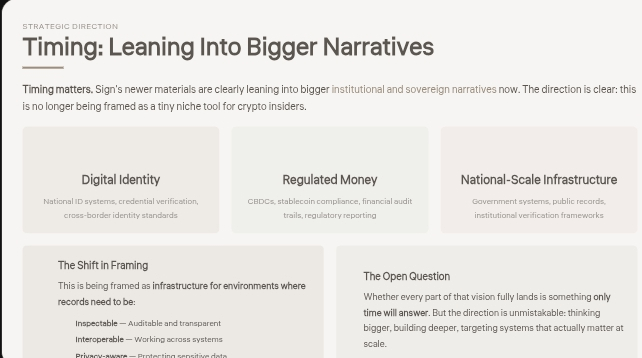
Another part I genuinely find compelling is the privacy angle. A lot of people hear the word “verification” and immediately think it means exposing everything. But that is not really trust. That is overexposure. Sign’s official product pages explicitly mention selective disclosure, privacy modes, and support for public, private, and hybrid attestations. To me, that is one of the smartest parts of the whole design. In real life, you usually do not need to reveal everything about yourself. You only need to prove the specific thing that matters. Systems that understand that are usually built with more maturity.
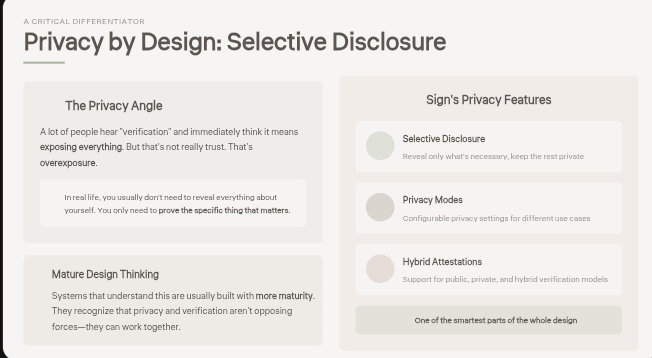
I also think timing matters here. Sign’s newer materials are clearly leaning into bigger institutional and sovereign narratives now, including digital identity, regulated money, and national-scale infrastructure. Whether every part of that vision fully lands is something only time will answer. But the direction is clear: this is no longer being framed as a tiny niche tool for crypto insiders. It is being framed as infrastructure for environments where records need to be inspectable, interoperable, and privacy-aware at the same time.
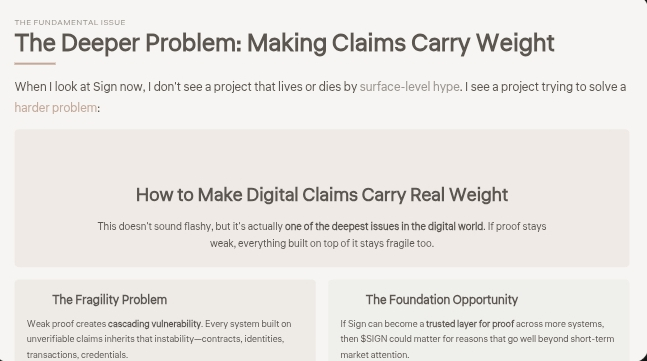
So when I look at Sign now, I do not really see a project that lives or dies by surface-level hype. I see a project trying to solve a harder problem: how to make digital claims carry real weight. That does not sound flashy, but it is actually one of the deepest issues in the digital world. If proof stays weak, everything built on top of it stays fragile too. And if Sign can keep becoming a trusted layer for that proof across more systems, then $SIGN could matter for reasons that go well beyond short-term market attention. That is what keeps me interested.