What is the sentence you fear hearing the most in Web3?
What I fear the most is: "Trust me, bro."
But what chills the spine more than a runaway dog is if one day you wake up to find - your Binance account has been restricted from withdrawals due to "IP location risk", not because you did something bad, but simply because your coordinates are politically "incorrect" on the map.
When local conflicts turn banks into weapons, the biggest pain point of Web3 is no longer about "whether to scam money" but rather: in this divided world, can your money truly belong to you?
This is $SIGN (@SignOfficial ) the underlying ambition of creating a "programmable trust protocol": it wants to use a few lines of code to build a "digitally neutral country that recognizes only rules and not nationalities" in this biased financial world.
🔍 Why was the "trust" in Web3 previously fragmented?
Imagine this: you are a programmer in Dubai, writing code brilliantly, wanting to borrow some money in DeFi to start a business.
The previous logic: You had to beg centralized platforms to do KYC, prove "I am not a bad person", and then pray that major powers are in a good mood today. This is "human trust"—not only exhausting, but your fate could change at any moment due to a geopolitical blacklist.
The current stalemate: Many sovereign funds and quality users in the Middle East are afraid to enter the market due to fear of being misidentified. Web3 has effectively turned itself into a "club for specific regions".
What we lack is not money, but a neutral credit score that "can be understood by code and is not controlled by a single power".
The magic of Sign: Turning "reputation" into LEGO blocks
What Sign does is actually very simple: it transforms "whether this person is reliable" into a piece of code instruction like LEGO blocks, which can be automatically executed in any smart contract.
1. What is "programmable"?
In the past, to prove "I am a compliant investor", you had to submit a resume, provide a passport, and take an oath.
The current logic of Sign is: If this address possesses the "compliance verification" issued by Sign, then the smart contract automatically opens the door without any centralized review.
2. "Only recognize code, not passport"
This proof is a digital passport that exists on the chain. The code scans your "digital backpack"; if you meet the standards, you pass. It doesn't matter whether you are in Riyadh or London; it only looks at your behavioral data. This is "programmable trust": making trust depend not on who is on stage, but on what you have done.
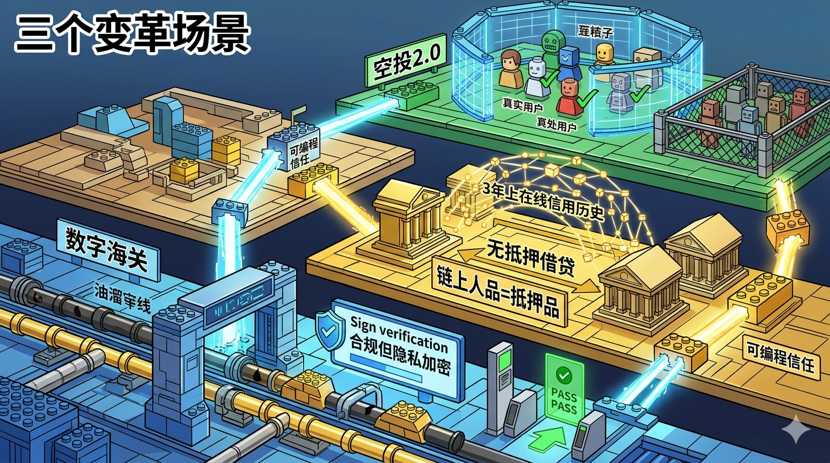
🚀 Revolution: Three scenarios that could change the game
1. Airdrop 2.0: Precisely "airdrop" to real people, not robots
Project parties in the Middle East fear that money will go to bad actors or sanction lists. With Sign, project parties can set thresholds: only addresses verified through "real behavior validation" can claim. This prevents robots and protects the compliance lifeline of the project.
2. Unsecured lending: The "credit backdoor" of petrodollars
If Sign has recorded your three years of on-chain repayment history, in the future, you might be able to borrow money with zero collateral—your "on-chain reputation" is the best collateral. This could even allow Sharia-compliant financial products to scale on-chain.
3. Cross-border trade: Automated "digital customs"
Assuming that in the future, the Middle East explores settling energy trades with stablecoins, Sign could become an automatic ticket-checking gate: before the transfer, the smart contract automatically checks the Sign proof—"This person is compliant, but identity privacy is encrypted". It protects the business while not exposing anyone.
The blueprint is beautiful, but who printed the passport for this "digital neutral country"?
• The trap of issuing authority: The "neutrality" of Sign depends on who qualifies to be an "issuing ambassador". If these ambassadors are already co-opted by major powers, then this "digital Switzerland" may just be another "digital colony".
• The cost of privacy: To gain trust, must we record all behaviors on the chain?
• The coldness of code: If you are accidentally misidentified, the code may not listen to your explanation.
Unless Sign can achieve decentralized governance of the Issuer, this "neutral country" is still just a "concession".
Market observation logic (geopolitical version):
• Look at the "official endorsement": Keep an eye on the official funds in Dubai or Abu Dhabi. If they announce adopting Sign as the default compliance layer, then it becomes the "digital Switzerland" of Web3.
• Look at the "integration breadth": Observe how many projects with non-Western backgrounds are starting to use "Sign proof" as an entry threshold.
• Look at the "neutrality": In the regulatory year of 2026, whoever can achieve compliance without bowing to a single power will be the winner in the chaotic world.
The essence of Sign is to upgrade trust from "determined by people" to "determined by code". In an increasingly fragmented geopolitical game, perhaps only neutral code can serve as the final arbitrator.
If you must choose one between the two: would you prefer to keep your money in a traditional bank that "might freeze your account due to geopolitical reasons", or would you prefer to entrust your identity to the Sign protocol that "only recognizes code, not passport"?