
I did not start thinking about Sign Protocol as Middle East infrastructure because of any announcement.
It was something more specific than that.
Sign's docs describe Sign Protocol as an evidence layer. Not an identity app. Not a credential issuer. An evidence layer — where attestations are structured, bound to an issuer, made queryable, and designed to survive movement across systems and time.
That phrase kept pulling me back.
Because the Middle East's digital economy problem is not a technology shortage. The UAE has among the highest digital infrastructure investment per capita in the world. Saudi Arabia's Vision 2030 is deploying billions specifically into sovereign digital systems. Bahrain built a regulatory sandbox that became a regional model for fintech licensing.
The problem is not building. The problem is evidence.
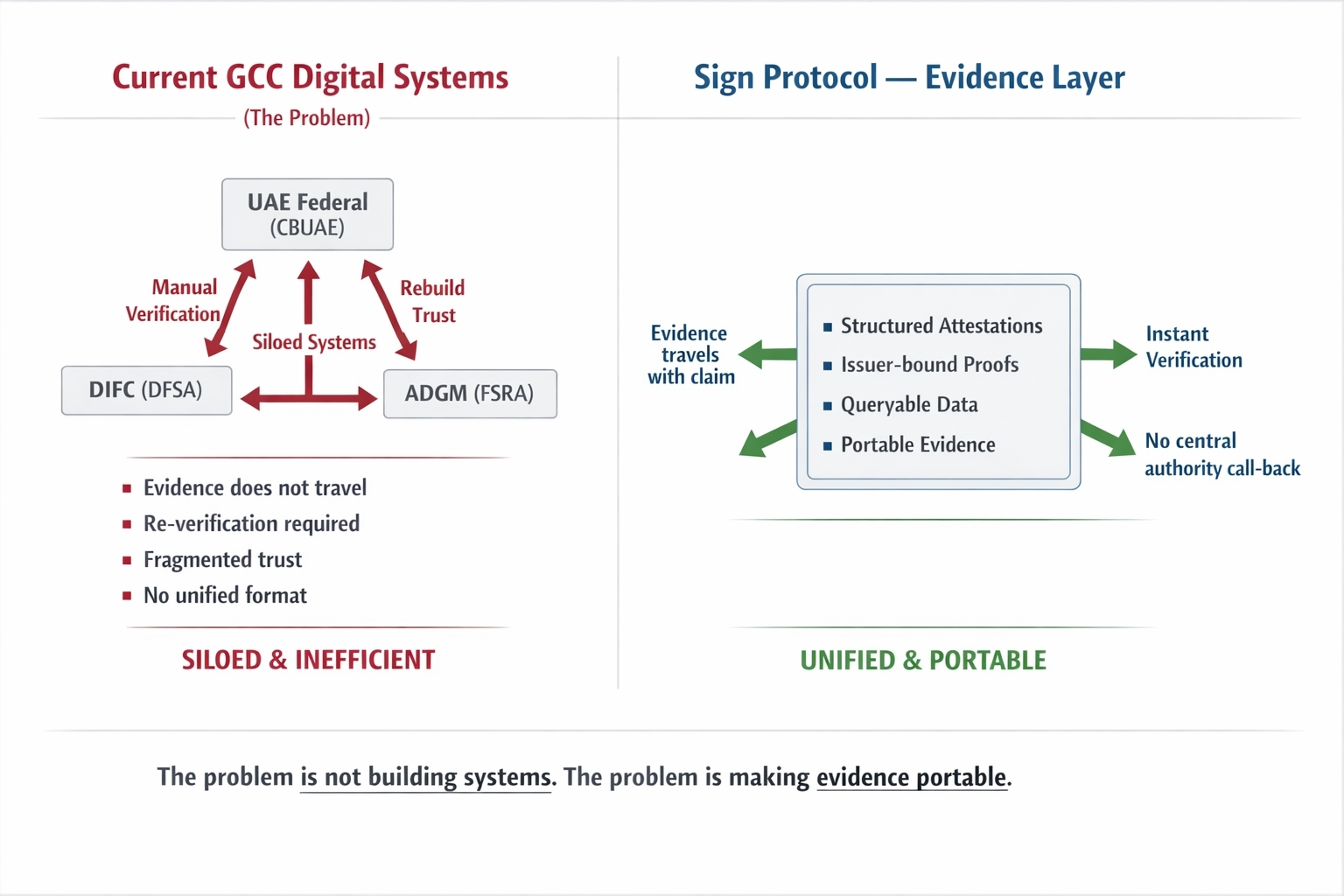
When a credential gets issued in one UAE jurisdiction and needs to be recognized in another — federal CBUAE, DIFC under DFSA, ADGM under FSRA — the question is not whether the credential exists. The question is whether the evidence behind it travels in a format every receiving system can verify without reconstructing trust from scratch.
That is the exact problem Sign Protocol's architecture addresses.
Sign's own docs are explicit about this. They describe attestations as portable, verifiable proofs that can travel across systems and time. The system supports writing attestations fully on-chain across EVM chains, Starknet, Solana, and TON, while also supporting hybrid storage models that keep sensitive data under sovereign jurisdiction.
A claim can move. The evidence behind it moves with it. And the receiving system does not need to call back to a central authority to verify it.
That matters enormously in a region where data sovereignty is not a preference. It is a legal requirement written into every digital transformation strategy from Riyadh to Abu Dhabi.
What I find more interesting is the TokenTable side of this picture.
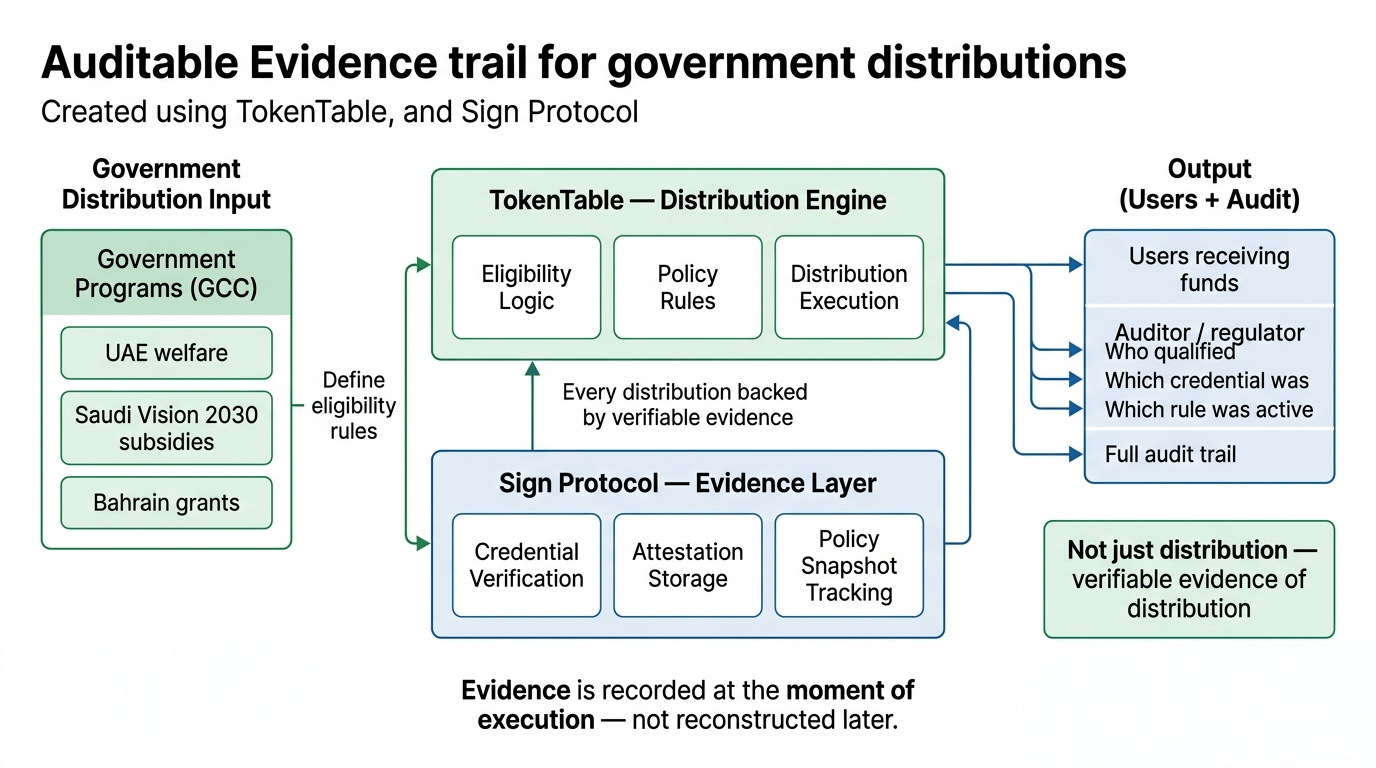
The GCC distributes enormous amounts of capital through government programs — Vision 2030 subsidies, UAE welfare distributions, Bahrain grant programs. Legacy systems handle the transfer. But they cannot easily answer the harder questions afterward. Who qualified. Under which rule. Which credential counted at the moment of distribution. Which policy version was active.
Sign Protocol's docs place TokenTable inside the S.I.G.N. capital system precisely for this reason. TokenTable handles the distribution logic. Sign Protocol handles the evidence layer underneath it. The division means that every distribution carries an auditable evidence trail that is structured, queryable, and inspection-ready — not reconstructed manually after the fact.
That is not a feature Middle Eastern governments are being sold on.
That is a problem Middle Eastern governments are already spending money trying to solve badly.
I do not think this means Sign Protocol will automatically win sovereign contracts across the GCC. That is not how institutional infrastructure gets adopted. Sign's own docs acknowledge this directly — the path to sovereign deployment is never linear, and it evolves with policy, adoption constraints, and interoperability requirements that no architecture can fully anticipate in advance.
But that honesty is part of what makes the framing feel real to me.
Sign Protocol stopped sounding like a project reaching for government credibility. It started sounding like a verification layer that the Middle East's regulatory architecture is already structurally asking for — quietly, in the language of evidence retention and cross-jurisdictional credential portability, not in the language of blockchain announcements.
That is a different kind of relevance.
And it is harder to dismiss.