



The total market capitalization of cryptocurrencies has decreased by more than 3 percent.
Bitcoin's dominance has slightly decreased to 58.3 percent.
Bitcoin and Ethereum exchange-traded funds have recorded significant withdrawals.
The fear and greed index indicates continued fear in the market.
The cryptocurrency market has experienced a noticeable decline, with the total market value dropping by more than 3 percent. This decline has reduced the total market capitalization to around $2.36 trillion, indicating a phase of weakness in the short term across digital assets. Such movements in exchange-traded funds (ETFs) often reflect a state of collapse or reduced risk appetite among investors. During unstable periods, capital tends to shy away from volatile assets, contributing to a broader market decline. Even small relative decreases in total market capitalization can signify significant changes in market sentiment.
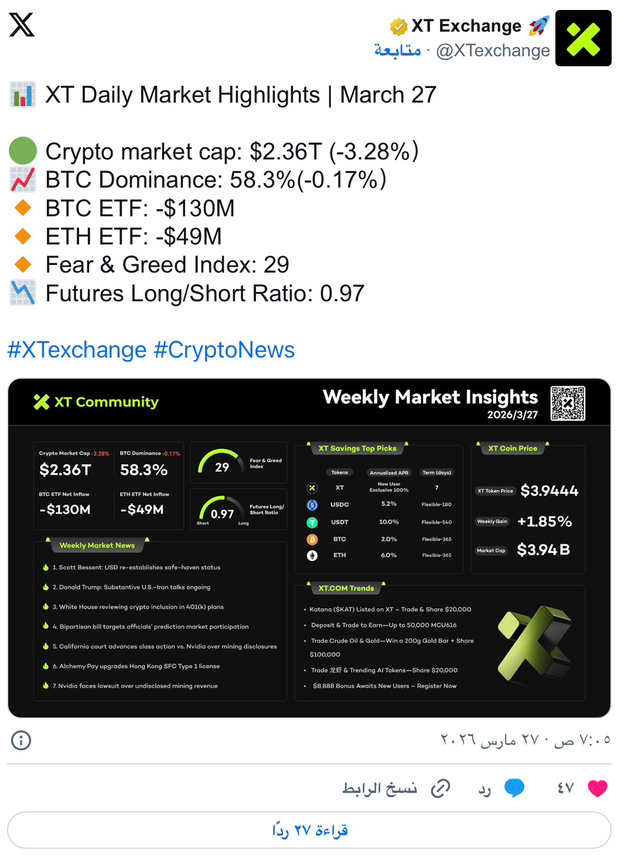
Market capitalization decline reflects widespread weakness $BTC
At the same time, Bitcoin dominance has slightly decreased. A decline in dominance often indicates that alternative currencies are facing relatively greater pressure, as they tend to react more sharply during corrections. This dynamic reinforces the idea that the current environment is affecting the broader market rather than isolated assets.
These flows are often interpreted as a sign of reduced exposure or strategic repositioning by large investors. ETF flows are a key indicator of institutional sentiment, providing insight into how major players navigate the current conditions.
ETF collapse indicates institutional caution $ETH
Bitcoin ETFs recorded outflows estimated at around $130 million, followed by Ethereum ETFs with nearly $50 million in withdrawals. Current market sentiment indicators point to a fear-driven environment. ETF data also highlights a cautious stance among institutional investors. The fear and greed index remains low, reflecting increased caution and uncertainty among investors.
However, short-term outflows do not necessarily indicate a long-term bearish shift. They could also be a result of profit-taking after previous gains or portfolio rebalancing in response to macroeconomic developments. Despite recent withdrawals, institutional participation in cryptocurrencies remains a significant force in shaping market trends.
Prospects of the cryptocurrency market $XRP
A combination of declining market capitalization, ETF collapse flows, and low sentiment points to cautious near-term expectations. External influences such as macroeconomic conditions, interest rate forecasts, and geopolitical developments continue to shape market behavior. When sentiment is weak, but positioning is balanced, markets often enter phases of consolidation. During these periods, price movements may remain volatile but lack a sustainable trend until a clearer catalyst emerges.
Investors are closely monitoring these factors to assess the potential trend. While current conditions reflect hesitation, historical market cycles show that periods of fear can precede recovery phases.
Currently, the focus remains on whether institutional flows will return and if sentiment will begin to stabilize. As conditions evolve, market participants will look for signs of renewed confidence that may support the next phase of growth.
#BinanceSquareFamily #BinanceSquare #Binance #NewsAboutCrypto #news