


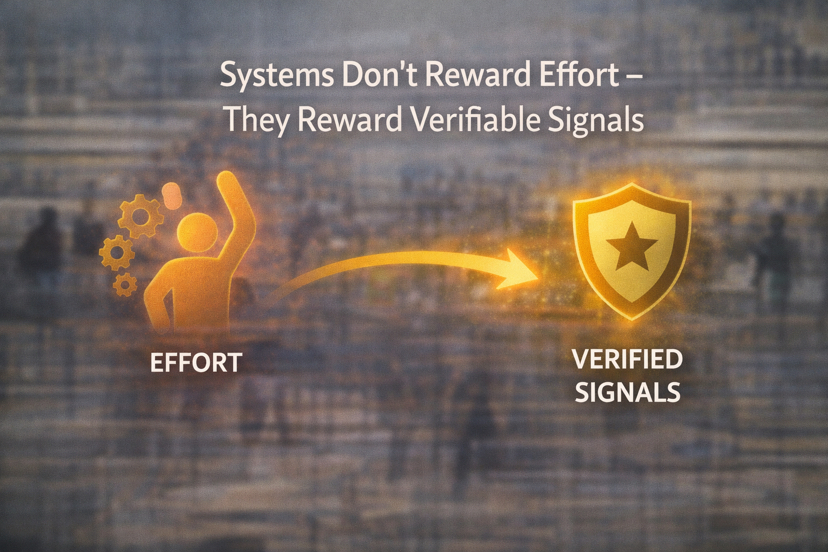
I keep noticing that systems don’t really reward effort.
At least not directly.
You can spend time contributing helping participating doing what feels meaningful. And still when outcomes are decided it doesn’t always line up with how much effort you put in.
At first that feels unfair.
But when you look closer it starts to make more sense.
Because systems don’t see effort the way people do.
Effort is subjective.
Intent is invisible.
Claims can be exaggerated or incomplete.
A system can’t reliably measure any of that.
So it doesn’t try.
Instead it looks for something else.
Signals.
Not just any signals but signals it can verify.
Because verification is what makes something usable inside a system. Without it there’s no way to distinguish between what actually happened and what is being claimed.
You can say you contributed.
But unless that contribution is structured and provable the system can’t really use it.
So it gets ignored.
Not because it didn’t matter.
But because it couldn’t be processed.
That’s the gap.
People experience effort.
Systems process signals.
And the two don’t always overlap.
This is where things start to feel misaligned.
From a human perspective value often comes from how much time energy or thought was put into something.
From a system perspective value comes from what can be verified structured and reused.
That’s a very different filter.
It explains why some actions get recognized while others don’t. Why some users qualify for rewards while others feel overlooked. Why outcomes sometimes feel disconnected from input.
The system isn’t evaluating effort.
It’s evaluating signals.
And signals only exist when something can be proven.
This is where verification becomes more than just a technical feature.
It becomes the mechanism that turns activity into something the system can understand.
When an action is verified it stops being ambiguous. It becomes a defined claim. Something with structure context and proof.
And once that happens it can be used.
It can influence decisions.
It can qualify for outcomes.
It can carry weight beyond the moment it occurred.
Without that step, the action remains invisible to the system.
Not invisible in the sense that it didn’t happen.
But invisible in the sense that it can’t be processed.
That’s an important distinction.
Because it shifts how value is created.
It’s not just about what you do.
It’s about what can be verified about what you do.
That doesn’t make effort irrelevant.
But it does mean effort alone isn’t enough.
For effort to matter inside a system, it has to translate into something that can be proven.
Something structured.
Something that can be checked without relying on interpretation.
Once that translation happens things start to change.
Your actions begin to produce signals.
Those signals begin to accumulate.
And the system can start to recognize them consistently.
This is also where things become more predictable.
Not necessarily easier.
But clearer.
Instead of guessing what matters you can start to see what the system actually responds to.
Not effort in isolation.
But verifiable signals.
And as systems become more automated more interconnected and more dependent on structured data that pattern becomes stronger.
Because systems can’t scale subjective judgment.
They can only scale what they can verify.
That’s the direction things are moving.
Not toward measuring everything.
But toward measuring what can be proven.
And once you understand that a lot of system behavior starts to make more sense.
Not as random.
Not as unfair.
But as a reflection of what the system is actually capable of processing.
Which in the end is not effort.
But proof.