
Last month, my family arranged a blind date for me. Before we met, the girl's parents did something that still makes me a bit awkward; they had someone check all my personal records. On the day of the meeting, the girl's mother came with a printed sheet, densely packed with all my information, and the first thing she said was: 'You changed jobs once in 2019, right?'
At that moment, my face turned red, not because the information was false, but because it felt like everything about me was pieced together into a file, laid out on the dining table for verification, like interrogating a criminal. What made it even more uncomfortable was that I completely understood the other party's logic: they didn't know me, there was no foundation of trust, and they could only rely on this method to reduce risks. This is a real need, but the process is extremely undignified.
Later, while eating, I kept thinking that if I could directly present a proof, only showing the information the other party cares about and not displaying the rest, this meal wouldn't have to be so awkward! No need to rely on others for checks, no need for awkwardness; I can control the boundary of information, and the other party can also get the answers they want.
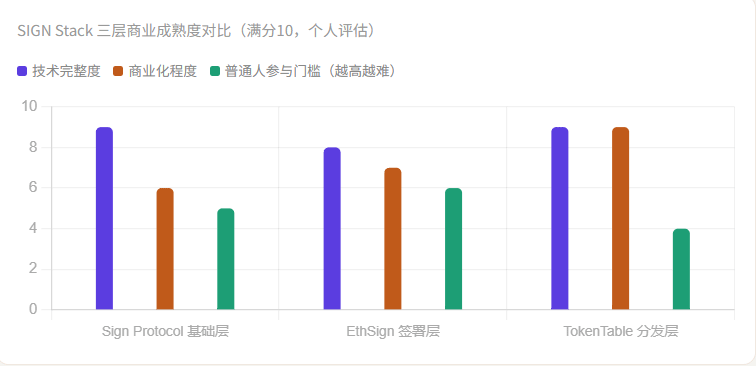
This is the core logic of @SignOfficial : on-chain certification of Attestation. You choose which information to make public and which to shield, but the version the other party receives is absolutely real and cannot be faked.
After discussing this underlying logic, what I want to share with my brothers is the OBI plan launched by SIGN. This is currently one of the few mechanisms in the SIGN ecosystem that ordinary people can directly participate in and have tangible benefits, without needing to understand technology or buy mining machines; the threshold is low enough that as long as you are a real person, you can participate.

The logic of OBI is actually very simple, but the problems it solves are not simple at all. One of the most painful things for veterans in Web3 is called witch attacks, where tasks are repeated to claim airdrops, taking away incentives that should be distributed to real users. Various projects have different anti-witch measures, but most are about finding patterns in on-chain data, which is a passive defense. The higher the skill, the higher the magic.
SIGN's approach is reversed. Instead of using various technical means to identify humans and machines, it is better to let users prove themselves on-chain, allowing the process to be completed by the users themselves. OBI is the implementation of this mechanism. You complete identity Attestation through a series of on-chain actions, and after the system recognizes you as a real user, it will continue to issue SIGN token rewards to you. The earlier you participate and the more you contribute, the higher your accumulated rights.
I participated myself, and the experience had little friction. The entire process is transparent and smooth on-chain, without any black-box operations where the platform decides how much to issue. Of course, the earnings are tied to the token price, which must be understood; it's not a risk-free stable income.
Looking at it from a higher level, the significance of OBI to the entire SIGN ecosystem is not just about issuing tokens. What SIGN wants to do is actually to filter out real users through incentives. Once this data layer reaches a sufficient scale, it becomes the foundation of the entire on-chain trust system. It is not only usable by SIGN itself, but other cross-chain applications can also call this verified proof of authenticity.
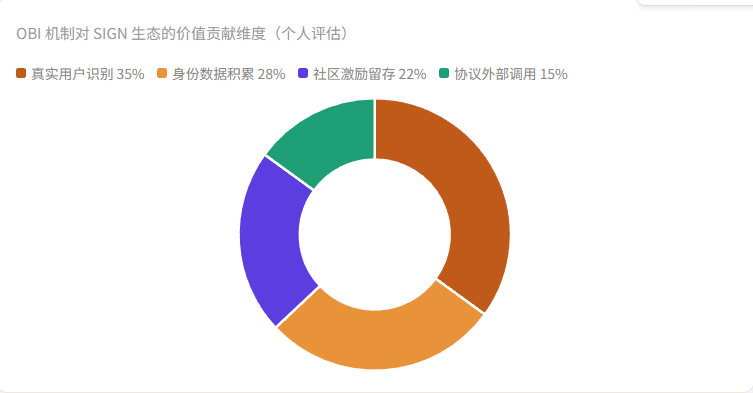
Of course, there are still areas I haven't figured out, such as how the total amount of rewards for each round of OBI is determined and what the decay curve looks like. The information disclosed by the official sources is still not complete, and this needs continuous tracking. The issue of token unlocking pressure hasn't disappeared; the circulating supply is only 10%, and how to release the remaining 35% of the ecosystem part directly affects the actual value of OBI rewards.
Back to that awkward matchmaking dinner, I later told my friends that the most uncomfortable part that day was not being checked, but the sense of powerlessness from the asymmetry of information that I could only passively accept.
What I find interesting about OBI is that it turns my status as a real and trustworthy person into a remote control that users can actively control.
On-chain is not a shackle, but your asset