
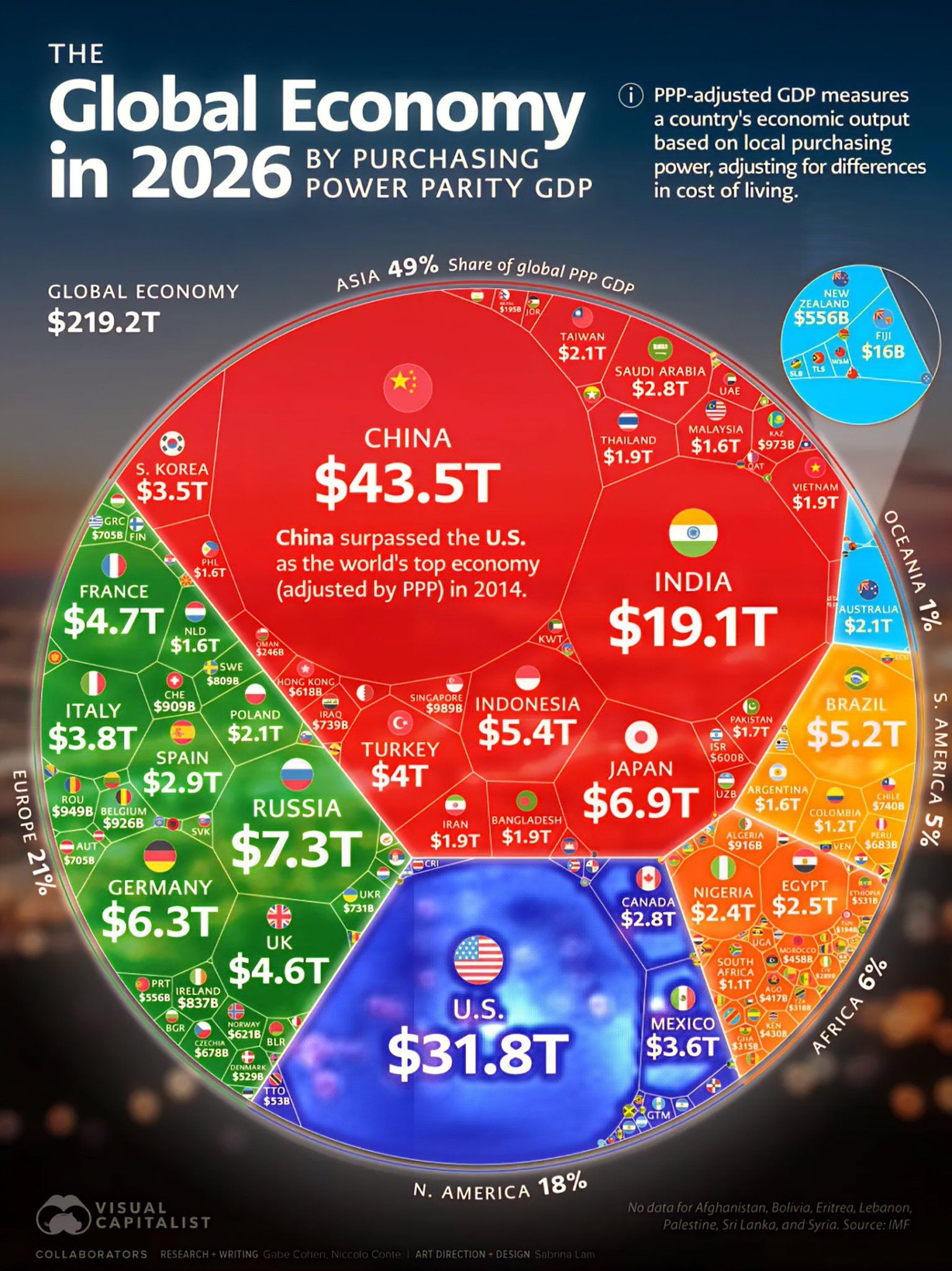
 Just came across the latest IMF data (visualized by Voronoi via Visual Capitalist), and the 2026 rankings of the world’s biggest economies by Purchasing Power Parity (PPP) tell a fascinating story. The global economic center of gravity is shifting faster than many realize.

Here’s the breakdown of the top 100, but the real takeaway isn’t just the numbers—it’s the tectonic shifts happening beneath them. 🇨🇳 China now leads with a staggering $43.49 trillion, overtaking the 🇺🇸 United States at $31.82 trillion. That gap isn’t just about size; it reflects China’s expanding influence in Asia, Africa, and global supply chains.
What really jumps out? The rise of the Global South. 🇮🇳 India has surged to the #3 spot with $19.14 trillion—cementing its role as a true economic superpower in the making. 🇮🇩 Indonesia at #7 and 🇻🇳 Vietnam at #23 highlight how Southeast Asia is becoming an unstoppable manufacturing and consumption hub. Meanwhile, 🇹🇷 Turkey’s leap to #11 shows that despite currency volatility, its strategic position and infrastructure investments are paying off in real economic output.
Another surprise? 🇪🇬 Egypt at #18 and 🇳🇬 Nigeria at #20 signal that Africa’s demographic dividend is beginning to materialize, even amid global headwinds. These aren’t just “emerging” markets anymore—they are core drivers of global growth.
On the European front, traditional powerhouses like 🇩🇪 Germany (#6), 🇫🇷 France (#9), and 🇬🇧 United Kingdom (#10) remain strong, but they’re growing at a much slower pace compared to their Asian and Middle Eastern counterparts. 🇸🇦 Saudi Arabia at #16 and 🇦🇪 UAE at #34 are aggressively diversifying beyond oil, using sovereign wealth funds to build entire new sectors from scratch.

A few under-the-radar moves worth noting: 🇰🇿 Kazakhstan at #36 and 🇺🇿 Uzbekistan at #55 are quietly becoming Central Asian economic anchors, while 🇪🇹 Ethiopia at #53 continues its rapid climb despite regional challenges. And don’t sleep on 🇵🇰 Pakistan at #27 and 🇧🇩 Bangladesh at #26—South Asia is now home to three of the top 30 economies globally.
One thing to keep in mind this list is based on PPP, which adjusts for cost of living and purchasing power differences. It’s often the best lens for comparing the real economic output and domestic market size of countries. In nominal (current dollar) terms, the rankings would look different—but PPP arguably tells us more about a country’s actual economic weight on the ground.

The world isn’t just multipolar anymore. It’s multicentered. Growth is no longer concentrated in the West or a single Asian hub—it’s spreading across continents, reshaping trade routes, supply chains, and where the next billion consumers will live.
What’s your take? Does PPP give the most realistic picture, or do you prefer nominal GDP rankings? Let’s discuss below. 👇
Please don’t forget to like, follow, and share! 🩸 Thank you so much ❤️
#BitcoinPrices #TrumpSeeksQuickEndToIranWar #CLARITYActHitAnotherRoadblock #TrumpSaysIranWarHasBeenWon