
Most people are wasting money on-chain, and they don’t even realize it.
We’ve normalized something strange in web3: the idea that if a piece of data can go on-chain, it should. So we dump everything there—metadata, long-form text, images—and then act surprised when gas fees explode.
Here’s the hard truth: the blockchain is a vault, not a filing cabinet.
Using the EVM as a database isn’t just inefficient—it’s financially irresponsible. Blockspace is premium real estate. You don’t store your old photo albums in a bank vault. So why are we doing the digital equivalent?
The Problem: On-Chain Bloat
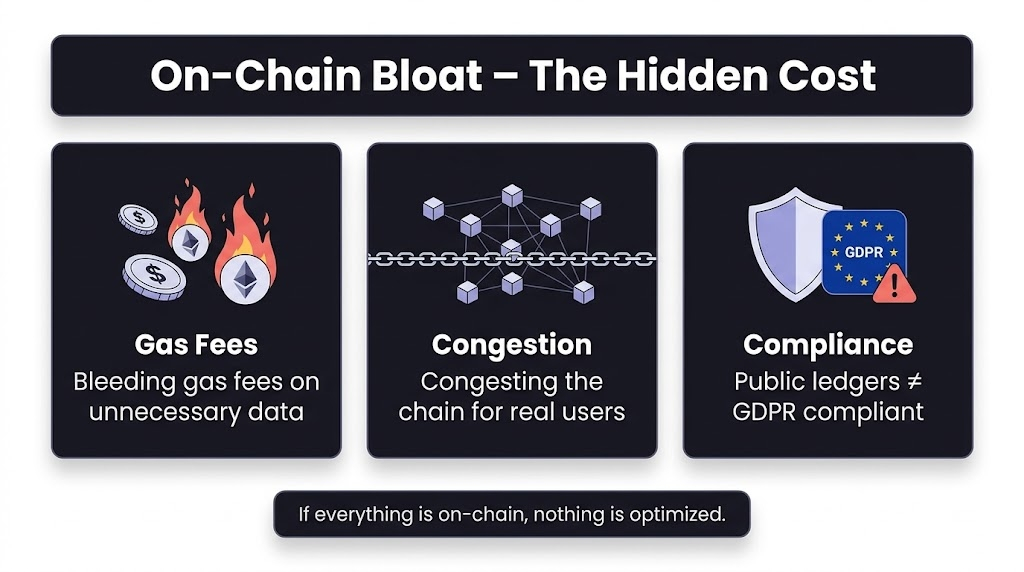
When you force every kilobyte of data onto the mainnet:
. You bleed gas fees on data that doesn’t need settlement-layer security.
· You congest the chain for everyone who actually needs it.
· You lock yourself out of compliance—GDPR and public ledgers don’t mix.
If everything is on-chain, nothing is optimized.
What Sign Protocol Gets Right
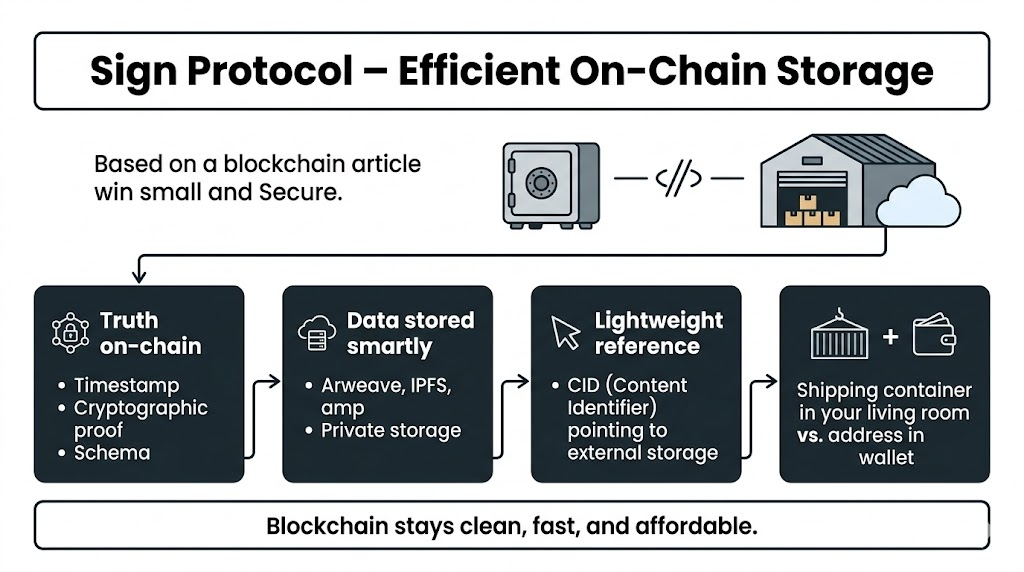
Sign Protocol flips the logic. Instead of stuffing everything into one expensive layer, it treats the blockchain like the premium asset it is.
Here’s how it works:
· You keep the truth on-chain: the timestamp, the cryptographic proof, the schema.
· The weight—the actual data—goes somewhere smarter: Arweave, IPFS, or even your own private storage.
What lives on-chain is a lightweight reference, like a CID. The data is still verifiable and permanent. But the chain stays clean, fast, and affordable.
It’s the difference between storing a shipping container in your living room versus keeping the address in your wallet. The container is safe elsewhere. The address is immutable on-chain.
Why This Matters for Real-World Use
This isn’t abstract theory. It applies directly to how we build today.
Think about:
· KYC records—you can’t put customer identity data on a public, immutable ledger. That’s a compliance nightmare. But you can put a verifiable proof on-chain while the sensitive data stays private.
· Supply chain tracking—you don’t need every GPS coordinate on-chain. You need a verifiable attestation that something happened. Sign Protocol gives you that without the bloat.
· NFT metadata—instead of cramming everything into the token, you store the metadata efficiently and keep the immutable pointer on-chain.
In every case, you get the security of the blockchain without the overhead.
Control Without Lock-In
What I appreciate most is that Sign Protocol doesn’t force one storage model.
If you want fully decentralized storage with Arweave or IPFS? Works perfectly.
If your legal team requires private infrastructure? Also works.
I’m not locked into a rigid system. I get sovereignty over where my data lives, while still anchoring trust on-chain. The schemas are clean. The attestations are clear. And I’m never guessing where the source of truth actually is.
The Bottom Line
Forcing everything on-chain isn’t decentralization—it’s waste. It’s paying first-class prices to ship cargo that belongs in a warehouse.
Sign Protocol takes a smarter path: keep the chain clean, store only what’s necessary there, and use the right place for the right kind of data.
The chain is a premium asset. Stop treating it like a landfill.
Build smarter. $SIGN
