

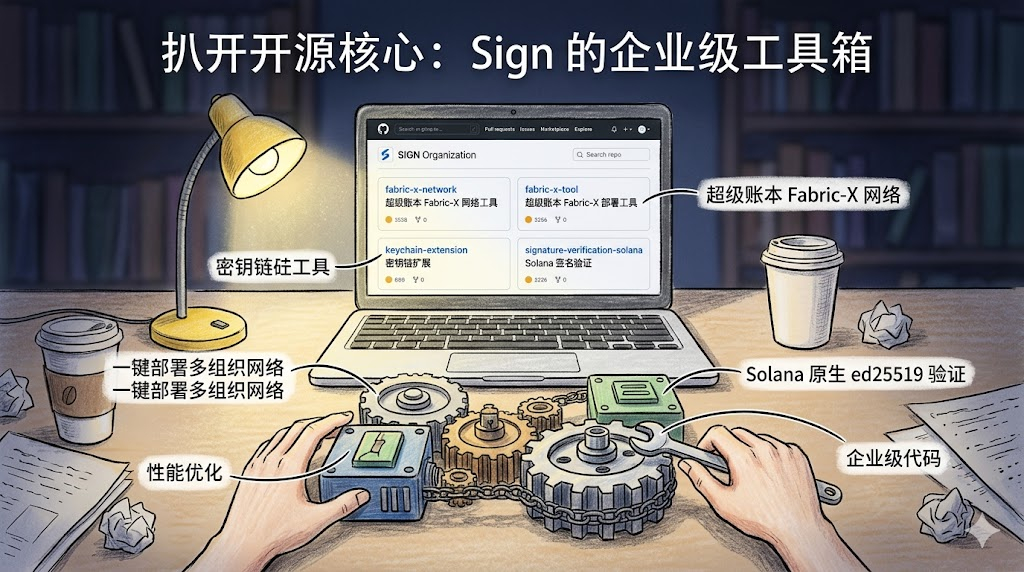
In the past few days, I came across a thread from CTO Jack Xu on X, and my first reaction was: this is a treasure discovery. I used to think that Sign just did electronic signatures, but this time Jack opened up the four core repositories that their team had kept hidden: `fabric-x-network`, `fabric-x-tool`, `keychain-extension`, and `signature-verification-solana`. I stayed up that night, going through the code, reflecting: this guy is really not hiding anything; he genuinely wants to pave the way for everyone.
To be honest, this code is not the kind of 'toy'. I carefully studied the `fabric-x-network`. Working with Hyperledger Fabric used to be a nightmare for operations, with certificate configuration and Docker orchestration driving people crazy. But this tool can deploy multi-organization networks with one click, more than ten times faster than the official process. Also, that signature verification program on Solana doesn't require rewriting those cryptography pitfalls; it can directly verify ed25519. For someone like me who wants to do practical work at the bottom level, this is simply a lifesaver. All of these are enterprise-level tools coming from the 'Built by Sign' organization, ready for implementation. I couldn't stop; I went through and starred each one.
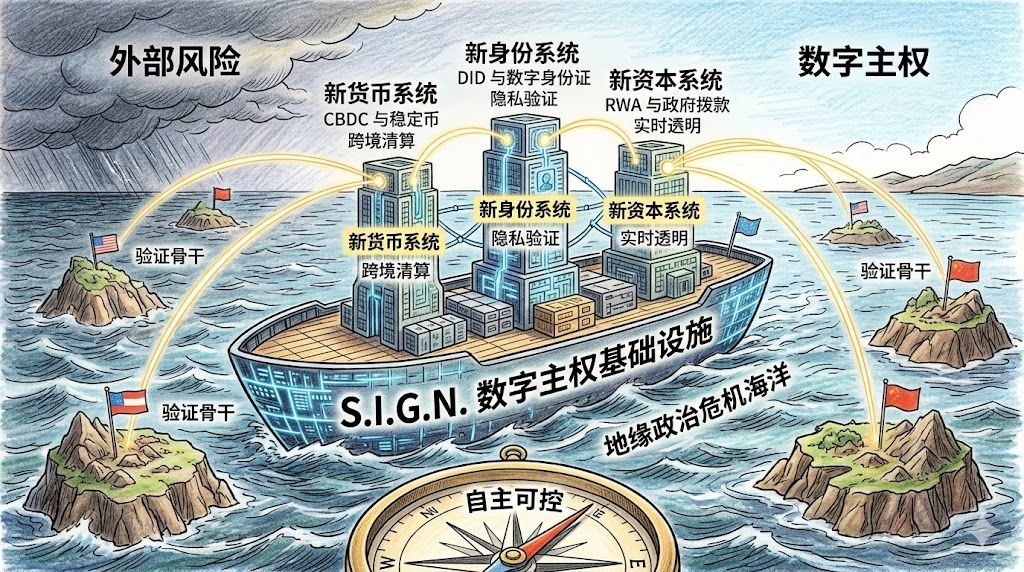
By digging into the code, I saw something more ambitious. After finishing GitHub, I ran to check their official website and documentation. I couldn't sit still: Sign is no longer the EthSign of the past. Their current full name is S.I.G.N. (Sovereign Infrastructure for Global Nations). Translated, it means 'Global Sovereign Infrastructure'. Their slogan is even bolder: 'Blockchain for nations. Crypto for all.' The goal is to serve 300 million people by 2028. I read it twice to confirm I didn't miscount any zeros. These people are genuinely helping countries build 'digital lifeboats'.
They have broken down this sovereign architecture into three main parts:
New Currency System: Support for CBDC (Central Bank Digital Currency) and compliant stablecoins, allowing countries to control cross-border settlement without being easily cut off from SWIFT.
New Identity System: Creating digital IDs based on W3C's DID. One-click verification without leaking privacy.
New Capital System: Putting government grants and RWA assets on-chain. Every budget transaction will be fully transparent within 24 hours.
This reminds me of the recent situation in the Middle East. I have a friend who does trade in Dubai; his payment was inexplicably frozen by the bank for three days due to 'compliance'. He lamented to me, 'Sometimes, having money in the bank doesn’t mean it’s yours.' In such times, infrastructure like $SIGN that focuses on 'verifiable endorsements' becomes a hard necessity rather than just a luxury.
Amidst the celebrations, I have to pour a bucket of cold water; as someone who has been in the circle for so long, I never rely on emotions for my livelihood. The recent hype around SIGN at Binance Square is indeed high, with the official offering nearly 2 million tokens for activities. This kind of 'Binance-style' approach can indeed ignite the market instantly.
But I have a few very cold-blooded observation metrics:
1. Don't be scared by FDV, but don't ignore it either. The total is 10 billion, and the fully diluted valuation (FDV) has already exceeded 400 million USD. This huge gap can easily backfire in the market during the reward issuance at the end of April and the emotional retreat.
2. See who is 'signing'. Blockchain can only prove that the data has not been altered, but it cannot prove that the data is true. Whether Sign can attract endorsements from UAE regulators and top auditors as 'big legs' will determine whether it is providing a 'master key' or an 'empty screwdriver'.
3. See real usage. Three months later, if there are no real financial institutions using their protocol for verification, then the grand narrative is just storytelling.
I think the most interesting point about this open source release is that they have transformed the term 'sovereign-level' from an abstract PPT into tangible code. Whether you are in government IT, bank development, or an individual like me, you can now clone the repository and run a test environment yourself. I've already forked those repositories and plan to try running one-click deployment this weekend. The next stop for Web3 may not be a more bustling public chain casino, but rather this kind of digital sovereign infrastructure that can truly serve nations. I'm ready for the next hands-on test; do you want to try a Quickstart together? (This article is a platform task and does not constitute any investment advice.)#Sign地缘政治基建