


I keep picturing this oddly specific scenario: a credential issued months ago, perfectly valid at the time, quietly moving through systems that never stop to question whether it still makes sense. And that’s where my thoughts keep looping when I look at Sign.
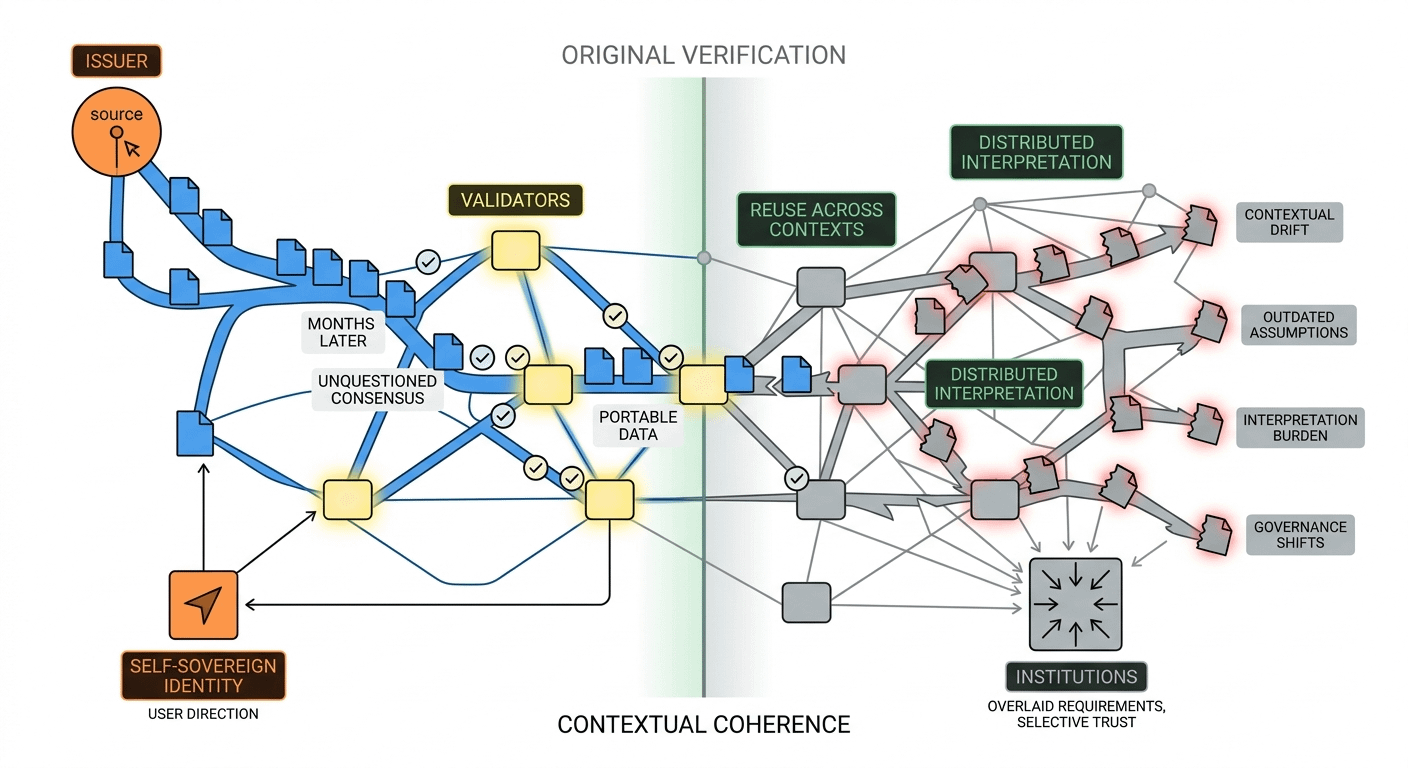
The structure is clean—almost reassuringly so. Issuers define what’s true, validators confirm it, and then the credential becomes portable, something the user carries across platforms without having to repeat the same verification again and again. And honestly, I get why that’s attractive. Repetition feels like inefficiency. But I can’t shake the feeling that repetition also acts like a kind of frictional audit, a moment where systems can reconsider what they’re accepting.
When that disappears, things become smoother. Maybe too smooth.
Because Sign isn’t just about verifying once—it’s about reusing that verification across contexts that weren’t necessarily part of the original assumption. That’s where the tension creeps in. A credential might be technically correct, yet contextually outdated. And the system, by design, doesn’t intervene there. It just ensures that what was issued remains verifiable.
That part makes sense to me. But it also feels incomplete.
I keep circling back to who carries the burden of interpretation. If Sign standardizes verification, then interpretation gets pushed outward—to platforms, to users, to whoever is consuming the credential. And those actors don’t behave uniformly. They bring their own assumptions, their own thresholds, their own incentives.
A platform might accept a credential without fully understanding its scope.
A user might reuse it in a context that stretches its meaning.
A validator might confirm something that is structurally correct but practically misleading.
Nothing is technically broken. But something feels off.
And then there’s the question of incentives, which sits quietly underneath everything. Validators are supposed to maintain correctness, the network aligns behavior through $SIGN, and the system aims to stay neutral. But neutrality is rarely static. Over time, incentives nudge behavior in subtle ways. Not dramatically, not all at once, but gradually.
A validator prioritizes throughput over scrutiny.
A dominant issuer sets informal standards others begin to follow.
A governance adjustment shifts how credentials are perceived, even if the rules don’t explicitly say so.
These aren’t failures. They’re shifts. But shifts matter.
I also find myself thinking about users more than the system itself. Because “self-sovereign identity” sounds empowering, but it quietly assumes a level of awareness and responsibility that most people don’t consistently maintain. Managing credentials, deciding when to share, understanding implications—it’s not trivial.
People forget.
People rush.
People trust the interface instead of the underlying logic.
And the system doesn’t correct that. It can’t.
Then there’s institutional behavior, which feels like a parallel layer running alongside everything else. Sign reduces reliance on centralized verification, but institutions don’t just step aside. They reinterpret, they overlay their own requirements, they selectively trust. So instead of removing centralization, the system reshapes it into something more distributed, but not necessarily more aligned.
And honestly, I get why that happens. No institution fully outsources trust.
So I keep looping back to this core tension: Sign makes verification portable, but portability assumes stability—of meaning, of context, of behavior. And those things aren’t stable. They shift, subtly, constantly.
Which makes me wonder if the real challenge isn’t verification at all, but maintaining coherence as credentials move further away from their origin.
Because the further they travel, the more they rely on shared understanding. And shared understanding… tends to erode.
I’m not dismissing the system. If anything, I find its restraint interesting—it doesn’t try to solve everything, just the structure of verification itself. But the unanswered parts don’t disappear. They sit at the edges, waiting for pressure.
And that’s probably where I keep looking—not at how Sign works when everything aligns, but how it behaves when things start drifting just slightly out of sync.
That’s usually where the real story begins.