
 This is the question I've been asked the most recently. My answer is: $80 SOL could indeed be the bottom; but! The $80 in March is likely not the bottom. Does that sound contradictory?
We know that the bottom is not "fallen" but "caught". So, when $SOL falls to a certain position and begins to consolidate, we only need to observe one thing - is there a concentrated influx of buying?
If there is, and the price stabilizes thereafter, then we can highly suspect that "the bottom has arrived".
Of course, a downward continuation will also attract some bottom-fishing funds, so the logic is: "having" does not necessarily mean it's the bottom, but "not having" is likely not.
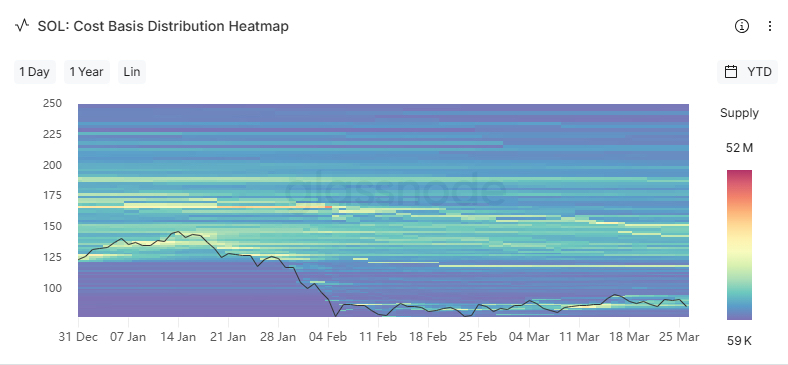
I marked the range of $125-$175 in the chart — do you see it? The cost line of over 52 million SOL is pressing here, piled up like a wall. This is the accumulation of chips left from the repeated fluctuations in the second half of last year.
Now the price has dropped to around $80, and everyone inside this wall is deeply trapped, with an average loss exceeding 45%. The bright colors above $150+ are fading — some can’t hold on anymore and are giving up their chips.
In the range of $75-$95, some new accumulation has indeed started to appear. In early February, SOL once fell to the yearly low of $67.50, and then it fluctuated back and forth between $75-$90 for nearly two months. But if you look closely, is this momentum enough?
Comparing the period in early January when SOL was around $135-$140 — the accumulation of chips at that time was thick and bright, that was called concentrated buying. And now, the new positions around $80 can only be considered "tentative entry".
This is an important reason for my belief that the $80 in March is highly unlikely to be the bottom.
However, the $80 SOL has indeed attracted some smart money, and the possibility of a large demand emerging when returning to this range cannot be ruled out.
If there is, that point in time of "$80" could possibly be the real bottom.
Whether it re-tests the previous low of $67 or stabilizes above $80, the number itself is not important; the key is to see concentrated buying inflow. A price recovery relying solely on weakened selling pressure can hold for a while but cannot last long.
Therefore, the viewpoint at the beginning of this article is not contradictory; I should have made this logic clear, right?
If you still don't understand, it's recommended to first clarify what "cost base distribution" means; otherwise, observing only the K-line in the crypto space is like driving using a rearview mirror — you can see the road, but the direction is reversed 🤣🤣🤣