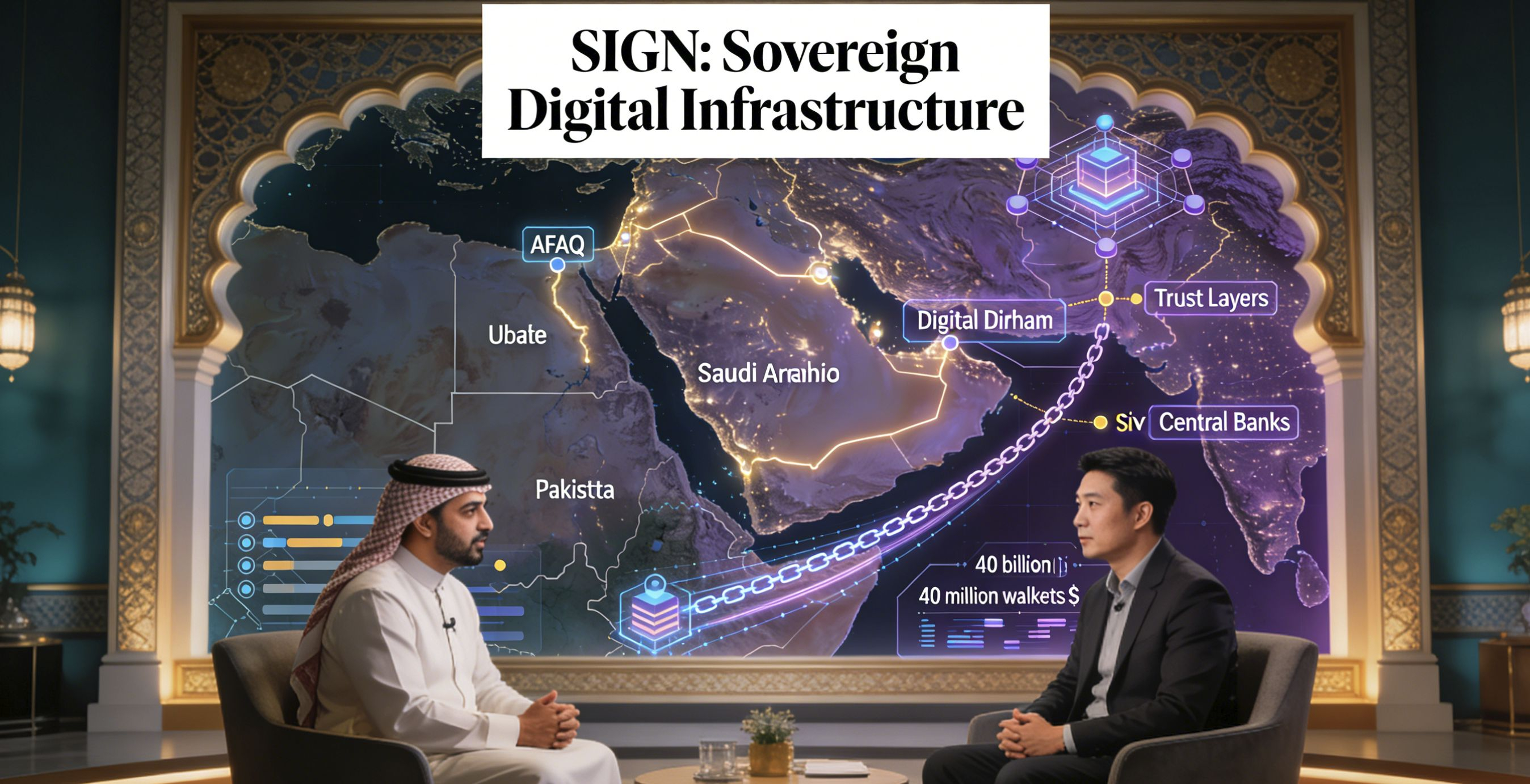
Last week in the Saudi TV studio, the atmosphere suddenly changed.
The host asked Xin Yan what he thought about the upcoming capital flows in the Middle East. This guy didn’t play by the rules; he directly stated that the geopolitical crisis has just begun, and a large amount of money is running out. I estimate that someone on site was sweating, but what really stuck with me was the next sentence—he said that SIGN is creating sovereign digital infrastructure, safeguarding the country's payment capability and identity trust.
Two weeks later $SIGN rose by 131.5%, and Upbit's spot trading volume surged to the top three.
To be honest, this increase makes my scalp tingle, but what concerns me more is what the market is really betting on. If you think everyone is just chasing a trend, you're too naive. I flipped through SIGN's cards and found that these people are not speculating on coins; they are pricing geopolitical risks.
The AFAQ system in the UAE can connect payments from six central banks in real-time, and the digital dirham is running quite well. But there's one pit that no one has filled—how do Emirati banks confirm that their Saudi counterparts' KYC meets their own standards when reconciling? How can they ensure that contracts signed can still be executed across borders? Right now, it's still relying on PDFs and the set of agency relationships from decades ago.
Six countries, six regulatory frameworks, six definitions of 'what is a legal identity'. This is not a technical issue; it's a trust gap.
@SignOfficial just happens to be caught in this gap. It is not about replacing the payment systems established by those countries, but rather adding a layer on top—allowing governments to mutually verify 'you are indeed the person you claim to be' without relinquishing sovereignty. The Abu Dhabi Blockchain Center in the UAE has already integrated this, and the Pakistan Digital Communication Ministry is also using it.
To put it bluntly, TokenTable has already executed a distribution of 4 billion dollars, covering 40 million wallets. Just think about what this means—it's not some air project making grand promises; there are indeed large institutions and even sovereign entities using it as a production line.
I have a buddy in Dubai who does cross-border payments. He says that the local tycoons there are not short on money; what they lack is a trustworthy channel that is not constrained by a single Western system. Whoever can combine compliance and absolute control is paving the way. SIGN is currently at 0.04 dollars, with a circulating market cap of 77.76 million. Is that expensive? Is it cheap? If you really view it as sovereign infrastructure, that number might not even be a fraction.
But seasoned players understand that the bigger the promise, the more they need to find out where the scythe is.
I'm focusing on two things: first, whether there are more real external businesses that can integrate this proof network into operation, and not just rely on marketing and community hype. Second, token empowerment shouldn't turn into a protocol working hard while all settlements go through stablecoins; otherwise, SIGN will truly become just a mascot.
At this price, I won't go all in, but a few hundred U to build an observation position isn't excessive. In these times, projects that can run trustworthy infrastructure at the sovereign level can be counted on one hand. If SIGN really deepens its connections in the Middle East, the valuation logic will not be event-driven; it will be about infrastructure re-evaluation.
By that day, the label the market gives it will probably be 'the first ticket to the sovereign digital world'.#Sign地缘政治基建