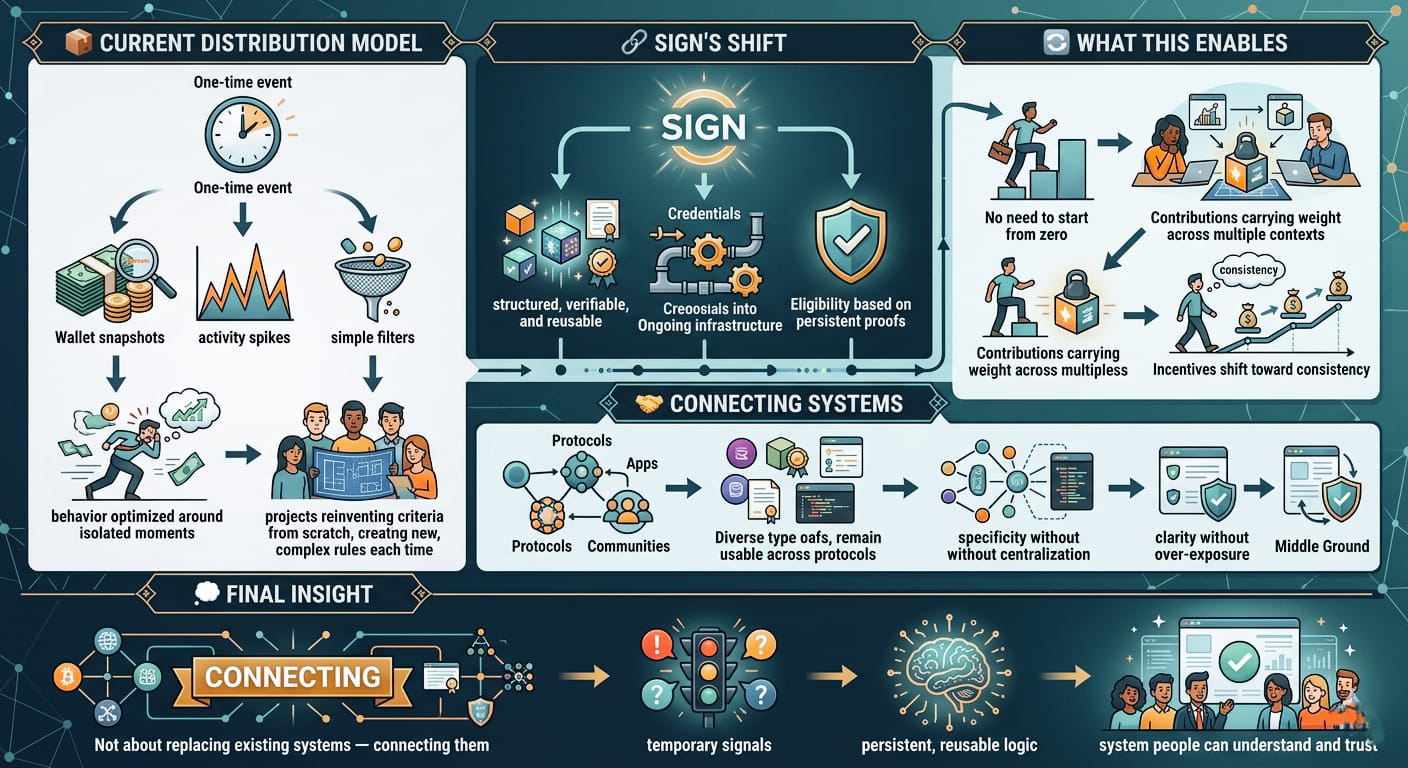
There’s a pattern I keep noticing in crypto every cycle introduces better tools for moving value, but very few actually improve how value gets assigned in the first place. We’ve become efficient at transactions, swaps, liquidity, and even complex financial engineering. But when it comes to deciding who deserves what, most systems still fall back on rough approximations: wallet snapshots, activity spikes, or simple eligibility filters that can be gamed or misunderstood. That’s where Sign Protocol starts to feel less like another tool and more like a missing layer that should have existed much earlier.
What makes this interesting isn’t just that SIGN deals with credentials it’s how those credentials shift the role of distribution itself. Instead of treating distribution as a one-time event (like an airdrop or incentive campaign), it begins to look more like an ongoing, structured system where eligibility can be defined, verified, and reused. That subtle change has bigger implications than it seems. It means projects don’t have to start from zero every time they want to reward users or contributors. They can build on existing proofs things that already happened, already verified rather than guessing based on surface-level activity.
If you think about it, a lot of inefficiencies in Web3 come from this constant resetting of context. Each protocol tries to figure out who its “real users” are, who contributed meaningfully, who should be trusted, and who might just be passing through. Without a shared way to express and verify those signals, every project ends up reinventing the same logic. SIGN, in a way, offers a structure where those signals can exist beyond a single app or ecosystem. A contribution doesn’t have to disappear once a campaign ends it can become part of a broader, reusable record.
Another angle that doesn’t get talked about enough is how this changes incentives over time. When rewards are based on one-off snapshots, behavior tends to optimize around those moments. People rush in, complete tasks, and move on. But if credentials start to matter across multiple contexts if they actually carry weight beyond a single interaction then behavior naturally shifts toward consistency and credibility. It’s less about catching the right moment and more about building a track record that holds up wherever it’s referenced.
There’s also something practical here that goes beyond theory. As more projects experiment with different ways of distributing value, the need for clearer, more transparent criteria becomes obvious. Users want to understand why they qualified or didn’t. Teams want systems that are harder to exploit without becoming overly complex. Credentials, when used properly, create a middle ground. They allow for specificity without requiring trust in a centralized decision-maker, and they reduce ambiguity without exposing unnecessary data.
What I find particularly compelling is that this approach doesn’t try to replace existing systems it connects them. Instead of forcing everything into a single standard or platform, it allows different types of proofs to coexist and still be usable across contexts. That kind of flexibility is important because Web3 isn’t a uniform environment. Different communities, protocols, and use cases all have their own definitions of value and contribution. A system that acknowledges that diversity, while still enabling interoperability, is far more likely to scale in a meaningful way.
Of course, none of this guarantees immediate impact. Infrastructure like this tends to grow quietly, often unnoticed until it reaches a point where it becomes difficult to operate without it. Adoption depends on whether teams actually choose to build around these ideas rather than sticking to familiar methods. But the direction itself feels grounded in real problems rather than abstract narratives.
In a space where attention often goes to what’s new or trending, it’s easy to overlook the layers that make everything else more reliable. SIGN seems to be focusing on one of those layers the part that decides how actions turn into recognized value. And if that layer improves, a lot of other things start to improve with it, even if indirectly.
Maybe the bigger takeaway isn’t just about credentials or verification. It’s about shifting the mindset from temporary signals to persistent ones, from isolated decisions to reusable logic. If that shift continues, distribution in crypto might stop feeling like a guessing game and start functioning more like a system people can actually understand and trust.
#signdigitalsovereigninfra @SignOfficial $SIGN