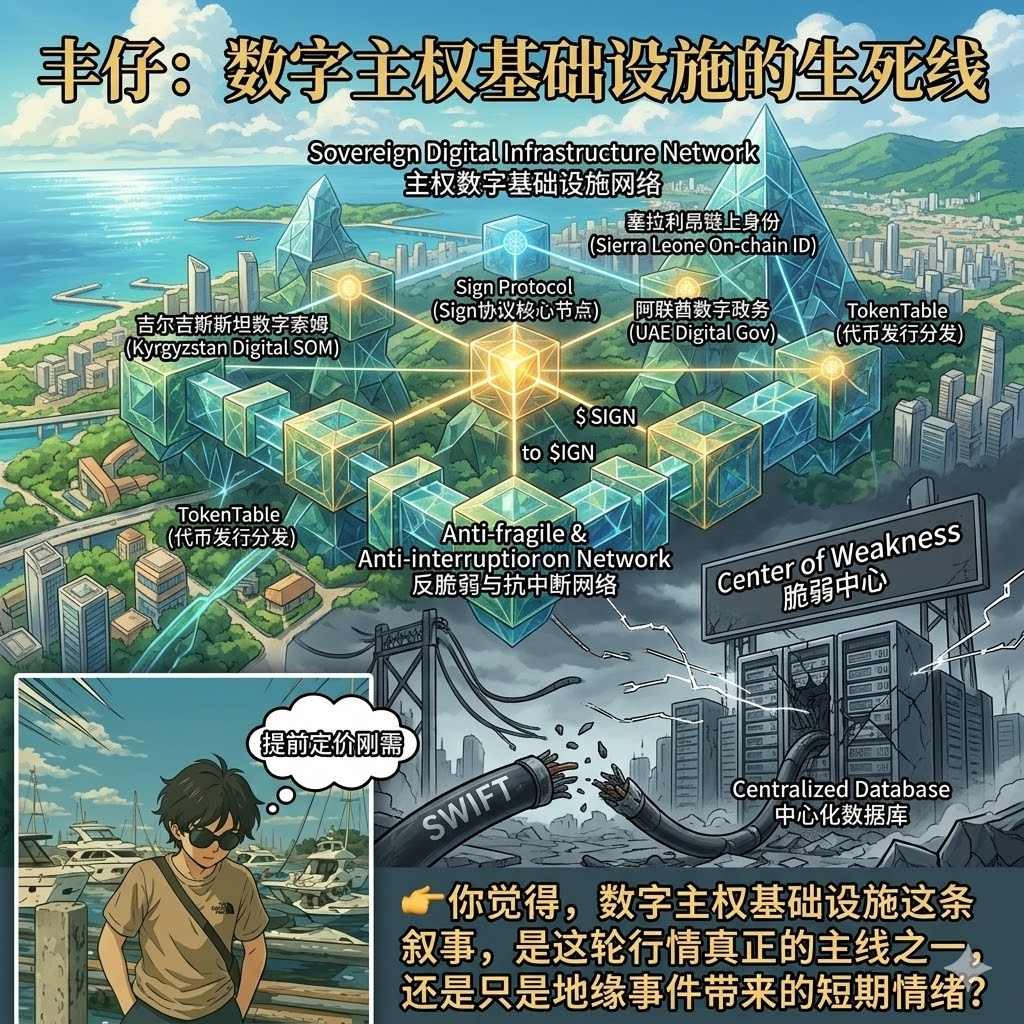
Fengzi discovered that many friends, upon seeing movements in war-related tokens, first react with "war stimulates coin prices," and then in the next moment feel that this logic is too simplistic and speculative, thus skipping over it. Fengzi initially thought the same way. However, after some reflection, he felt that this line of thinking was a bit too simplistic.
As the war has progressed to today, one thing that has slowly surfaced is this: the most vulnerable aspect of modern nations may not be the control over oil and gas pipelines or ports. Rather, what is often more fragile is that system which remains completely invisible on a daily basis yet operates in the background: payment clearing, identity verification, asset registration, and cross-border settlement.
These things seem to be taken for granted in peacetime. Centralized systems are efficient, low-cost, and no one sees a problem. But once in an environment of sanctions, cyberattacks, and financial disconnection, it is not a matter of slowness, but a direct issue of stopping.
Fengzai thinks this is the real logic behind the recent movements of projects like $SIGN , not emotions, but rather the market pricing in something in advance.

Sign is not an ordinary protocol project, nor is it simply a payment tool. Its product line includes TokenTable, a token issuance and distribution platform with real business scale, as well as the Sign Protocol @SignOfficial which aims to establish a global trust and identity infrastructure. These two aspects overlap, both focusing on fundamental issues: digital identity, verifiable credentials, sovereign payment rails, and RWA.
Moreover, the cooperative direction it releases has been consistently following the same line. The digital som in Kyrgyzstan's CBDC pilot, the deployment of on-chain identity and residency certificates in Sierra Leone, and digital government cooperation with the UAE: these may seem far from the market at ordinary times, but they collectively point in one direction: helping sovereign nations migrate their core systems from centralized architectures to a more interruption-resistant, verifiable, and harder to cut off network.
Usually, the term "digital sovereignty" sounds like an abstract policy concept, with more academic significance than practical meaning.
However, when a country's SWIFT interface is cut off, when cross-border payment systems fail directly due to sanctions, and when core databases stop operating because of cyberattacks, at that point, digital sovereignty is no longer a concept; it becomes a prerequisite for whether the country can continue to operate normally.
Fengzai believes that in the future, countries will compete not only on resource reserves, military scale, and financial size, but also on who completes the independence upgrade of digital infrastructure first, and who turns their core systems into a network that does not rely on a single vendor and is not afraid of being cut off externally.
This matter is not urgent in peacetime, but it becomes a lifeline in extraordinary times.
So from this perspective, Fengzai does not think that the recent price movements of $SIGN are merely driven by emotions. It feels more like the market making a directional judgment: as geopolitical conflicts become increasingly normalized, digital sovereignty will gradually shift from a narrative to a necessity, and those infrastructure projects that have laid out in this direction in advance will suddenly transform from "not many understand it" to "everyone understands why it is valuable" at some point.
Fengzai does not have an answer to when this point in time will arrive. But "correct direction" and "timing" are two different matters; what Fengzai is certain of now is only the former.
Do you think that the narrative of digital sovereignty infrastructure is one of the main lines of this market cycle, or is it just a short-term emotion brought about by geopolitical events? 👇