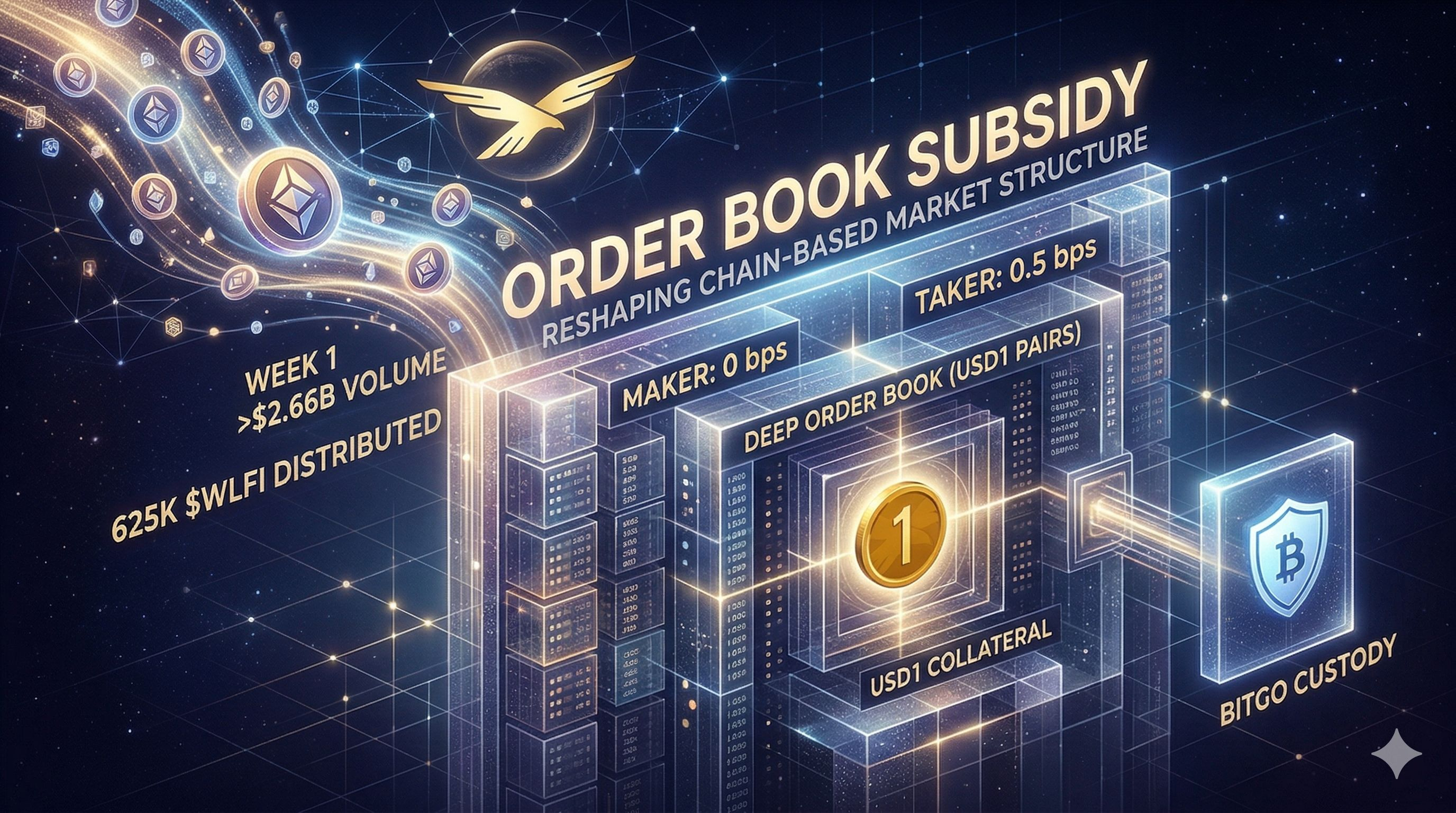
Carefully observing @worldlibertyfi's 2.66 billion dollars in transaction volume during the first week on Aster, I am most surprised not by the frenzy of the data, but by a long-planned chill.
Many people are still envious of that 625K $WLFI reward, thinking this is just another liquidity stimulation in a new bottle. But honestly, if you still use the logic of 'mining 2.0' to understand it, you might completely miss the ambition of WLFI.
This is not about giving benefits; it's about severely impacting the quality of orders in the global dollar market.
1. The 625K WLFI reward is not about quantity, but about habit.
The most expensive thing in the financial market is not the capital, but the memories that have been taken away. A quick look at Aster's fees: Maker 0 bps / Taker 0.5 bps. This extremely rare low difficulty meets the monthly 2.5M WLFI inspiration, essentially creating an order book.
Traditional mining is about paying you to stay; once the funds run out and rewards are claimed, people leave. However, WLFI's current actions involve leveraging the value of governance tokens to force a relatively strict CEX trading depth on-chain. When traders get used to smooth transactions in a market priced at USD1, USD1 becomes more than just a stablecoin; it has become a gravitational well of liquidity. Once these habits are formed, they are difficult to dislodge.
2. The flagship advance of USD1, from trading chips to financial foundation
The supply on Solana skyrocketed from 160 million to 855 million, with daily trading volume stabilizing above 200 million. This fivefold leap stems from an extremely bright power transfer. The issuance, minting, and custody of USD1 are entirely under BitGo, with the project party not touching a penny.
This professional isolation greatly dissipates the trust delay experienced during institutional entry. USD1 has now completed its identity coverage; it is both a unit of account and collateral on Aster. When a stablecoin possesses the certainty of BitGo along with the lowest trading difficulty across the network, it is no longer just a shadow of USDT but a must-have option for large on-chain transactions.
3. Give the project party two suggestions: be strict and don't be afraid of being selected
As a deep participant in the second week, I have two thoughts:
Granularity of data: A transaction volume of 2.66 billion is indeed impressive, but the community wants to see the retention rate of non-stimulative transactions. It is recommended that the official frequently showcase the real-time evolution of price differences to demonstrate that this order book indeed makes trading smoother, and not just mechanical numbers.
The value of governance: Since WLFI is the only governance token, should we not link order depth with governance weight in the future? Long-term holders not only have voting rights but can also dictate the flow of the order book. Governance power truly becomes the command stick of market depth, rather than dormant code in wallets.
4. Finally
The end of finance is not mathematics, but human nature. What WLFI is doing is rebuilding the most intricate order of Wall Street on-chain using the #WLFI engine.
Don't just chase those rewards; look at the solid buy and sell orders still present in the late night. That layer of accumulated depth is what USD1 truly aims to occupy as the on-chain dollar stronghold.
#WLFI #USD1 #AsterDEX #市场结构 #Defi
This article represents personal views only and does not constitute any investment advice, DYOR!