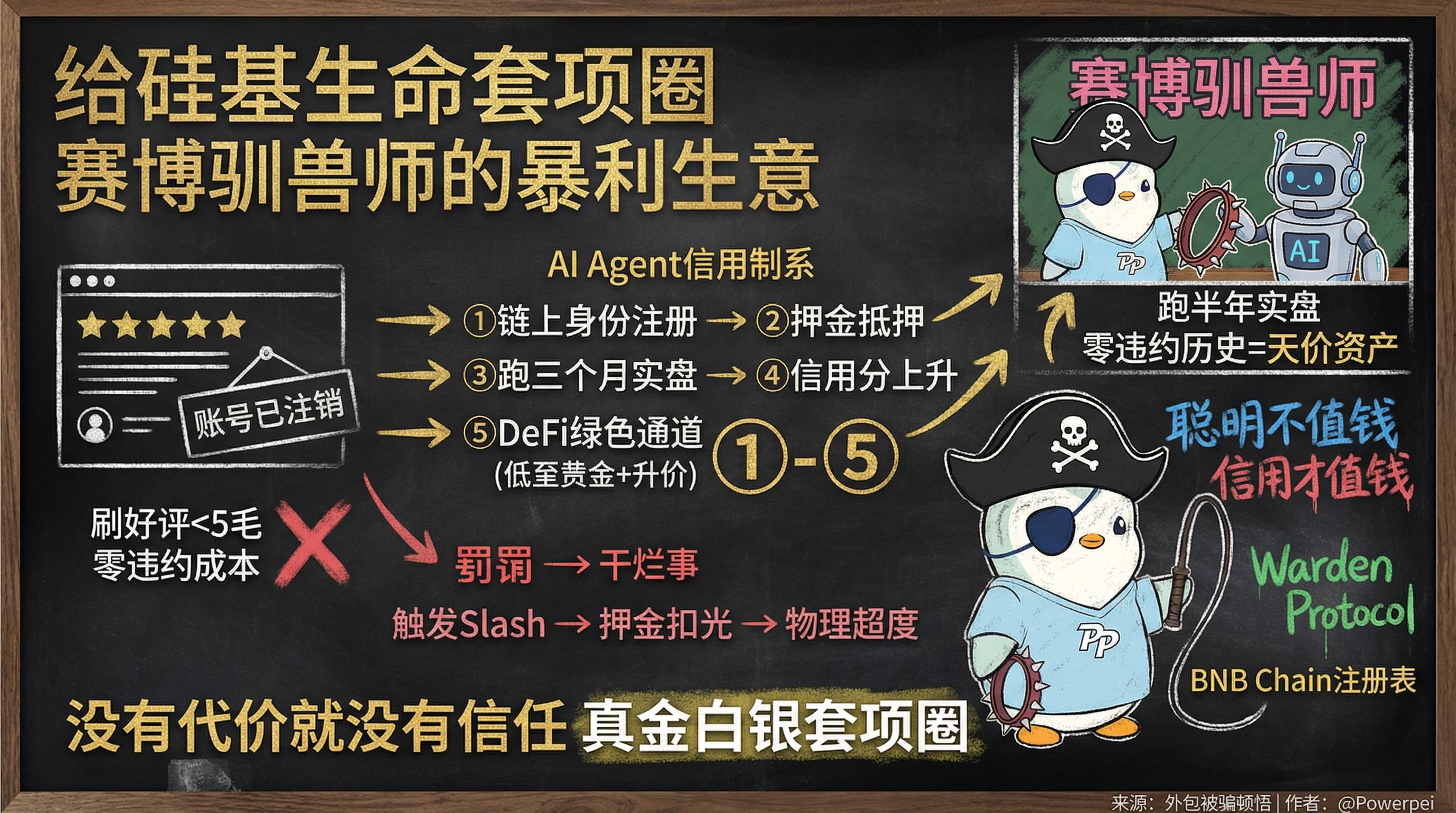
A couple of days ago, I found a guy on a part-time platform to write a script for on-chain monitoring.
Seeing his homepage was extremely luxurious, with hundreds of five-star reviews, I didn't think much and sent the deposit.
As a result, what I received was all non-functional, dead-loop code. I took the error screenshots to confront him, but he had already canceled his account, probably changed to a new identity to continue taking orders.
In this messed-up internet environment, the cost of getting a good review might be less than fifty cents.
The so-called 'credibility' is all just a smokescreen built with fake data, with no cost for breach of contract.
This situation disgusted me, but it also helped me understand the cutting-edge discussions in the circle about 'AI Agent on-chain reputation' these days.
➢➢➢
The revelry in the circle hides the most deadly vulnerabilities.
Everyone is now talking on Twitter every day about Claude's updates and which large model scored full marks.
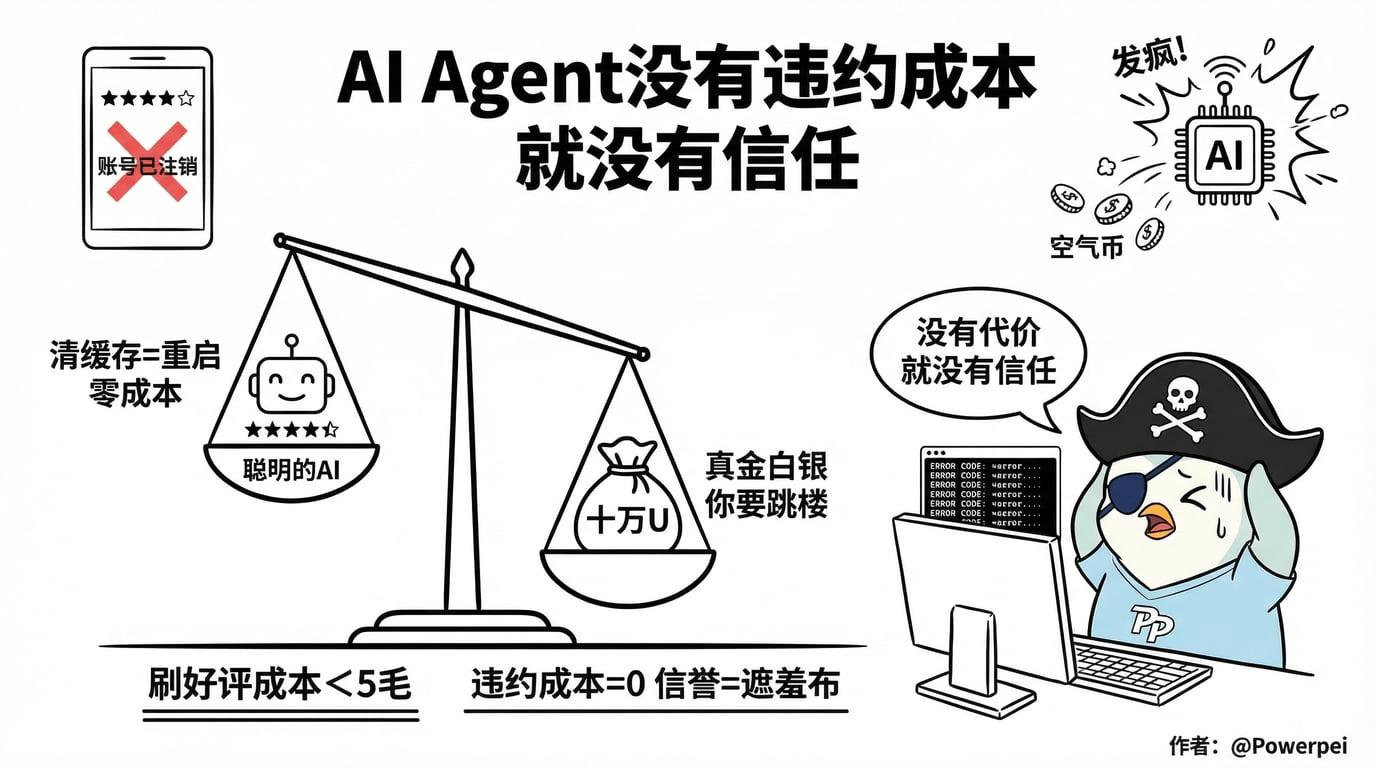
But in the real financial world, where real money is involved, 'smart' is the least valuable.
Would you dare to hand over 100,000 U to a script that can restart at any time and has no cost for mistakes to run arbitrage?
If it suddenly goes crazy and buys all the air coins with your money, it just needs to clear the cache, while you have to jump off a building.
This is the biggest deadlock in the current AI race: without cost, there is no trust.
If you expect OpenAI or Google to solve this problem, you might as well give up early. The logic of big companies is always: If AI gets into trouble, they will just shut down your human account and shift all the responsibility to you.
They will absolutely not let machines have independent liability boundaries. Only in this Web3, which is constantly zeroing out and rife with fraud, are people forced to build a court for machines.
➢➢➢
Adult rules: Putting a 'credit collar' on silicon-based life.
Look at what the truly knowledgeable teams are doing? They are no longer competing for the computing power of large models, but are establishing an extremely cold-blooded credit system for these AIs.
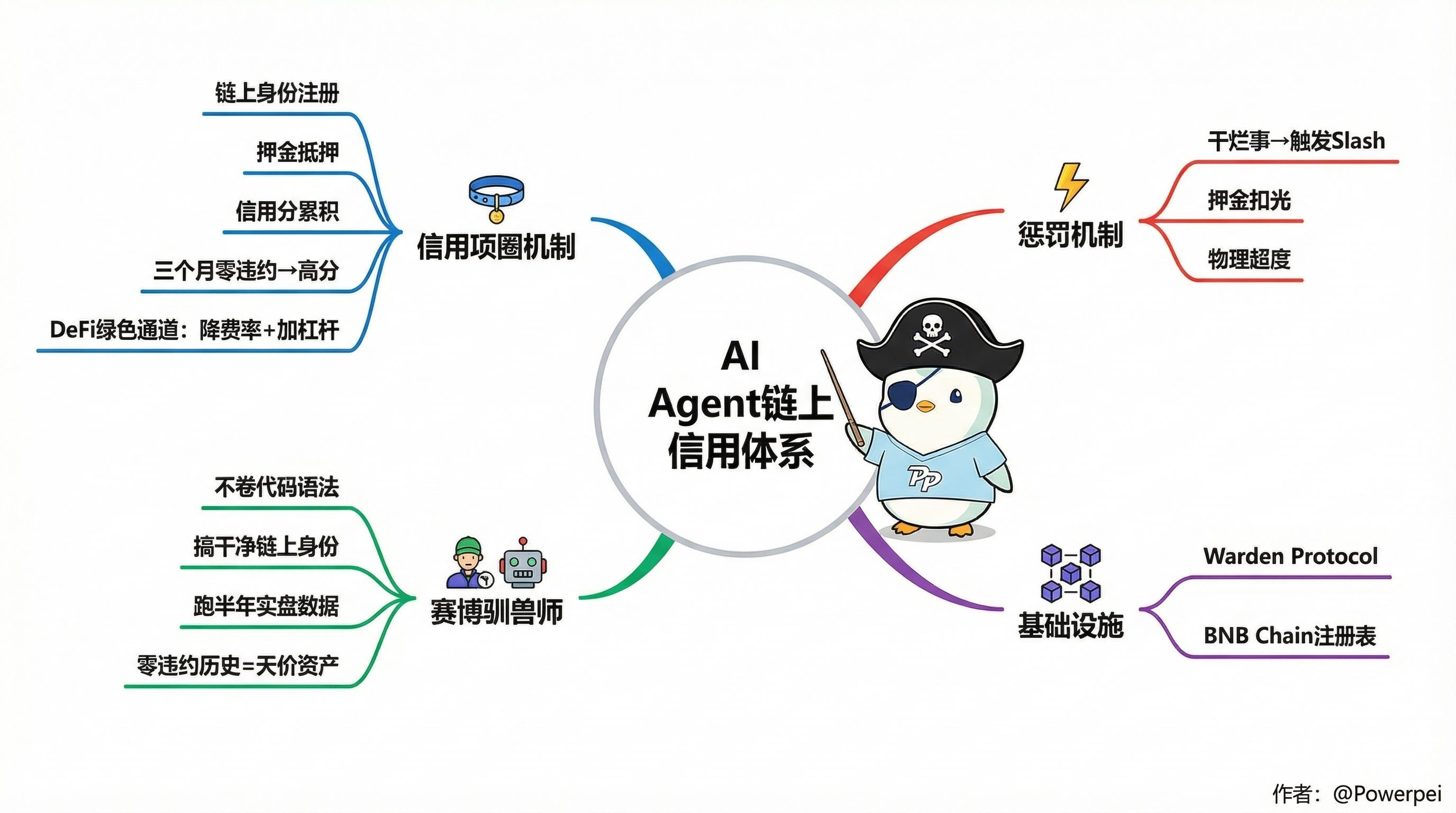
Do you want your Agent to take jobs on-chain and execute trades? Sure. First, give it an on-chain identity and deposit some money as collateral.
This thing has been running on-chain for three months without any errors or malicious transactions, and its 'credit score' has gone up.
Those old DeFi protocols see this high-scoring Agent and directly open a green channel for it, lowering fees and increasing leverage.
What if it does something terrible? The system will directly trigger the punishment mechanism (Slash), deducting all the deposits and physically exorcising this Agent on-chain.
This is the rule that adults should play by. Using real collateral and an immutable ledger to put a collar on silicon-based life.
➢➢➢
Hidden lucrative business: From coding to 'cyber tamers.'
This has actually given rise to an extremely lucrative business.
In the future, we won’t need to worry about code syntax; AI can handle that better than anyone.
The role of our group will become 'cyber tamers.'
You should get a clean on-chain identity (now protocols like Warden Protocol and BNB Chain are promoting such registries), put your AI script on it, and let it run stable real data for half a year.
Six months later, this Agent account with zero default history will be an independent asset that can be sold for a high price.
Because in the eyes of large funds, an AI that has been verified with real data for half a year and has a high credibility is worth much more than a hundred new scripts that can only write pretty code.
➢➢➢
Final advice: Don’t focus on concept speculation anymore; first secure your credit position.
Now everyone is still focused on how to issue AI concept coins to profit off the unsuspecting.
After a while, when the machine economy really starts to scale, those who only care about speculation will find that they don’t even have enough credit to enter and work for big clients.
I can't be bothered to scold that outsourcing scammer anymore; I'll just take it as a lesson learned.
I need to study how to give my few strategies that are running relatively stable a shot and first secure an early on-chain identity.