
The mass adoption of Bitcoin by institutional investors has resumed, but global instability and the risk of rising inflation in the United States limit BTC breakouts above $70,000.
 The consolidation of Bitcoin
BTCR$ 359,816
continued until Thursday, with bulls struggling to maintain the $70,000 level, as conflicting narratives about the BTC market structure and its growing institutional adoption clashed with broader bearish factors negatively impacting US stock markets.
Citing Bernstein's price estimate of $150,000 by the end of 2026, Bloomberg analysts stated that data shows institutional investors returning en masse to Bitcoin markets, reinforcing the view that BTC has 'hit a bottom'.
In early March, a week-long streak of inflows into spot Bitcoin ETFs nearly hit $1 billion, while Strategy bought 22,237 BTC for $1.6 billion through its new perpetual preferred stock, Stretch (STRC). In addition to the success of STRC, Strategy also revealed plans to raise capital with the aim of acquiring an additional $44.1 billion in Bitcoin.
More evidence of institutions returning to the crypto market has come from $10 trillion asset manager Morgan Stanley, which filed documents to launch its own spot Bitcoin ETF. Morgan Stanley recommends that investors maintain an allocation of 2% to 4% in cryptocurrencies and, on March 26, a proposed rule from the Department of Labor, which would allow brokers managing and offering services in the $10 trillion 401(k) retirement plan market to invest in Bitcoin, advanced in the White House's regulatory review process.
On Thursday, Coinbase also launched entries for real estate financing secured by tokens for Fannie Mae loans, effectively allowing Bitcoin holders to use BTC and USDC to finance residential mortgages. The offering allows investors to unlock the trapped liquidity of BTC without selling it or generating a taxable event.
What is the importance of the support at $70,000 for Bitcoin?
Although renewed interest from institutional investors in buying Bitcoin is evident, the price volatility of BTC and its inability to break a nearly six-month downward trend remain clear obstacles. The ongoing war between the US-Israel and Iran, along with President Trump's threat to send ground troops to Iran, continues to negatively impact the stock and cryptocurrency markets.
On Thursday, in a post on Truth Social, President Trump stated that Iran's negotiators 'must take this seriously soon, before it's too late, because when that happens THERE WILL BE NO TURNING BACK, and it won't be pretty!'. The clear increase in the positioning of US military assets in the Middle East has worried markets, fearing that a ground operation could begin as early as this weekend.
 Post on Truth Social by President Donald Trump. Source: Truth Social
After a series of statements from the president, US markets retreated, with the Dow Jones losing 400 points, while the S&P 500 and Nasdaq recorded declines of 1.49% and 2.07%, respectively. On the other hand, WTI and Brent oil advanced, with both posting gains of over 4%.
With the increasing uncertainty about the course of the war between the US-Israel and Iran and the long-term impact of record oil prices on US inflation and the economy in general, investors are choosing to reduce their exposure to volatility.
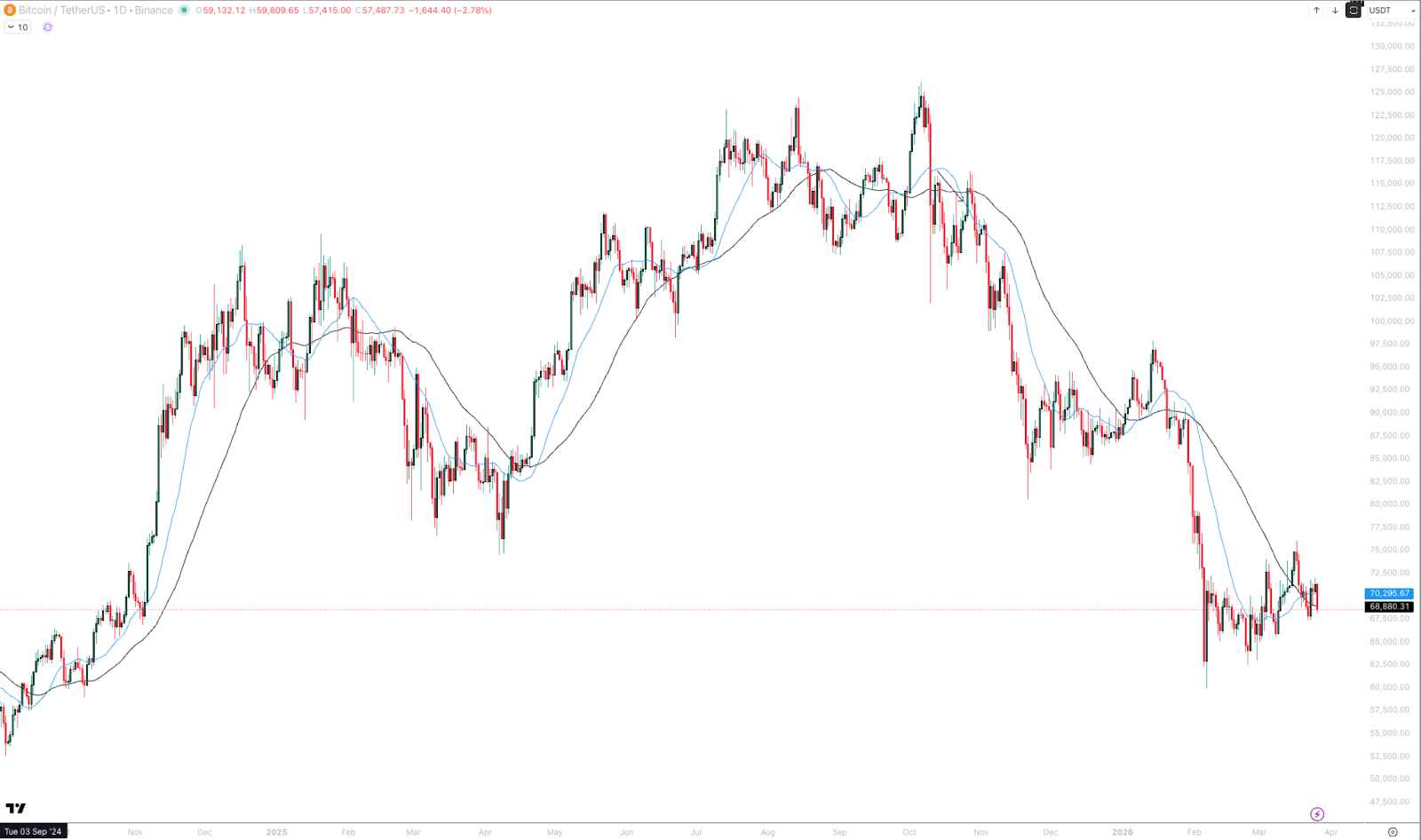 Daily chart BTC/USD. Source: TradingView
This explains the frequent drops of Bitcoin below $70,000, as well as the short duration of highs in the range between $71,000 and $76,000. Still, a positive point is that institutional and retail investors seem to see the $70,000 or below region as an ideal buying zone, reinforcing this level as support.


