

In the wave of digital technology reshaping global finance and governance systems, a project called Sign Protocol is quietly rising from the tool layer of Web3 to become a national-level digital infrastructure. It is no longer just an on-chain electronic signature tool but has evolved into the underlying engine of 'sovereign national digital transformation', a core evidence layer of a complete technology stack called S.I.G.N. (Sovereign Infrastructure for Global Nations). Its slogan 'Blockchain for nations. Crypto for all.' is not just empty talk, but is gradually being implemented in countries like Kyrgyzstan and Sierra Leone.
1. From EthSign to S.I.G.N.: A Strategic Leap
The predecessor of Sign Protocol is EthSign, which was born in 2022 as a Web3 tool aimed at bringing traditional electronic signatures (like DocuSign) on-chain, serving on-chain agreement signing for DAOs, protocols, and enterprises. In 2024, the project upgraded to Sign Protocol, introducing two main primitives: 'Schemas + Attestations', becoming a multi-chain attestation protocol that can create, validate, and query any statement across chains.
The real turning point occurred in 2025. With the official release of the S.I.G.N. sovereign infrastructure framework, Sign Protocol completely shifted to national-level applications, integrating TokenTable (asset distribution engine) and EthSign, constructing a complete stack covering digital currency, digital identity, and asset distribution. That same year, the project signed a CBDC (Digital Som) cooperation agreement with the National Bank of Kyrgyzstan and reached a memorandum of understanding with the Sierra Leone government for building a national digital identity system, marking its transition from 'technical agreement' to 'national infrastructure'.
2. S.I.G.N. Framework: Building Digital Sovereignty with Three Pillars
S.I.G.N. White Paper (v2.2.0, December 2025) defines its architecture as three main pillars:
New Money System
Adopting a 'dual-path blockchain' design: The public path is a customizable L2 or L1, supporting PoA/PBFT consensus with a TPS of about 4000 for transparent audits; the private path is based on Hyperledger Fabric X, using Arma BFT consensus with a TPS of over 100,000, dedicated to privacy-focused retail CBDC, with central banks fully controlling the nodes.
Supporting wholesale CBDC (transparent settlement) and retail CBDC (ZK privacy + programmable + offline payments), and allowing central banks to regulate exchange rates and limits through atomic swaps.
New ID System
Based on W3C Verifiable Credentials (VC), DID, and OpenID for VC standards, achieving Self-Sovereign Identity (SSI).
Citizens independently control identity data through wallets, with the government serving only as the credential issuer. Supports ISO mobile driver's license standards, with offline verification via QR codes/NFC.
New Capital System
Driven by TokenTable, supporting high-throughput asset distribution for over 40 million wallets, with identity gating, conditional logic, vesting, and real-time auditing capabilities.
All qualification verifications for distributions rely on Sign Protocol's Attestation as 'trusted evidence'.
3. Sign Protocol: Technical Analysis of the Core Evidence Layer
As the 'heart' of S.I.G.N., the core of Sign Protocol consists of two main primitives:
Schemas: Structured data templates, similar to JSON Schema, defining field types, validation rules, and versions to ensure cross-system interoperability.
Attestations: Specific statements signed with a private key by authorized issuers (such as government agencies), which can be stored entirely on-chain, off-chain, or in a hybrid manner.
Its technical capabilities include:
Privacy enhancement: Supporting Groth16, Plonk, BBS+, and other ZK proofs to achieve 'selective disclosure' (e.g., proving age > 18 without revealing the birth date) and 'unlinkability'.
Revocation and expiration: Implementing real-time revocation using Bitstring Status List, supporting timestamp-based automatic expiration.
Cross-chain compatibility: Supporting EVM, Solana, Aptos, TON, and other chains, unified querying through SignScan Explorer and REST/GraphQL/SDK.
Flexible deployment: Can be deployed on public chains (transparent), private chains (permissioned), or in hybrid modes, meeting the needs of sovereign states for control and privacy.
Compared to the Ethereum Attestation Service (EAS), Sign Protocol places more emphasis on sovereign controllability, cross-chain capabilities, and non-EVM support, designed specifically for national-level scale.
4. Real Implementation: From Pilot to National Scale
Kyrgyzstan: In October 2025, the National Bank signed an agreement with Sign to develop a pilot for the Digital SOM CBDC, serving 7.2 million citizens and supporting interoperability with the KGST stablecoin.
Sierra Leone: In November 2025, in collaboration with the Ministry of Communications and Technology Innovation, a national digital ID system will be built to address the financial exclusion problem of 60% of the population without valid identities.
Abu Dhabi: Strategic cooperation with the Blockchain Center to promote the on-chain digitization of public sector records.
Historical data: The early TokenTable has served 50 million users, distributing over $2 billion in digital assets.
Goal: To serve 300 million people by 2028.
5. Team, Financing, and Tokenomics
Core Team: CEO Xin Yan has been interviewed multiple times by Forbes and personally signed national-level agreements. Co-founders include Potter Li, Jack, and other early EthSign members.
Funding background: Cumulative financing exceeds $55 million, with YZi Labs (formerly Binance Labs) leading a strategic round of $25.5 million, backed by top institutions and individuals such as Sequoia Capital and CZ ($16 million in empty investment grants).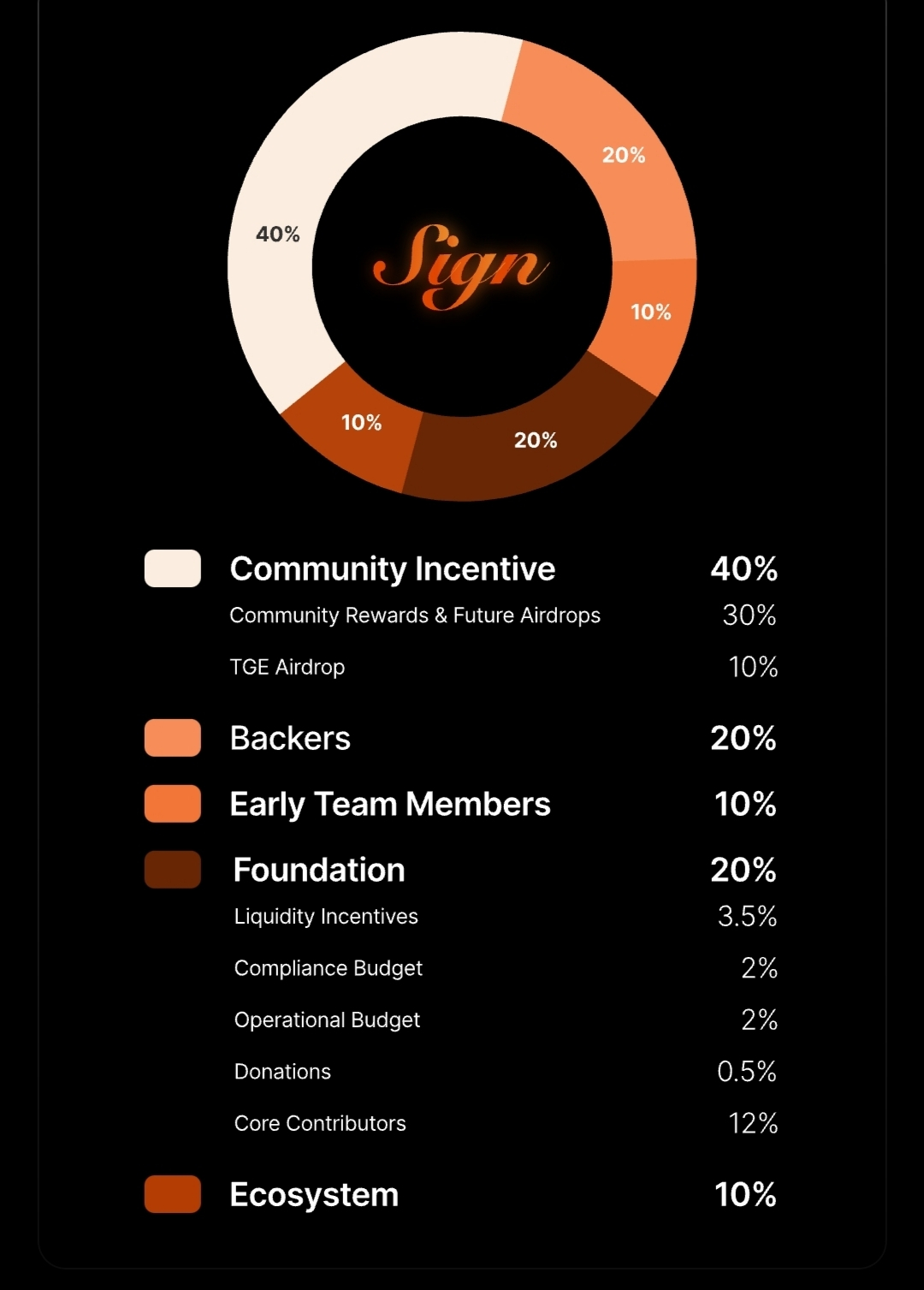
$SIGN token:
Total supply of 10 billion tokens, with approximately 12% (1.2 billion tokens) circulating at TGE.
Distribution: Community incentives 40% (including 10% TGE airdrop), foundation 20%, investors 20%, ecology 10%, team 10%, liquidity 1%.
Usage: Payment of attestation fees, network incentives, governance voting.
Current market cap is approximately $70 million, with an FDV of about $425 million, classified as a mid-cap project.
6. Risks and Challenges: The Gap Between Ideal and Reality
Despite the grand narrative, Sign Protocol still faces multiple challenges:
Early adoption: Currently still in the pilot phase, nationwide promotion requires 1-2 years of validation.
Sovereignty and centralization controversy: While government-controlled nodes enhance sovereignty, they may also raise questions about decentralization.
Token unlock pressure: A large number of tokens for the community, team, and investors will unlock in 2026-2027, which may create selling pressure.
Extreme scenario resilience: The node's survivability under network disconnection and physical destruction still needs to be tested in practice.
Intensifying competition: In the CBDC space, various central banks are developing their own solutions, while in the identity field, there are competitors like Worldcoin.
7. Future Outlook: The Ultimate Proposition of Code as Sovereignty
The ultimate vision of Sign Protocol is to provide a 'code-built digital sovereignty' in an era of geopolitical turmoil and fragile financial systems. When artillery destroys banks and fiat currency becomes worthless, citizens' identity, property records, and payment capabilities can still be restored through global nodes. This is not only a technical ideal but also a profound response to the 'right to digital existence'.
However, the realization of this vision depends on the continuous adoption by sovereign states, the resilience of global nodes, and the long-term stability of the token economy and governance mechanisms. It is not a ready-made answer to the 'last safe haven', but an ongoing social experiment.
For developers, quick access can be achieved through docs.sign.global; for investors, $SIGN has been listed on mainstream exchanges, and attention should be paid to airdrops and the catalyzation of sovereign contracts; for ordinary users, the system will be experienced through national digital wallets in the future.
Sign Protocol stands at the intersection of Web3 and national governance. It is no longer just 'on-chain signatures' but attempts to rewrite the trust contract between the state and citizens with code. The success or failure of this experiment will determine whether 'digital sovereignty' becomes a reality or remains a utopia in white papers.
And I am willing to be a witness, thinker, and small participant in this narrative. Because I believe that when artillery destroys banks, code can still survive.
@SignOfficial #Sign地缘政治基建 $SIGN
