
To be honest, the biggest braggarts in this market are never the tech experts, but the illusionists. What really made me stop and stare at $SIGN for hours late at night wasn't the hype in the group about whether it would pull off a big upward move. It was a sudden realization: when geopolitics tears open huge gaps in the global financial system, the most valuable thing might no longer be money itself, but rather—who the hell has the authority to prove "this money, this identity, this right, is real"?

I'm a seasoned crypto investor, and I'm naturally allergic to the phrase "sovereign-level narrative." You know how it is—once that term is paired with an exchange's event, airdrop expectations, and a few high-profile collaboration posters, it's almost always a new emotional manipulation tactic. But this time, I can't just casually scroll past it with "Don't get too excited, let's see what happens."
The reason is incredibly simple: $SIGN It doesn't just make grand promises and then hire programmers to write the code; it does most of the dirty work first before even starting to offer services. I checked the backend data: TokenTable has issued over $4 billion worth of tokens to over 40 million wallets, Sign Protocol's schema adoption skyrocketed from 4,000 to 400,000, and Attestation (proof) went from less than 700,000 to over 6 million. In 2024 alone, its revenue reached $15 million. This is on a completely different level from those projects that just change their PPT roadmaps and offer nothing of substance.
Many people who read SIGN still have a light-hearted understanding of it, such as "on-chain evidence storage," "digital signatures," or "tools for issuing credentials." I don't see it that way. What it truly addresses is an extremely hardcore, real-world, and incredibly expensive problem: when trust across oceans begins to crumble, and outdated systems are no longer absolutely reliable, who will create a verifiable, transferable, and auditable proof that doesn't require revealing all your secrets? This isn't just a Web3 product issue; it's an infrastructure interface issue for a chaotic era. Sign Protocol isn't building a functional plugin for a specific blockchain; it's creating a cross-system, universally applicable "trusted receipt layer."

If you apply this logic to the situation in the Middle East, you'll understand why the recent discussions on #Sign地缘政治基建 have suddenly become so popular. The most obvious strategy employed by the wealthy Middle Easterners in the past two years isn't blindly investing in the US dollar, nor is it foolishly embracing Web3 entirely; they're playing a "multi-track" game: continuing to use old channels while also preparing new ones, with Plan Bs for local currencies, stablecoins, regional clearing, and on-chain settlement. Why? Because no one dares to bet their entire fortune on a single system. You can continue using the old bridge, but you must build the second bridge in advance. From this perspective, SIGN has become the "super connector" between multiple systems. The old world isn't completely dead, and the new world isn't fully developed; the most lucrative part in between is actually the toll fees.
What's even more ruthless is that they don't just rely on words to explain their logic. In October 2025, Sign directly signed an agreement with the Central Bank of Kyrgyzstan to develop a Digital SOM; then in November, they secured an MOU for sovereign digital identity and stablecoin payment infrastructure in Sierra Leone.
Okay, you can continue to criticize the slow implementation of top-level infrastructure projects, the many hidden problems, and the lack of transparency, but you can no longer categorize it as one of those PPT projects that only involve spending money to release PR documents. At least, they have genuinely encountered the toughest obstacle in the government's governance landscape. For someone like me who judges projects by whether they've actually been implemented, this is more effective than publishing ten long articles from KOLs promoting their projects.
Furthermore, I'm quite fascinated by its underlying "unified evidence layer" design. S.I.G.N. has grand ambitions; it aims to integrate new currencies, new identities, and a new capital allocation system into a single underlying logic. Simply put, whether you're developing a CBDC, citizenship, issuing government subsidies, or compliant distribution, what seem like several separate issues essentially boils down to one question: Who is qualified? How is it proven? Is it recognized across systems? Who audits the accounts in case of disputes? Once this abstraction layer is operational, it's no longer about selling solutions one by one; it's about bringing the increasingly complex frictions of the real world into its own rule engine. This thing may not seem appealing normally, but it's a lifesaver when systems fracture, decouple, or break down.
Hold on, don't rush in blindly. I'm not writing this to get you all fired up for a quick thrill ride. On the contrary, I think the most important thing to focus on when watching SIGN right now isn't how awesome it is, but whether its "flaws" are sophisticated enough.
What does this mean? The problems it faces are far beyond the low-level issues of projects like "Does it even have code?", "Is it a shell company?", or "Are there any real people on the blockchain?". It faces a much higher, hellish difficulty: Will sovereign clients really dare to hand over their core data? The understanding of data privacy, deletion rights, and auditing rights varies greatly across different jurisdictions—can all of this be solved with code? Most critically, can the value of this amazing system actually be transferred to the token, or will the token price only rely on attracting attention through trending events?
This is why I'm unwilling to simply treat the hype surrounding Binance CreatorPad (from March 19th to April 2nd, 2026) as a guaranteed positive development. While a major exchange providing traffic and buzz can certainly boost the project's reach and popularity, it doesn't guarantee real user retention. The true measure of a project's quality isn't the peak of the promotion, but rather how many API calls remain after the hype dies down. Does the real attestation stay? Are large institutions willing to pay for cross-chain verification costs? These less-visited, less-explored ledgers are the real game-changers.
There's another point that needs a dose of reality: the token structure. With a total supply of only 10 billion tokens and a relatively small circulating supply, this high FDV and low liquidity situation is enough to make even seasoned investors shudder. I strongly agree with the warnings from the group members. Any scheme with a "grand narrative + long implementation cycle + insufficient liquidity" carries a fatal risk of time mismatch: the business is progressing in "years," market sentiment is trading in "days," and the pressure of unlocking and dumping takes "months." If this gap isn't handled well, even the grandest logic will be repeatedly crushed by the market. Haven't we learned enough the hard way that narratives can't keep up with liquidity?
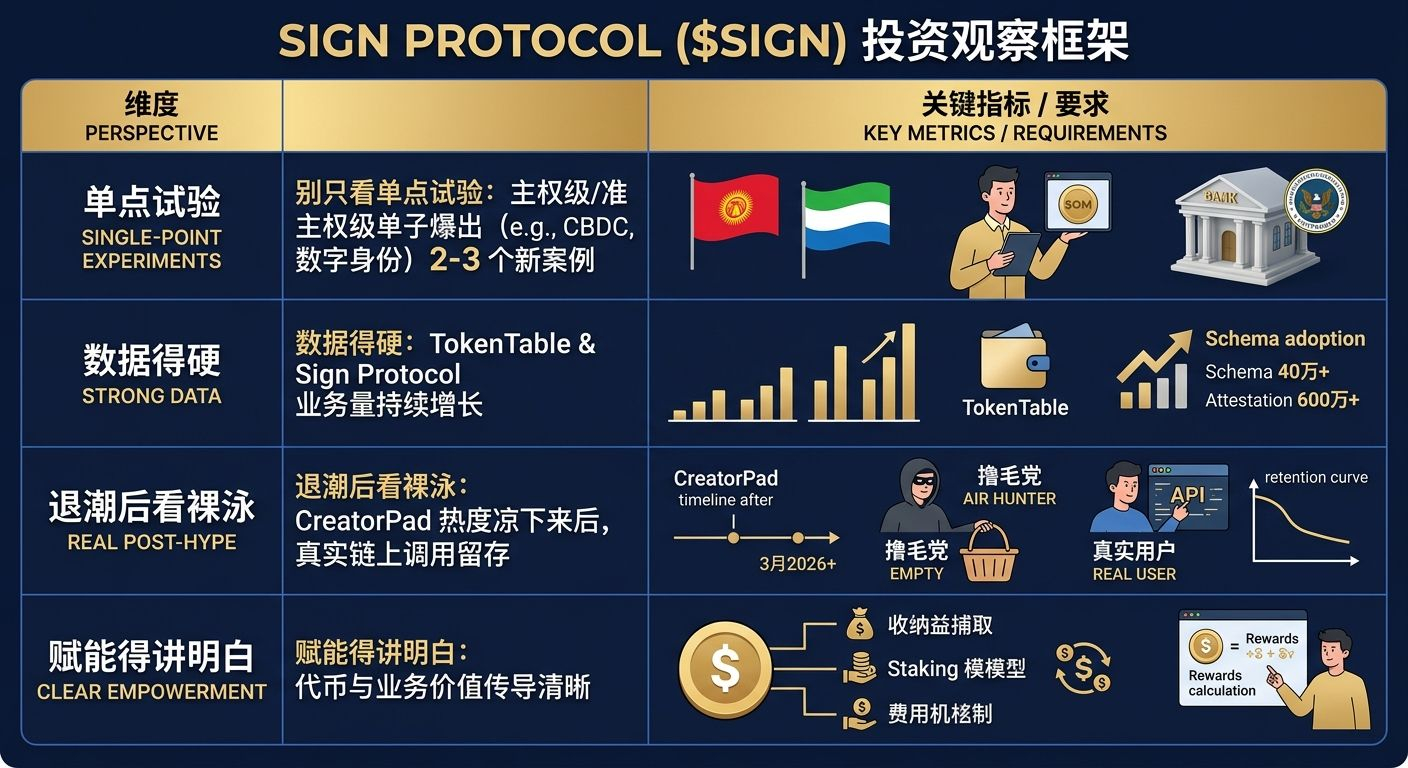
So, to summarize my personal stance on real-world trading: I don't believe "this thing will take off tomorrow," nor do I believe "this is just another scheme orchestrated by big institutions." It has indeed evolved from the "hype stage" to the "verifiable order book" stage, but it still lacks a few hard indicators to achieve a "value loop." I'm personally monitoring these points:
Don't just look at single-point tests: Can we uncover two or three more publicly verifiable sovereign-level or quasi-sovereign-level test results?
The data must be solid: TokenTable and Sign Protocol's business volume must continue to grow, proving that they are not just relying on old products to keep things afloat.
The tide recedes to reveal the naked swimmers: Once the hype surrounding CreatorPad completely cools down, real on-chain calls still need to continue; otherwise, it will end up being all about those who exploit loopholes and those who participate in promotions.
Empowerment needs to be clearly explained: the value transfer between tokens and business operations must be clear. Otherwise, no matter how good the system is, it's just a public infrastructure, so why should we, the token holders, pay for it?
Ultimately, what drew me to @SignOfficial is precisely that it's becoming less and less like a "serious" crypto project. It lacks the shady, speculative feel of a project that relies on a flashy concept to pump and dump for weeks; instead, it resembles a backup system quietly laying its foundations in chaotic times.
Some people will definitely complain that it's too slow, not exciting enough, and doesn't give that instant riches thrill. But I'm starting to really believe that old saying: those who truly reap the greatest benefits from the cracks in the times are often not the ones who jump the highest or shout the loudest, but the ones who secretly weld the connections shut in the dark.
Here's my strategy: add it to your high-priority watchlist, and when it drops to a comfortable level, you can gradually build a base position. But absolutely only buy based on the logic of "long-term infrastructure verification," don't approach it with the mentality of a short-term gambler. It's like a cross-sea bridge where the piers have just been laid; whether the bridge looks beautiful or not doesn't matter. What we need to see is whether armored trucks will actually drive across it one after another.