
I noticed it in the flow first.
Not the chart. Not the hype. The shape.
You watch enough tokens long enough, you start to feel when something isn’t moving freely… even if the numbers say it is. Volume spikes. Price reacts. Everyone on the timeline suddenly becomes an expert. And still… something feels tight.
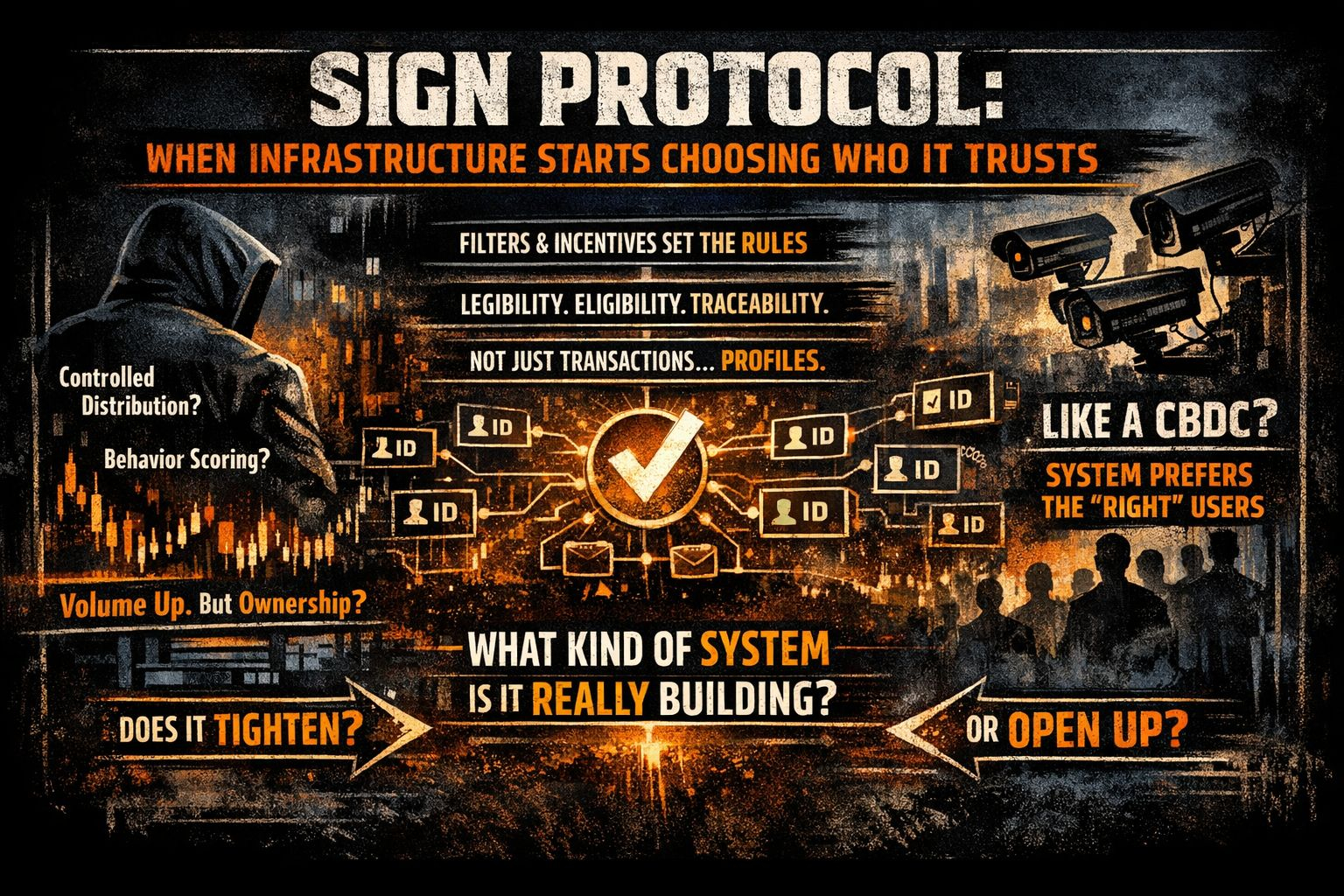
That’s where I am with Sign Protocol.
I’ve Seen This Pattern Before
I remember a project a few cycles back—huge attention, massive liquidity events, constant chatter about “infrastructure.” On paper, it looked alive. In reality… it felt guided. Like most of the real decisions had already been made before the market showed up.
That memory sticks.
Because once you’ve seen controlled distribution dressed up as organic growth, you don’t really unsee it.
And that’s the first friction point here.
Sign Protocol didn’t feel loose from the start. It felt arranged. Supply concentrated early… and now the question isn’t whether it can move—it clearly can—it’s whether it can open up.
Big difference.
Activity Isn’t Depth. It Never Was.
This is where people get distracted.
They see trading activity and assume the system is alive. They see wallets rotating, volume climbing, price reacting… and it looks like a real market.
Sometimes it is.
Sometimes it’s just motion.
I’ve had moments where I watched a token trade all day—nonstop—and still felt like nothing meaningful was happening underneath. No real broadening. No real ownership shift. Just… circulation.
That’s the risk here.
With Sign Protocol, I’m not convinced the underlying distribution has actually expanded in a way that makes the system breathe yet. It still feels narrow. Still feels like the edges are defined.
And heavy trading doesn’t fix that.
It just hides it for a while.
The Structure Matters More Than the Story
Here’s where I stop caring about narratives.
Every project sounds good when it explains itself.
Coordination. Identity. Trust. Infrastructure.
Pick your buzzword.
I’ve seen that language recycled so many times it’s almost stomach-turning. The pitch evolves, the diagrams get cleaner, the framing gets sharper… and then reality hits, and you realize most of it was just surface-level alignment.
What matters is the structure.
And Sign Protocol’s structure is… deliberate.
Not chaotic. Not accidental.
Designed.
That’s not inherently bad. But it does mean something important:
The system has preferences.
The Wallet Is No Longer Neutral
This is the part that keeps pulling me back.
Because once you look past the token, you start seeing the behavioral layer underneath.
How holders are treated.
Where tokens sit.
How long they stay there.
I’ve seen this shift happening across multiple projects… but it’s especially visible here.
Sign Protocol isn’t just tracking ownership.
It’s starting to filter it.
I’ve Seen This Evolution Before… Just Not This Clearly
I remember when wallets were simple.
You held something. That was it. No extra context. No behavioral scoring. No subtle incentives nudging you toward a “better” way of existing inside the system.
That changed.
Gradually.
Now, where your assets sit matters. How long you hold them matters. Whether your behavior aligns with what the protocol prefers… matters.
And Sign Protocol leans into that.
Not loudly. Not aggressively.
But it’s there.
Incentives Aren’t Neutral. They Never Are.
This is where I get skeptical.
Because I’ve watched this market take control mechanisms and reframe them as optimization. Better coordination. Better targeting. Better efficiency. Always “better” something.
It sounds harmless.
Sometimes it is.
But over time… it adds up.
The system starts caring about your behavior. Starts rewarding certain patterns. Starts making some users more legible than others.
That’s not just infrastructure.
That’s preference encoded into design.
The CBDC Comparison Isn’t Random
I know people push back on this.
They say it’s a stretch. That comparing projects like Sign Protocol to state systems like CBDCs is lazy.
Maybe.
But I don’t think the comparison is about intent anymore.
It’s about direction.
I’ve had moments where I looked at both sides private protocols and government systems and realized they’re starting to converge in subtle ways. Not identical… but aligned in instinct.
Legibility.
Eligibility.
Traceability.
Conditional access.
Sometimes enforced.
Sometimes incentivized.
Same endpoint… different path.
Sign Protocol sits closer to that line than most people want to admit.
That Doesn’t Make It Wrong
Let’s be clear.
I’m not saying this is a flaw.
I’m saying it’s a tension.
Because there’s real value in what Sign Protocol is building. Structured attestations. Portable trust. Systems that can verify claims without constantly resetting.
That matters.
I’ve seen firsthand how broken verification layers slow everything down. Rechecking the same data. Revalidating the same identity. Rebuilding trust from scratch every time something crosses a boundary.
It’s inefficient.
Painfully so.
Sign Protocol is trying to fix that.
But Fixing Trust Changes Behavior
And this is the part people underestimate.
When you make systems better at reading users… you change how users behave inside those systems.
Sometimes for the better.
Sometimes not.
Because now the system doesn’t just process transactions it interprets patterns. It recognizes persistence. It rewards consistency.
And slowly… the user stops being just a participant.
They become a profile.
I’m Not Convinced It Breaks… Yet
This is where I land.
Sign Protocol hasn’t shown its final form.
Not even close.
Right now, it’s in that phase where everything still feels flexible. Open enough. Undefined enough. The kind of phase where people project what they want it to become.
I’ve seen that phase before too.
It doesn’t last.
Eventually, the system tightens. Or it expands. But it doesn’t stay ambiguous forever.
The Real Test Isn’t the Market
It never is.
I don’t care if the chart moves. I don’t care if attention spikes. I don’t even care if the narrative evolves into something cleaner and easier to sell.
That’s all surface.
What I’m watching is deeper.
Does ownership broaden?
Does behavior diversify?
Does the system stay open… or start preferring certain users over others?
That’s where the real story is.
Still Watching… For a Reason
I’ve tried to dismiss projects like this before.
Sometimes I was right.
Sometimes I wasn’t.
Sign Protocol sits in that uncomfortable middle zone.
Too structured to ignore.
Too early to trust.
Too deliberate to write off as noise.
And maybe that’s why I keep coming back to it.
Because it’s not obvious.
Because it’s not clean.
Because it’s doing something that feels… consequential.
I don’t think it has shown its hand yet.
And I’ve learned that the most important part of any system isn’t what it says it enables…
it’s what it quietly rewards.
So I’ll keep watching Sign Protocol for that moment.
The one where it stops feeling flexible… and starts revealing what it actually wants.
When that happens…
what kind of system is it really building?