

I wasn’t even looking for Sign when this thought hit me. It came up in a random dev conversation where someone casually said that “on-chain governments aren’t far away, just early.” Most people say things like that and move on, but this one stayed with me. So I decided to actually look deeper into what Sign is building.
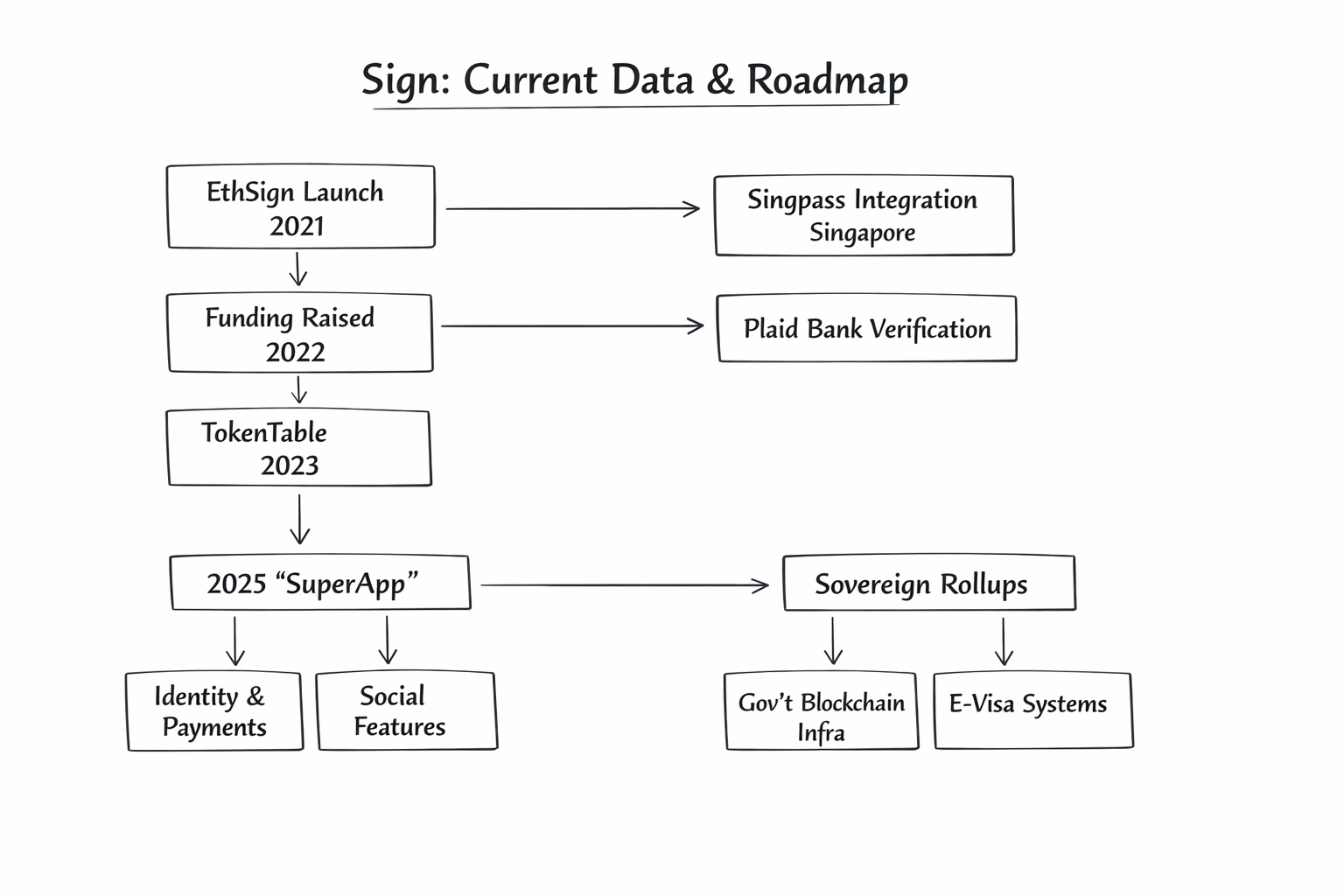
The first thing that stood out wasn’t hype. It was consistency. They’ve been building for years. EthSign launched back in 2021. Then funding in 2022. TokenTable in 2023. But what really caught my attention wasn’t the timeline itself—it was what they connected to. Getting into Singapore’s Singpass ecosystem is not easy. Integrating with Plaid to verify real bank balances is even more serious. That’s where things stop being just crypto tools and start becoming real infrastructure.
Then I noticed something most people ignore: revenue. Around $15M in 2024, which is close to what they raised in total. That’s rare. A lot of projects still survive on speculation. This one is actually being used.
When I moved into their roadmap, things became more interesting. The 2025 SuperApp looks like their consumer play. Identity, payments, and social all combined into one system. On paper, it sounds powerful. Something similar to Alipay, but built around verifiable on-chain data. I’ll be honest though, I’m cautious here. Super apps are extremely hard to pull off. But if they manage to connect identity with real incentives like SIGN rewards, it could drive adoption faster than most protocols.
The more serious part of the roadmap, in my view, is the sovereign rollup direction. Strip away the technical language and it’s simple: they want to offer governments their own blockchain infrastructure. A system where identity, payments, and records are built into one stack. This is not just crypto anymore. This is digital infrastructure.
If you look at countries where systems are still fragmented, this idea starts to make more sense. In places where records are slow, verification is manual, and trust is weak, a system that can verify identity and transactions instantly could change everything. It’s not about replacing systems overnight, but improving how they work.
But this is also where reality pushes back. Systems like this are not easy to scale. Cross-chain setups are already difficult. Keeping different networks in sync, managing latency, and maintaining consistency is a real challenge. Now imagine doing that across multiple countries, each with its own rules and requirements. That complexity is not small.
There’s also another concern that I can’t ignore. If a company becomes the backend for identity and payments at a national level, who is really in control? Governments should ideally run their own infrastructure, not depend entirely on one provider. Even if the technology is strong, control always matters at that level.
Still, the direction is hard to ignore. This is not just a roadmap full of ideas. There are already real examples. Sierra Leone’s e-visa system shows that governments are at least willing to test this approach. Expansion into different regions suggests this is not a one-time experiment.
What keeps coming back to my mind is a simple shift in thinking. Instead of trying to execute everything everywhere, Sign seems to focus on verification. Prove something once, and reuse that proof across systems. That idea sounds simple, but if it works, it can remove a lot of inefficiency from how systems operate today.
I don’t see this as guaranteed success. There are too many moving parts for that. But I do see it as one of the few projects that is actually trying to connect crypto with real-world systems in a meaningful way. Not just tokens, but infrastructure.
And if that direction continues, this might be less about Web3 experiments and more about how future systems are actually built.