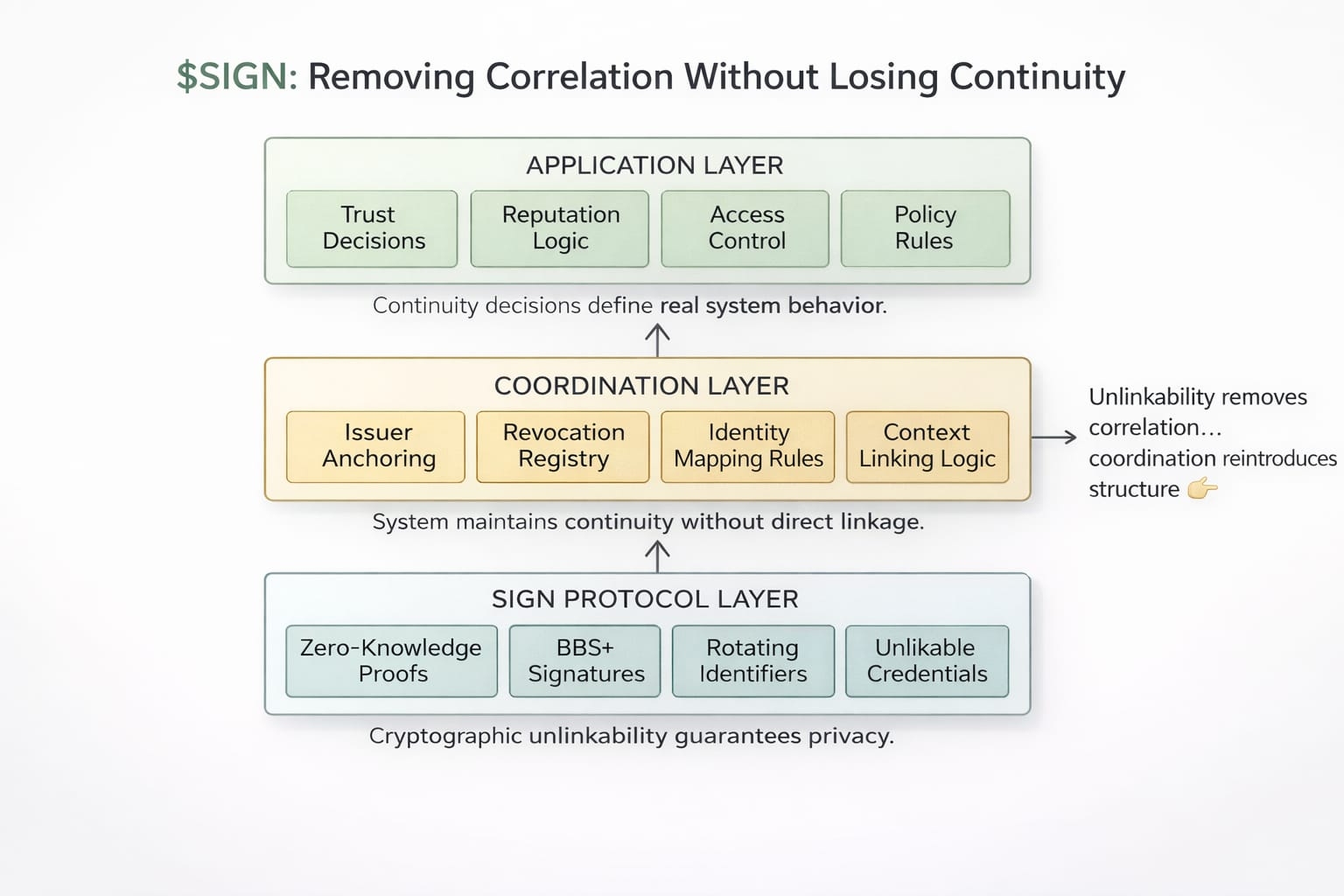
I’ve been thinking about this more than I expected, because on the surface $SIGN looks like it solves one of the biggest hidden problems in digital systems, which is correlation. Most systems today don’t just verify something, they quietly connect everything you do over time. Even when you only want to prove one simple thing, your activity gets linked, tracked, and stored in ways that go far beyond that single interaction. What makes $SIGN interesting is that it flips this model. By using zero knowledge proofs, rotating identifiers, and cryptographic tools like BBS+ signatures, it allows every interaction to stand on its own. Each proof looks fresh, independent, and disconnected from anything that came before it. From a privacy and digital identity perspective, that is a huge shift and honestly something that feels long overdue.But the deeper I think about it, the more I realize that removing correlation at the interaction level does not actually remove the need for coordination inside the system. It just moves it somewhere else, somewhere less visible but still necessary. Because in real-world systems, things are not meant to exist as isolated moments. Value builds over time. Trust is not created in a single interaction, it grows through repeated validation, history, and consistency. Permissions change, credentials expire, reputations evolve, and access decisions depend on more than just one proof at one point in time. So even if SIGN makes each interaction unlinkable, the system still has to answer a bigger question, which is how continuity works without breaking that unlinkability.This is where things start to get interesting and a bit uncomfortable. Because once verifiers cannot directly correlate activity, something else usually steps in to keep the system usable. It might be an issuer that anchors identity across different contexts, or a registry that keeps track of revocation and status, or even a policy layer that decides when separate proofs should still be treated as belonging to the same entity. The system avoids obvious linkage, but it still needs some form of structure to function over time. And that structure is where subtle dependencies can begin to form.The more unlinkability you introduce at the surface, the more pressure you place on whatever sits underneath to maintain consistency. Without that layer, every interaction becomes isolated, and that creates a different kind of problem. No history means no accumulation of trust. No accumulation means weaker systems. You lose the ability to say not just “this is true now” but “this has been consistently true over time.” And that distinction matters more than people think, especially in financial systems, governance models, and any environment where long-term behavior is important.So what initially looks like a clean privacy solution actually reveals a deeper trade-off. You can allow interactions to be linkable, which makes systems easier to coordinate but introduces tracking risks and weakens user privacy. Or you can make interactions fully unlinkable, which protects users but forces the system to rely on some coordinating layer to rebuild continuity in a different way. And that layer is not always neutral. It can become a dependency, a hidden point where identity is effectively reconstructed, even if it is not visible in the proofs themselves.That is why SIGN stands out to me, not just because of what it solves, but because of the questions it raises. Technically, it delivers strong unlinkability. The cryptography works exactly as intended. But system design does not stop at cryptography. The real challenge is how to preserve continuity, trust, and usability without quietly reintroducing the same correlation the system was trying to remove. That balance is not easy, and it is where most designs either compromise privacy or introduce new forms of control.What makes this space exciting right now is that we are starting to explore new ways of thinking about that balance. Maybe coordination does not need to be centralized. Maybe continuity can exist in a more user controlled, minimal, and context specific way, instead of being globally reconstructed across systems. Maybe identity does not need to be reassembled at all, but instead proven differently depending on the situation. These are not fully solved ideas yet, but they point toward a direction where privacy and usability do not cancel each other out.So when I look at $SIGN, I do not just see a protocol solving correlation. I see a system pushing us to rethink how digital trust actually works. Because the real question is not whether correlation can be removed, it clearly can. The real question is whether we can build systems that maintain continuity without quietly bringing correlation back in a different form. And honestly, it feels like we are just at the beginning of figuring that out.