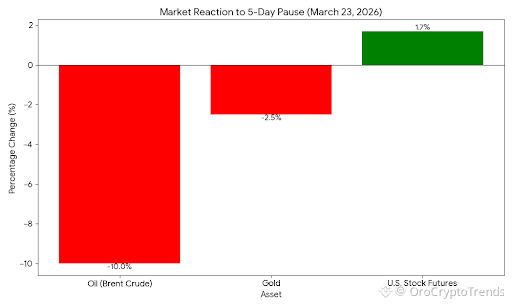
When Donald Trump floated the idea of a five-day halt on striking Iran’s energy infrastructure in March 2026, markets did not rally in relief. They hesitated. The reaction was subtle but telling—a momentary suspension of conviction across oil, equities, and crypto alike. It was not the escalation that moved markets, but the pause itself. In a system conditioned to price certainty—whether peace or conflict—ambiguity has become the most destabilizing force.
This is where the story becomes less about geopolitics and more about systems. The Strait of Hormuz, that narrow artery through which a fifth of the world’s oil flows, is not merely a geographic chokepoint. It is a symbol of centralized dependency, a single-threaded vulnerability in an otherwise sprawling global network. And in the background, almost quietly, Bitcoin continues to present itself as something else entirely: a distributed counterpoint, a mesh of chains rather than a single lane of transit.
The five-day halt, then, is not just a policy gesture. It is a stress test of narratives.
The Pause as Signal, Not Silence
Markets are often described as forward-looking, but more precisely, they are expectation engines. They do not simply react to events; they react to the clarity of events. A missile strike is tragic, but it is also legible. A ceasefire is fragile, but it is definable. A pause, however, exists in a liminal space—neither escalation nor resolution.
Trump’s proposed halt created exactly this condition. Oil markets, which might otherwise spike on conflict, found themselves suspended between risk and restraint. Traders hesitated to price in supply shocks without confirmation of disruption. Meanwhile, macro funds began recalibrating their exposure, not because of what had happened, but because of what might still happen.
In such moments, liquidity does not disappear; it migrates. Capital searches for surfaces where uncertainty can be absorbed rather than amplified. Historically, this has meant flows into gold, sovereign bonds, and the U.S. dollar. Increasingly, however, another asset enters the conversation—not as a replacement, but as a parallel.
Bitcoin.
Bitcoin as a Parallel System
To understand Bitcoin’s role in this moment, one must move beyond the simplistic framing of “risk-on” versus “risk-off.” Bitcoin is neither purely speculative nor purely defensive. It occupies an ambiguous middle ground, much like the geopolitical pause itself.
In times of acute crisis, Bitcoin often behaves like a risk asset. Liquidity tightens, leverage unwinds, and prices fall. Yet in the aftermath—when the structural implications of crisis begin to unfold—Bitcoin frequently re-emerges as a narrative hedge. Not against any single event, but against the system that produces such events.
This duality is not a flaw; it is a feature. Bitcoin is still in the process of becoming. It is, in many ways, a federating layer—an attempt to coordinate value across borders without relying on the political stability of those borders. Where oil routes depend on naval power and diplomatic alignment, Bitcoin depends on consensus and computation.
The contrast is stark. One system is enforced by geography and force. The other by code and agreement.
The Strait and the Chain
The Strait of Hormuz represents a form of concentration risk that is almost anachronistic in a digital age. It is a single point through which vast amounts of value must pass, making it inherently fragile. Any disruption—whether military, political, or accidental—reverberates globally.
Bitcoin, by contrast, is designed to avoid such chokepoints. Its ledger is replicated across thousands of nodes. Its transactions are validated by a decentralized network of miners. There is no strait to blockade, no central authority to pressure. It is, in theory, antifragile—a system that becomes more robust as it is tested.
Yet theory and practice are not always aligned.
Bitcoin’s infrastructure, while decentralized, still interfaces with centralized systems. Exchanges, custodians, and fiat on-ramps act as gateways, reintroducing points of failure. In a true geopolitical crisis, these gateways can become bottlenecks, limiting Bitcoin’s ability to function as a seamless alternative.
The mesh of chains, it turns out, is still partially tethered to the old world.
Liquidity, Narratives, and Time Horizons
The immediate market response to the five-day halt revealed an important truth: time horizon matters. Short-term traders saw uncertainty and reduced exposure. Long-term allocators saw a reminder of systemic fragility.
For the former, Bitcoin’s volatility remains a deterrent. In moments of ambiguity, they prefer assets with clearer behavioral patterns. For the latter, volatility is secondary to trajectory. They are less concerned with Bitcoin’s price over five days and more with its role over five years.
This divergence creates a layered market structure. At the surface, Bitcoin may dip alongside equities as risk appetite wanes. Beneath that surface, however, a slower accumulation can occur—driven by institutions and individuals who interpret geopolitical instability as validation of decentralized systems.
The result is a market that appears contradictory but is, in fact, coherent across different time scales.
Skepticism and Structural Limits
It would be easy, at this point, to frame Bitcoin as the inevitable beneficiary of geopolitical tension. But such a narrative risks oversimplification.
Bitcoin does not exist in a vacuum. Its valuation is still deeply intertwined with global liquidity conditions. Central bank policies, interest rates, and dollar strength all exert significant influence. In a scenario where geopolitical tension leads to tighter monetary policy, Bitcoin could face headwinds despite its narrative appeal.
Moreover, Bitcoin’s adoption as a hedge is far from universal. Many institutional investors still view it as an emerging asset class with unresolved regulatory and operational risks. In a crisis, they may prefer the familiarity of gold or the liquidity of government bonds.
There is also the question of scale. Can Bitcoin absorb the kind of capital flows that move through traditional safe havens? Its market depth, while growing, remains limited compared to global bond markets. A sudden influx of capital could lead to extreme volatility, undermining its role as a stabilizing asset.
In this sense, Bitcoin is both a promise and a question mark.
The Narrative Layer
What the five-day halt ultimately underscores is the power of narrative in shaping markets. The pause itself did not change the underlying realities of the Strait of Hormuz. Oil still flows through it. Tensions still surround it. But the narrative shifted—from imminent disruption to suspended uncertainty.
Bitcoin operates within its own narrative layer. It is often described as digital gold, a store of value, or a hedge against inflation. Yet these narratives are not static. They evolve in response to external events.
Geopolitical tension adds a new dimension to this evolution. It frames Bitcoin not just as a financial asset, but as a geopolitical one—a system that exists outside the direct control of any single nation-state.
This framing is both powerful and precarious. It attracts interest from those seeking alternatives to traditional systems, but it also invites scrutiny from those who see it as a challenge to existing power structures.
A Blueprint, Still in Draft
If Bitcoin represents a blueprint for the internet of value, it is a blueprint still being drafted. Its architecture is elegant, but its implementation is ongoing. Layer-two solutions, institutional adoption, and regulatory frameworks all play a role in shaping its future.
The events surrounding the five-day halt highlight the urgency of this process. As global systems face increasing stress, the demand for resilient alternatives grows. Bitcoin offers one such alternative, but it must continue to evolve to meet that demand.
This evolution is not just technical; it is social. It requires trust—not in a central authority, but in a distributed network of participants. It requires coordination without coercion, consensus without hierarchy.
In this sense, Bitcoin is as much a social experiment as it is a technological one.
Between Oil and Code
The juxtaposition of oil routes and blockchain rails is more than a metaphor. It is a reflection of two fundamentally different approaches to organizing value.
Oil represents a world of physical constraints—where geography, politics, and power intersect. Bitcoin represents a world of digital possibilities—where value can move across borders with minimal friction.
The transition from one to the other is neither linear nor inevitable. It is a gradual process, shaped by both innovation and resistance. Traditional systems do not disappear overnight; they adapt, integrate, and sometimes co-opt new technologies.
Bitcoin, for its part, does not seek to replace these systems entirely. It offers an alternative—a parallel track that can coexist with existing infrastructure.
The Fragility of Trust
At its core, the five-day halt is a reminder of the fragility of trust in global systems. Trust in supply chains, in political stability, in the continuity of trade. When that trust is shaken, even briefly, markets respond.
Bitcoin’s value proposition is often framed as trustlessness—the idea that one does not need to trust any single entity. Yet this framing can be misleading. Bitcoin does not eliminate trust; it redistributes it. Trust is placed in code, in mathematics, in the collective behavior of the network.
This redistribution is not without challenges. It requires a shift in mindset, from reliance on institutions to reliance on systems. It requires individuals to engage with technology in new ways, to take on responsibilities that were previously delegated.
In this sense, Bitcoin is not just a financial innovation; it is a cultural one.#Write2Earn #ZakiWeb3Media