
I keep seeing projects treat blockchains like they’re infinite storage layers, as if the whole point is to cram as much data on-chain as possible. And every time I see it, I have the same reaction: why are we doing this to ourselves?
Because the reality is simple—putting large amounts of data fully on-chain gets expensive fast. Gas fees aren’t theoretical. They’re real, and they add up quickly. What might look elegant in a whitepaper turns into something completely impractical the moment you try to scale it in the real world.
Just because a blockchain can store something doesn’t mean it should.
The problem with “everything on-chain”
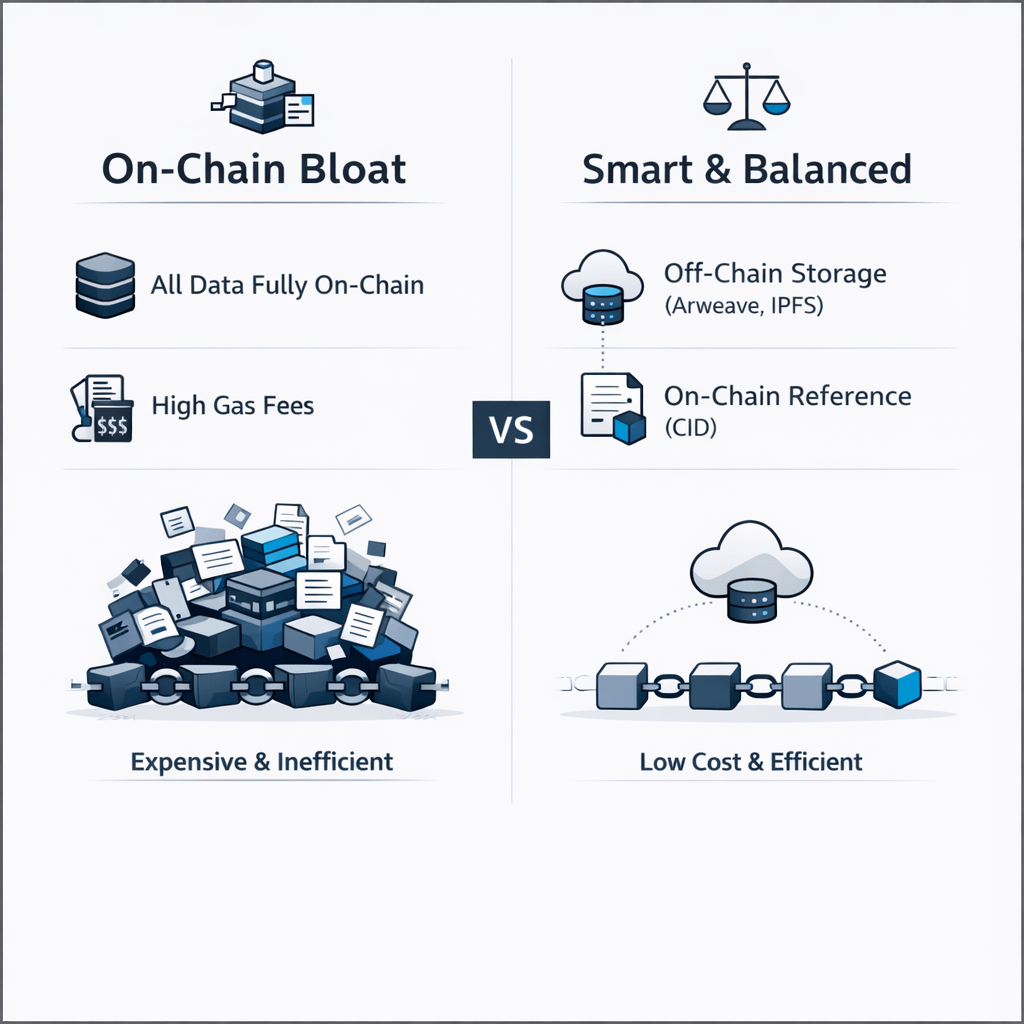 Attestations are a great example of this tension. In theory, putting all attestation data directly on-chain sounds transparent and trustless. But in practice, it becomes bloated, inefficient, and frankly unrealistic.
If every credential, document, or proof carries heavy payloads stored directly on-chain, you’re not building a scalable system—you’re building a cost problem.
And let’s be honest: blockchain is not the right place for bulky data.
It’s not optimized for that. It was never meant to be.
What actually makes sense
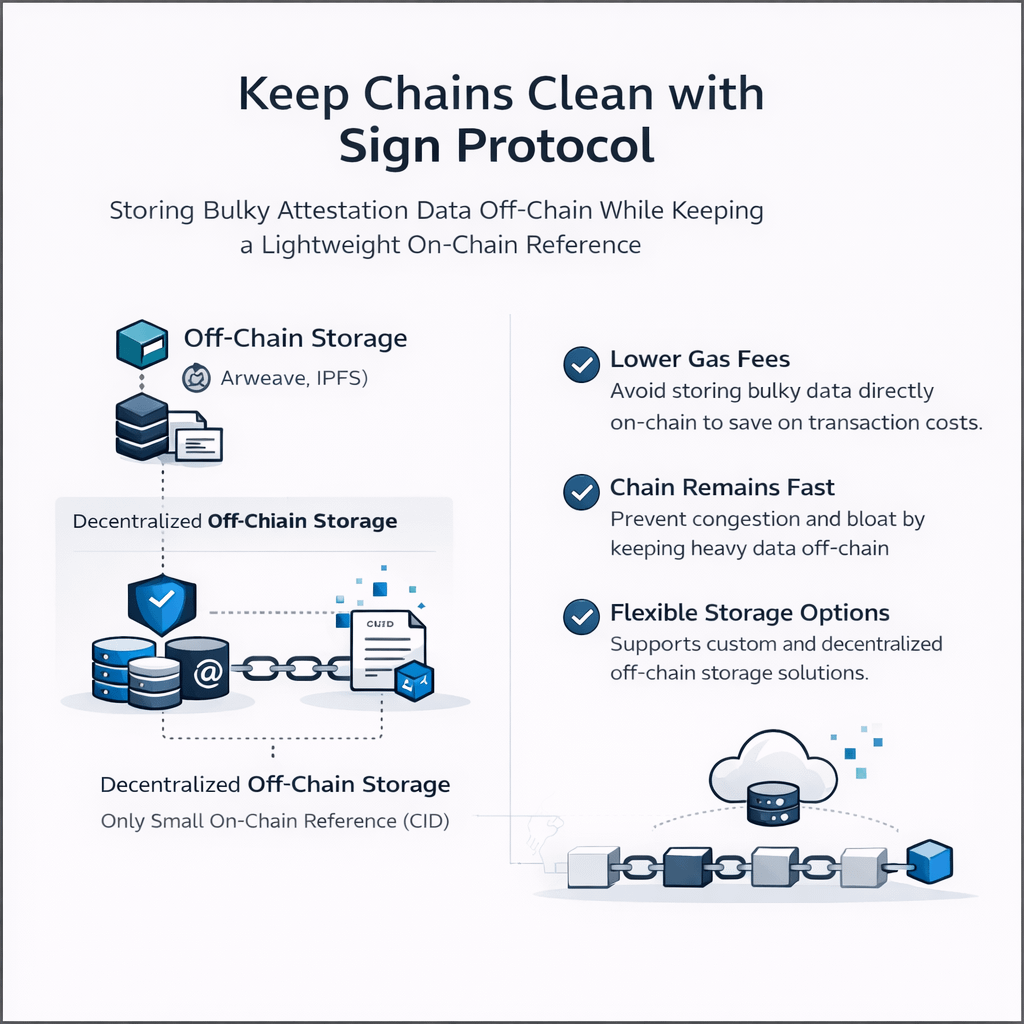
This is why the approach taken by Sign Protocol really clicks for me.
Instead of forcing everything on-chain, it takes a more balanced route:
Heavy or bulky data lives off-chain (on systems like Arweave or IPFS)
The blockchain stores only a lightweight reference, like a CID
That’s it. Clean, efficient, and practical.
You still get access to the full data. You still maintain verifiability. But you’re not paying absurd gas fees just to store things that don’t belong on-chain in the first place.
And more importantly—you’re not clogging the chain.
Clarity matters more than people think
One thing I appreciate is that Sign Protocol doesn’t make this confusing.
Its schemas and attestations clearly show where the data lives. You’re not left guessing whether something is fully on-chain, partially off-chain, or hidden behind some abstraction.
That clarity matters.
Because once you move beyond toy examples and start dealing with real data—credentials, identity, compliance records—you need to know exactly what’s happening. Ambiguity isn’t acceptable when real applications are involved.
Flexibility is not optional
Another thing that often gets overlooked: not everyone wants to rely solely on decentralized storage.
And that’s fair.
Some teams need more control. Some need compliance-friendly setups. Some might prefer hybrid or even custom storage solutions depending on their use case.
What I like here is that Sign Protocol doesn’t lock you into one model. It supports custom storage options as well, which makes it adaptable instead of rigid.
That kind of flexibility is what real infrastructure should look like.
A more balanced way to build
At the end of the day, this is what makes sense to me:
Keep the chain clean
Store only what is necessary on-chain
Offload heavy data to better-suited systems
Be intentional about design decisions
Developers should be selective. Save gas where it actually matters. Use the right place for the right kind of data.
Because otherwise, we’re just recreating inefficiencies under a different label.
Final thought
The best infrastructure isn’t maximalist—it’s balanced.
 And that’s exactly why Sign Protocol stands out to me. It doesn’t try to force everything on-chain for the sake of ideology. It acknowledges the limitations, works around them intelligently, and gives developers clear, practical tools to build real systems.
That’s the kind of thinking this space needs more of.
@SignOfficial #signdigitalsovereigninfra $SIGN
