
It started with something as ordinary as signing a document. Not the dramatic kind with fireworks or viral hype, but the everyday frustration of trusting that a contract, a credential, or a promise would actually hold up without some middleman vanishing, leaking data, or changing the rules overnight. That's where SIGN quietly took root, growing from a simple decentralized signing tool into something far more alive: a network of attestations and distributions that now reaches governments and everyday people alike.
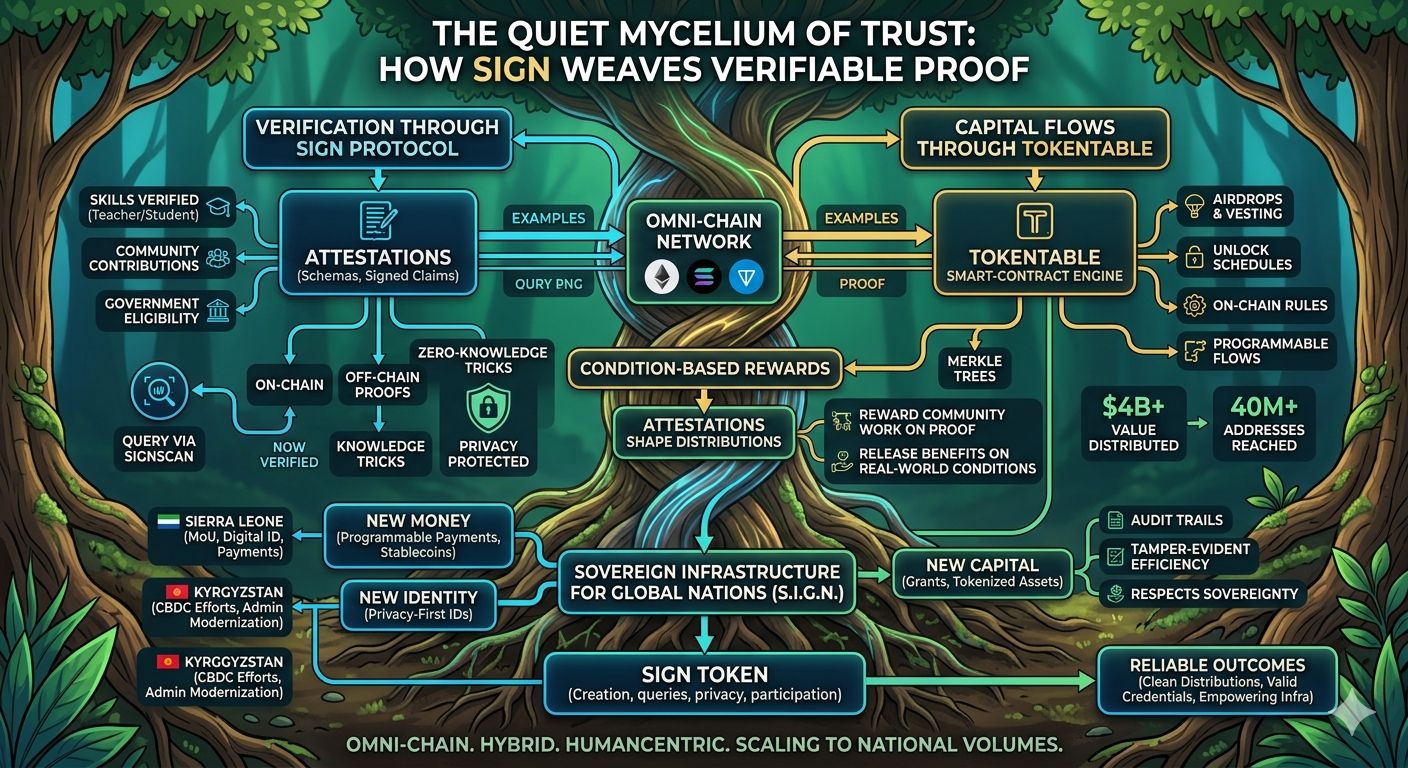
I remember hearing stories from early builders who were tired of spreadsheets deciding who got tokens and who didn't. TokenTable became their answer a smart-contract engine that has already moved more than $4 billion in value to over 40 million addresses across chains like Ethereum, Solana, TON, and others. It handles airdrops, vesting schedules, and unlocks with Merkle trees and on-chain rules that feel less like rigid code and more like fair, transparent rivers directing capital where it’s meant to go. No more blind lotteries or easy rugs; just programmable flows that people can actually audit and rely on.
But sending value is only half the conversation. The real question that kept surfacing was: how do we know, with confidence, who truly deserves it? That’s where the Sign Protocol feels like the living heart of the system. It lets anyone a teacher verifying a student’s skills, a community attesting someone’s contribution, or a government confirming eligibility create structured, signed claims called attestations. These follow reusable schemas, like shared templates that keep things consistent yet flexible.
What I love about it is the humanity baked in. Attestations can live fully on-chain when transparency matters most, stay off-chain with cryptographic proofs for better privacy and scale, or mix the two. Zero-knowledge tricks mean you can prove you qualify for something an opportunity, a grant, a reward without spilling your entire life story. Tools like SignScan help people find and verify these claims easily, and the whole thing works across chains so a proof created in one place can be checked in another without awkward bridges or tribal drama.
The magic happens when these two sides talk to each other. An attestation doesn’t just sit there as a digital badge; it can directly shape how tokens flow from TokenTable. A project might reward real community work only after verifiable proof lands on-chain. A benefits program releases funds once real-world conditions maybe satellite data on crops or local endorsements are cryptographically confirmed. It doesn’t replace human judgment or relationships; it just gives them better scaffolding, shrinking the gray spaces where mistrust and abuse tend to creep in.
### Feeling the Shift Toward Sovereign Ground
As more eyes turned toward real-world impact, SIGN naturally stretched into something bigger: S.I.G.N., or Sovereign Infrastructure for Global Nations. Here, the protocol becomes a kind of shared nervous system for building new money (think programmable payments and stablecoins), new identity (privacy-first digital IDs), and new capital (targeted, transparent grants and tokenized assets).
This isn’t abstract theory anymore. Sierra Leone signed an MoU with SIGN to develop national digital identity systems and stablecoin payment rails, aiming to make services more inclusive and reduce the paperwork that so often blocks ordinary citizens. In Kyrgyzstan, partnerships point toward modernizing administration and even supporting CBDC efforts like Digital SOM. These moves carry a different emotional weight they’re about giving people in places with legacy barriers a bit more agency: the ability to prove who they are or what they’ve earned without handing over their whole data life to fragile central systems.
For the people running these systems, there’s a quiet kind of relief too audit trails that don’t rely on vulnerable databases prone to breaches or endless disputes. The architecture respects sovereignty: nations keep control over policy and sensitive operations while gaining tamper-evident efficiency and interoperability. It feels less like “blockchain versus government” and more like offering tools that let institutions evolve on their own terms, enhancing what works while gently modernizing the rest.
Economically, it all hangs together with care. The SIGN token powers attestation creation, queries, privacy features, and network participation, tying utility directly to real activity. TokenTable has already shown it can generate revenue through distribution services, keeping things grounded beyond pure speculation. By linking flows to verifiable conditions, the system encourages genuine participation and creates privacy-respecting signals that help capital find where it can actually create value. Recent funding over $55 million total, including strategic rounds led by YZi Labs reflects real conviction in scaling these ideas toward national levels.
### The Human Texture in 2026’s Currents
Right now in 2026, the broader world feels alive with possibility and friction. Verifiable credentials are maturing, zero-knowledge tools are moving into everyday use, and nations are wrestling with digital transformation while trust in old systems continues to fray. SIGN stays hybrid and omni-chain by instinct recognizing that not every record needs to be fully public while expanding schemas and developer tools at a measured pace.
Of course, no living system is without its aches. Scaling to handle nation-state volumes means constantly refining indexing and querying. Regulations differ wildly from place to place. Reaching people who’ve never touched crypto requires interfaces that hide the complex math without weakening the security underneath. In the end, success will come down to quiet reliability: distributions that actually land cleanly at scale, credentials that hold up under pressure, infrastructure that feels empowering rather than overbearing.
Metaphorically, SIGN reminds me of mycelium beneath a forest floor an unseen web shuttling nutrients between roots, helping the whole canopy weather storms. It doesn’t fight to be the loudest or tallest; it simply enables everything else to connect and grow with less waste and more resilience.
### Horizons That Touch Something Deeper
Looking ahead, the vision starts to feel personal. Picture a farmer receiving climate support because satellite data, community voices, and their own efforts have been woven into tamper-evident proofs funds flowing not through layers of doubt but with a kind of mathematical fairness that still leaves room for human oversight. Or a freelancer carrying a portable thread of skills and endorsements that travels with them across platforms and borders, opening doors without endless gatekeeping.
SIGN doesn’t promise to erase mistrust; that’s woven too deeply into our relationships, cultures, and power dynamics. What it offers instead is sturdier ground to stand on: proofs that are hard to fake, privacy that feels respectful, and connections that let coordination happen at scales we once only dreamed of.
It grew from very human frustrations the hassle of unreliable signing, the unfairness of opaque distributions, the daily barriers in outdated systems. The result doesn’t feel like a cold product launch but like an evolving, breathing substrate. Verification and value distribution are starting to move in a shared rhythm, with code and math quietly bearing witness while the intent stays rooted in something profoundly human: the simple freedom to prove what you’ve done, participate meaningfully, and build a bit more securely without so many unnecessary shadows or gates holding people back.
The threads keep spreading underground. What eventually pushes through the soil will depend on how communities, builders, and nations decide to nurture it together. In a noisy world, there’s something quietly hopeful about that kind of organic growth.
@SignOfficial #SignDigitalSovereignInfra
