

In recent days, watching the situation in the Middle East, I have a growing feeling:
This is no longer a simple geopolitical conflict, but a test of the 'trust system' collapse.
Energy is being choked, shipping routes are blocked, and financial markets are experiencing severe fluctuations; these are just the surface.
The deeper change is
This world is becoming increasingly difficult to discern 'what is real.'
Information can be manipulated
Data can be tampered with
Positions can switch at any time
Even 'facts' are being rewritten in different narratives.
Once you understand this layer, looking back at the cryptocurrency market, you will notice a subtle change:
In the past, everyone speculated on liquidity, narratives, and emotions;
But in this environment, the market begins to gradually turn in one direction.
Whoever can provide 'credibility' has long-term value.
This is also why I revisited @SignOfficial .
Many people are still using a very simple logic to view it:
If it rises, chase it; if it falls, panic.
But if you shift your perspective to a deeper level, you will find that what it is doing actually happens to step on a key point —
Building a 'trustworthy data infrastructure'.
To be more specific, the $SIGN does not solve the price issue, but rather three deeper problems:
Data credibility
There is a lot of on-chain data, but what is missing is 'verifiability'.
$SIGN enables data to have the attributes of 'immutable + verifiable' through cryptographic signature mechanisms.
Identity credibility
One address ≠ one real entity.
In a cross-chain and cross-application environment, the identity system is missing.
$SIGN is about filling in the 'identity trust'.
Cross-system trust connection
How is information recognized between chains and between chains and reality?
$SIGN is essentially creating a 'trust layer protocol'.
Now, placing these capabilities in the context of the Middle East situation is quite interesting.
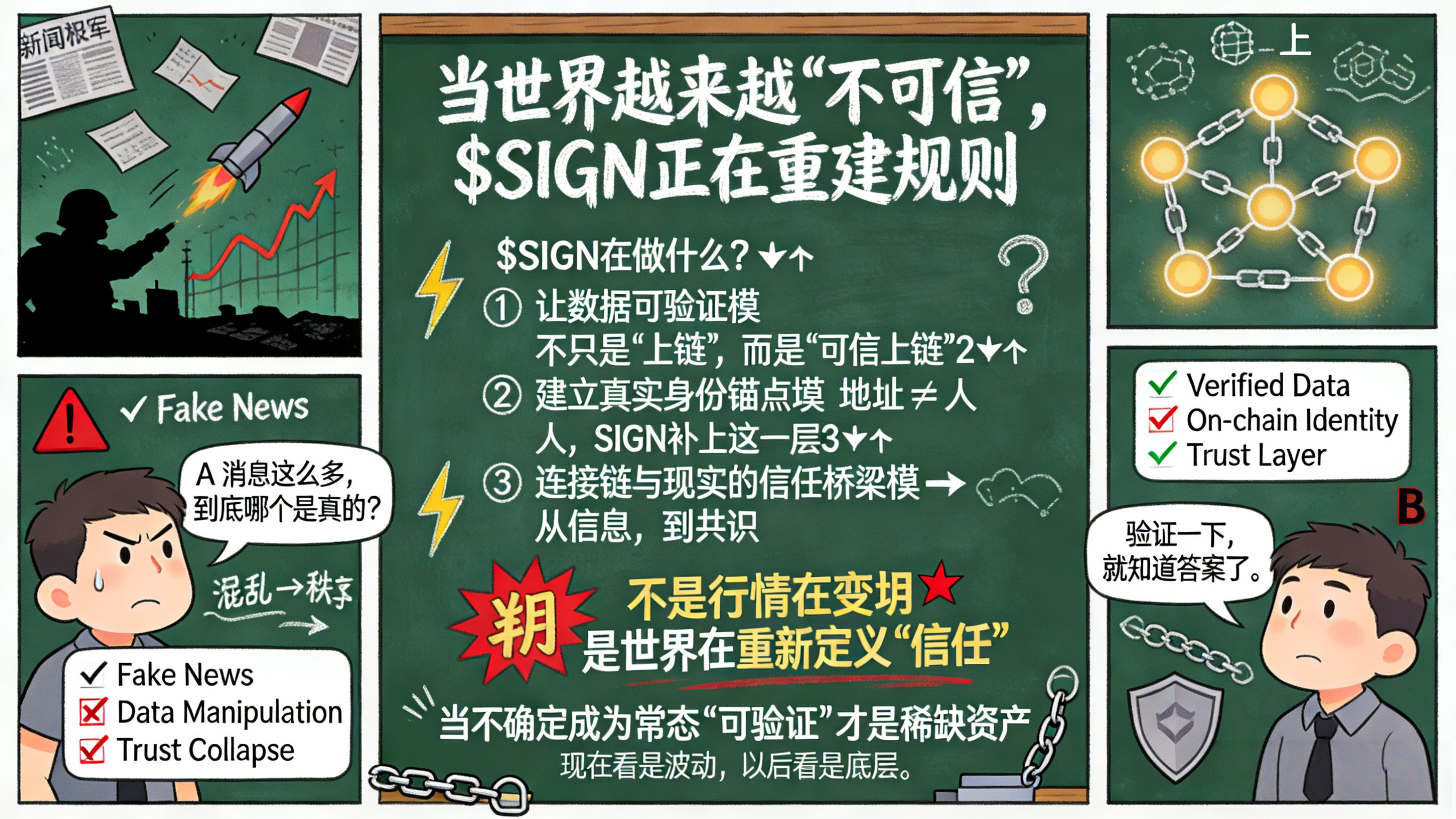
What is the most core resource in war?
It is neither oil nor weapons.
It is information.
Whoever controls the information controls the initiative.
But if the information itself is not trustworthy, the entire system will be distorted.
At this time, an infrastructure like $SIGN that 'allows information to be verified' will have a new positioning:
it is not an option but a necessity.
Let's return to the market itself.
Currently, $SIGN has dropped from 0.06 to 0.03, and many people feel it is weakening.
But if you look at it from a longer cycle, this kind of volatility actually indicates one thing:
The market has not truly understood its pricing logic.
In the short term, it is treated as an ordinary Alt for trading;
In the long term, it resembles a 'trust layer asset'.
And once the market begins to shift from 'speculating emotions' to 'seeking certainty',
The valuation method for such projects will change.
It's not about the growth rate, but about looking —
What position does it occupy in the entire system?
So the question arises:
In a world that is becoming increasingly chaotic and difficult to establish trust —
What is the ceiling of a project that specifically addresses the 'trust issue'?
My personal view is:
In the short term, $SIGN may continue to fluctuate and even continue to wash the plate;
But in the medium term, it will gradually be priced by 'users' rather than 'speculators'.
In the long term, its value does not depend on market sentiment,
And it depends on something more realistic
Will the demand for 'credibility' in this world continue to rise?
So rather than asking whether $SIGN will rise,
How about changing the question:
If the future world becomes increasingly uncertain, will you need an infrastructure that 'can verify reality'?
This may be its true growth space.#Sign地缘政治基建 $SIGN